
The short version
- Drilling rate
- $25 – $100 / ft soft ground low, hard rock high — our well drilling cost guide
- Minimum job charge
- $8,000 – $15,000 most drillers, whatever the depth
- Pump + pressure tank
- $4,000 – $8,000 installed a hole is not a water supply
- Who regulates the water
- you do EPA does not regulate private wells
What does a well drilling contractor actually do?
A well driller bores a hole down to a water-bearing layer, lines it with casing, seals the top, and proves the well produces water. Most also install the pump, pressure tank and line to the house — but not all, so ask.
On raw land, the driller is usually your first utility call after the perc test. You cannot get a building permit in most rural counties without a water source on paper, and you cannot finance a house on land with no water plan.
The job breaks into four parts: siting, drilling, casing and grouting, then development and testing. Each one shows up as a separate line on a good quote.
How much does it cost to drill a well?
Plan on $25 to $100 per foot of hole, with most drillers charging a minimum of $8,000 to $15,000 regardless of depth. A 250-foot well in mixed ground, with pump and tank, typically lands between $15,000 and $27,000.
The rate depends on what's under you. Sand and clay drill fast and cheap. Granite drills slowly and wears bits, which is why hard rock runs roughly double the per-foot rate.
Casing is often priced separately at $15–$25 per foot for PVC. Steel costs far more but is required in some states and formations.
Our well drilling cost guide breaks every line out, and the well drilling cost calculator lets you run your own depth and ground type. Not sure of the depth? Our well depth lookup shows how deep the recorded wells near your land go.
How deep will my well need to be?
Nobody can promise a depth before drilling — but your neighbors' wells come close. Most states keep a public database of well completion logs showing depth, yield and static water level for nearby wells.
Ask any driller you interview to pull those logs. A driller who quotes depth without looking at local records is guessing.
As a rough guide, residential wells in the US range from under 100 feet in shallow sand aquifers to 400+ feet in fractured bedrock. Deeper water is generally better protected. The EPA notes that drilled wells have a lower risk of contamination because of their depth and continuous casing.
For the trade-offs, read shallow well vs deep well.
What happens on drilling day?
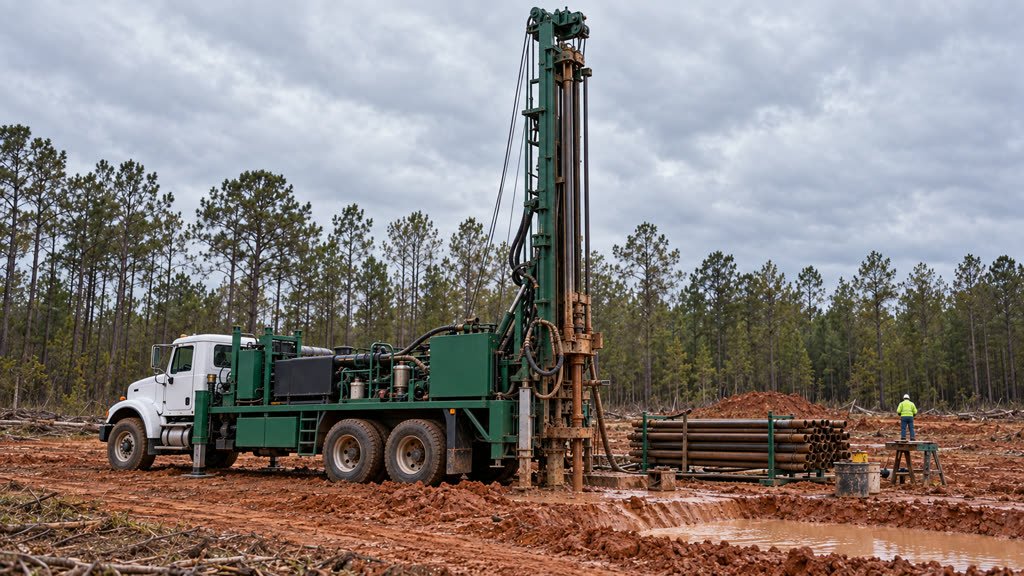
The rig arrives, sets up over the staked spot, and drills until it hits enough water — usually in one to three days. Most residential wells are drilled by rotary rigs: mud rotary in soft sediment, air rotary in rock.
Here's the typical order:
- Site access. The rig is a heavy truck. It needs a firm path roughly 12 feet wide and clear overhead. Soft ground may need a gravel pad first.
- Drilling. The driller logs every change in soil and rock — ask for a copy.
- Casing and grout. Casing is set through loose soil into stable rock or the aquifer, and the gap around it is sealed with grout so surface water can't run down the outside.
- Development. The well is pumped or air-lifted until the water runs clear.
- Yield test. The driller measures gallons per minute (GPM). Ask your lender and county what minimum yield they require for a home.
Expect mud, cuttings and some rutting. That's normal; plan to regrade afterward.
Do I need a permit and a licensed driller?
In nearly every state, yes to both. Well construction is regulated at the state level, and most states require a licensed or registered driller who files a completion log after the job.
The permit usually covers:
- Setback distances from septic tanks, drain fields, property lines and livestock areas
- Minimum casing depth and grouting standards
- Abandonment of any old wells on the property
Setbacks matter on raw land because your well and your septic system have to share the same lot. Site them together, on paper, before either goes in. Our septic installation hub covers the septic side of that layout.
Check your driller's license directly with your state's licensing board before you sign. It takes five minutes and most homeowners skip it.
How do I test the water once it's drilled?
Test before you drink it, and then test every year. The EPA does not regulate private wells — the owner is responsible for water quality.
The EPA recommends testing private wells at least once a year for total coliform bacteria, nitrates, total dissolved solids and pH. Your county health department or a state-certified lab can run the tests.
Add tests for local problems: arsenic in parts of New England and the Southwest, radon in granite areas, and uranium or fluoride where local records show them. Your state extension service publishes a list for your region.
What comes after the well is drilled?
A well isn't a water supply until a pump, pressure tank and supply line are installed. That stage costs $4,000 to $8,000 for most homes.
Most deep wells use a submersible pump. Shallow wells under about 25 feet can use a jet pump mounted above ground. The pump feeds a pressure tank in the house or a well house, which keeps the pressure steady.
Costs and choices for that stage are in our well pump installation cost guide. If you're replacing a pump on an existing well instead, read the well pump replacement cost guide.
Which questions should I ask a well driller before signing?
Ask about the dry hole clause first. In most contracts, you pay for every foot drilled whether or not the well finds water.
The full list:
- Are you licensed in this state? (Verify it.)
- What depth do the local well logs suggest — and can I see them?
- What's your per-foot rate, and what's the minimum charge?
- Is casing priced separately? PVC or steel, and to what depth?
- What happens if the hole is dry? Do you charge to move and redrill?
- Does the quote include the pump, tank, wiring and trench to the house?
- Who pulls the permit and files the completion log?
- What yield (GPM) will you guarantee, if any?
Get at least three written quotes, and compare them line by line, not by the total.
What comes next on raw land?
Most land buyers follow the same order: survey → perc test → land clearing → well → septic system → gravel driveway. The full sequence is in how to prepare land for building a house.
What comes next?
Land preparation runs in a sequence. Getting the order wrong is the most expensive mistake on a raw lot — grading before the septic is sited means paying to move the same dirt twice.
Sources
Every figure on this page traces back to one of these. Open them and check us — that is what they are here for.
- US EPA — Learn About Private Water Wells Dug, driven and drilled wells, depths and contamination risk.
- US EPA — Protect Your Home's Water Annual testing: coliform bacteria, nitrates, dissolved solids, pH.
- Texas TDLR — Water Well Drillers and Pump Installers Texas licensing program for well drillers.
- Florida DEP — Water Well Contractor Licensing Florida well permitting and contractor licensing.
- NC DHHS — Certified Well Contractors North Carolina well contractor certification register.
Links verified October 2026. Tell us at info@landclearingandexcavation.com if one has moved.
Frequently asked questions
How much does it cost to drill a well for a house?
Most homeowners pay $15,000 to $27,000 for a finished 250-foot well with pump and tank. The hole alone costs $25 to $100 per foot, with an $8,000 to $15,000 minimum charge.
How long does it take to drill a well?
Drilling itself usually takes one to three days. Permits, scheduling and pump installation stretch the whole project to two to six weeks in most areas.
How do I know if there's water on my land?
Look up the well logs for neighboring properties. Most state agencies publish them online. Nearby wells with good yield are the best predictor you have.
Do I need a permit to drill a well?
Almost always. Most states require a permit and a licensed driller, and the driller files a completion report when the job is done.
How long does a drilled well last?
A properly built drilled well commonly lasts decades. The pump, which lasts 10 to 15 years, usually needs replacing several times before the well does.
Who tests well water?
You do — the EPA does not regulate private wells. Use your county health department or a state-certified lab, and test at least once a year.
Get quotes from local contractors
Tell us about the job and we will pass it to licensed contractors who work in your area. No cost, no obligation.