
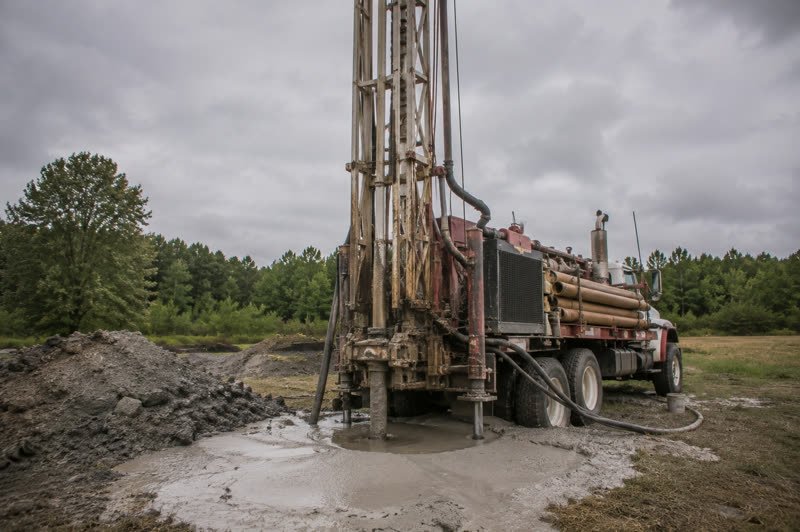
At a glance
- Soft ground
- $25 – $45 / ft sand, clay, alluvium
- Mixed ground
- $35 – $60 / ft soil over rock — the common case
- Hard rock
- $50 – $100 / ft air rotary; raises the rate 25–40%
- Casing, separately
- $15 – $25 / ft PVC; steel runs far higher
- Minimum charge
- $8,000 – $15,000 most drillers, regardless of depth
- 250 ft, with pump
- $15,000 – $27,000 mixed ground, every line counted
- Pump + tank
- $4,000 – $8,000 installed — a hole is not a water supply
- A dry hole
- you pay in full the clause to get in writing
Drilling runs $25 to $100 per foot depending on the ground, and most drillers carry a minimum charge of $8,000 to $15,000 regardless of depth. Soft soils are $25 to $45. Hard rock needing air rotary is $50 to $100. Casing is billed separately at $15 to $25 a foot.
That minimum exists because mobilization and permits cost the same whether the hole is 80 feet or 800. A 250-foot well in mixed ground, with the pump and pressure tank, works out at roughly $15,000 to $27,000 once every line is counted.
| Line item | Typical range | Average | Basis |
|---|---|---|---|
| Drilling — soft ground | $25 – $45 / ft | — | Sand, clay, alluvium |
| Drilling — mixed ground | $35 – $60 / ft | — | Soil over rock |
| Drilling — hard rock | $50 – $100 / ft | — | Air rotary; Angi puts rocky ground at $50–$75 |
| Casing — PVC | $15 – $25 / ft | — | Priced separately from the hole |
| Casing — steel | $30 – $130 / ft | — | Where conditions demand it; vs $6–$11 PVC material |
| Pump + pressure tank | $4,000 – $8,000 | — | Installed, including wiring and drop pipe |
| Minimum job charge | $8,000 – $15,000 | — | Mobilization, permits, fixed costs |
| Difficult access | +$500 – $2,000 | — | Mobilization surcharge |
Last updated: · Reviewed by Nisar Dalvi
Who pays when the hole comes up dry?
You do, in full. Under a standard dry-hole clause you owe the per-foot drilling and the materials up to the agreed depth even if the borehole never produces usable water.
This sounds harsh until you see the logic: a driller sells drilling, not water. The rig, the crew, the fuel and the casing all get consumed whether or not the hole produces. The National Ground Water Association's standard form contract makes it explicit — it does not warrant that the well will produce water in any specific quantity, and it includes an optional "dry hole discount" as a sales tool rather than an obligation.
No state regulates dry-hole payment. It is contractual, every time. Which means it is negotiable, every time.
- Ask for the dry-hole clause before you sign, and read what it says about a reduced rate or a discount.
- Ask whether a second attempt is included, and at what price. It usually is not.
- Ask about guaranteed-yield or no-water-no-pay siting. Some drillers sell it. It costs more up front and moves the risk off you.
Basis: NGWA standard form contract terms and drilling-industry contract guidance, 2026. This is the norm, not a warning about a particular contractor.
What does the ground do to the price?
More than depth does, foot for foot. Hard rock raises the per-foot rate by roughly 25% to 40% over mixed soil, because air rotary drilling is slower.
| Ground | Per foot | What it means for casing |
|---|---|---|
| Soft — sand, clay, alluvium | $25 – $45 | Usually cased and screened full depth, or the hole collapses |
| Mixed — soil over rock | $35 – $60 | Cased through the overburden, often open below |
| Hard rock | $50 – $100 | Frequently completed open-hole — less casing, slower drilling |
Sources: 2026 driller pricing pages and Angi, which puts overall drilling at $25 to $65 a foot with $25 to $35 typical and $50 to $75 in rocky or difficult ground. The spread between sources is real — get a local per-foot rate before you budget.
How deep will my well be?
Nobody knows before drilling. But you do not have to take a guess on faith, because completion reports are public record.
In Texas a driller must deliver the well log within 60 days to the state, to the landowner, and to the groundwater conservation district. Those reports are searchable by the public:
- TWDB Submitted Drillers Report database — wells drilled after 2002
- TCEQ Water Well Report Viewer — the older paper reports, before 2003
Florida water management districts hold well permits and completion reports for their own areas. North Carolina requires drillers to file a completion record, available through NCDEQ or your county.
Spend ten minutes in that database before you sign a drilling contract. If wells within a mile of you are finishing at 150 feet and a contractor is quoting a 400-foot job, you have just found the most valuable question you can ask.
Is a drilled hole a water supply?
No, and this is where cheap quotes come from. A complete, usable domestic well needs everything below, and a quote that stops at "drilling and casing" has left most of it out.
- Grouting and the sanitary seal
- The well cap
- Development and flushing
- Pump, pressure tank, wiring and drop pipe — $4,000 to $8,000 installed
- The trench and electrical run from the well head back to the house
- Water testing, and any treatment the results call for
- Permits
Bacteria and nitrate lab testing typically takes 3 to 5 days before final clearance, so build that into your schedule rather than discovering it on move-in week.
Replacing a pump later is its own project — well pump replacement cost covers what that runs, and the well pump replacement guide covers how to tell which part actually failed.
How do I check a well driller's license?
Water well drilling is licensed in every state we cover, and the lookups are free and public.
- Texas — TDLR licenses drillers and pump installers. Water Well Drillers and Pump Installers program, which also carries the reporting forms and the well construction standards.
- Florida — DEP water well contractor licensing, administered with the water management districts.
- North Carolina — Find a certified well contractor.
How far does a well have to be from a septic system?
Every state sets a minimum separation between a water well and septic components, and it is one of the few rules that can make an otherwise fine building site unworkable.
Confirm your number with the state before you site anything. In Texas the spacing minimums sit in TDLR's water well rules — 16 TAC Chapter 76 — and TDLR publishes the well siting standards on its program page. Florida and North Carolina set theirs through their health and environmental agencies. Counties can be stricter than the state.
We are deliberately not printing a single national distance here. The commonly quoted figures vary between 50 and 100 feet depending on the state and on which septic component is measured from, and we could not read the current Texas rule text at source to confirm the exact figure — the state's code portal has moved and the standards are published as linked PDFs. Ask TDLR or your county and get the answer that governs your site.
Which way the setback runs matters too: the drain field is what has to be kept away from the well. Our septic installation guide covers siting from the septic side.
Work out your own number
Our well drilling cost calculator takes expected depth, ground conditions and whether you want the pump included, and returns a range built from the figures on this page.
Feed it the depth you found in the well log database, not a guess. That is the whole point.
What comes next?
Land preparation runs in a sequence. Getting the order wrong is the most expensive mistake on a raw lot — grading before the septic is sited means paying to move the same dirt twice.
Sources
Every figure on this page traces back to one of these. Open them and check us — that is what they are here for.
- US EPA — Private Drinking Water Wells Federal guidance for private well owners.
- Texas Water Development Board — Water Well Drillers Database Submitted well reports: real depths and yields near a parcel.
- Texas TDLR — Water Well Drillers and Pump Installers Texas licensing program for well drillers.
- Florida DEP — Water Well Contractor Licensing Florida well permitting and contractor licensing.
- NC DHHS — Certified Well Contractors North Carolina well contractor certification register.
Links verified August 2026. Tell us at info@landclearingandexcavation.com if one has moved.
Frequently asked questions
How much does it cost to drill a water well?
Drilling runs $25 to $100 per foot depending on what you are drilling through, and most drillers apply a minimum charge of $8,000 to $15,000 whatever the depth, because mobilization and permits cost the same either way.
Soft ground is $25 to $45 a foot, mixed ground $35 to $60, and hard rock needing air rotary $50 to $100. Casing is billed separately at $15 to $25 a foot.
Adding it up on a common case — a 250-foot well in mixed ground with the pump and pressure tank comes to roughly $15,000 to $27,000. Shallower wells in easy ground fall back to that $8,000 to $15,000 minimum.
Who pays if the well comes up dry?
You do, in full. This is the answer people are most surprised by and it is the industry norm rather than a bad contractor.
Under a standard dry-hole clause you still owe the per-foot drilling and the materials up to the agreed depth even if the borehole never yields usable water. The National Ground Water Association's standard form contract expressly does not warrant that a well will produce water in any particular quantity.
No state regulates this — it is purely contractual. Some drillers offer a dry-hole discount, and a few sell guaranteed-yield or no-water-no-pay siting at a premium. Get the clause in writing before you sign.
Is casing included in the per-foot price?
Usually not. Expect drilling at $30 to $60 a foot plus casing at $15 to $25 a foot as a separate line.
How much casing you need depends on the ground. In loose sand or alluvium the hole has to be cased and screened its full depth or it collapses. In competent bedrock a well is often completed open-hole, with casing only through the overburden — so rock drills slower but frequently needs less casing.
Do not assume those cancel out. If conditions call for steel rather than PVC, material cost jumps from roughly $6–$11 a foot to $30–$130.
How deep does a water well need to be?
Nobody can tell you before drilling, and any quote that states a depth with confidence is guessing.
The useful move is to look up what neighboring wells actually finished at. Well completion reports are public record in Texas, Florida and North Carolina — the links are in the licensing section above.
If three wells within a mile hit water at 150 feet and a contractor is pushing a 400-foot contract, that is your cue to get a second opinion.
What flow rate do I need from a well?
5 gallons per minute is the working minimum for most single-family homes, and it is the rate many mortgage lenders want to see. 8 to 12 GPM is good; 15 and up is excellent.
1 to 3 GPM is marginal but genuinely workable with storage. Even a 1 GPM well produces about 1,440 gallons a day, which is more than a household uses — the problem is delivering it during a morning peak, and that is what a storage tank solves.
Can a low-yield well be fixed?
Usually, and it is rarely terminal. Three options, cheapest first:
A storage tank system runs $3,000 to $15,000 installed — a 500 to 2,500 gallon tank plus a booster pump, which lets a slow well fill a buffer overnight. Hydrofracking costs $2,500 to $4,500 and succeeds in about 85% to 95% of cases in fractured bedrock. Deepening the well is $8,000 to $15,000 with a lower success rate, around 60% to 75%.
The order matters: storage is cheapest and always works; deepening is dearest and works least often.
What is usually left out of a well drilling quote?
Quotes typically cover drilling and casing. The commonly excluded items are the expensive ones: grouting and the sanitary seal, the well cap, development and flushing, the pump system, the pressure tank, the trench and electrical run back to the house, water testing, and permits.
Compare line items, not totals. The cheapest quote is very often the one that stops at the hole — and a drilled hole is not a water supply.
Get quotes from local contractors
Tell us about the job and we will pass it to licensed contractors who work in your area. No cost, no obligation.