
At a glance
- Tank only
- $3,500 – $8,500 for a 3–4 bedroom home, field left alone
- Whole system
- $9,000 – $18,000 Texas; $15,000–$25,000+ engineered in Florida
- Retiring the old
- $1,000 – $3,000 crushed and filled in place — the usual route
- Removing it
- $3,000 – $5,000 full excavation and haul-away
- Concrete lasts
- 40 – 100 years plastic 20–30, steel 15–25
- Concrete labor
- +$500 – $1,500 it needs a crane; plastic and fiberglass do not
Replacing just the tank costs $3,500 to $8,500. Replacing the whole system costs $9,000 to $25,000. Those are two completely different jobs, and the search that brought you here does not distinguish between them.
The difference is roughly $10,000, and it turns on one question: is your drain field still working? Settle that before you accept any quote.
| What is being replaced | Typical range | Average | Basis |
|---|---|---|---|
| Tank only, field kept | $3,500 – $8,500 | — | 3–4 bedroom home, drain field certified healthy |
| Whole system, Texas | $9,000 – $18,000 | — | Dillon Septic replacement range |
| Whole system, engineered | $15,000 – $25,000+ | — | Florida ATU, mound or near wetlands |
| Retire old tank in place | $1,000 – $3,000 | — | pumped, top destroyed, filled with sand — common route |
| Excavate and remove it | $3,000 – $5,000 | — | required where it sits close to a structure |
| Abandonment permit | $75 – $500 | — | Florida DOH charges $75; elsewhere $100–$500 plus inspection |
Last updated: · Reviewed by Nisar Dalvi
Can you replace the tank alone and keep the field?
Often, yes — and it is the option most homeowners never hear about, because the company quoting a full system has no particular reason to raise it.
The tank and the drain field fail on completely different schedules. A concrete tank lasts 40 years or more; a drain field lasts 20 to 30. So a tank that cracks early, or a steel tank that rusts out at 20, can absolutely sit in front of a field with plenty of life left.
| Tank only — yes | Full system — no way around it |
|---|---|
| Tank cracked, corroded or collapsed | Field already failing — soggy ground in dry weather, effluent surfacing |
| Field drains normally under load | Outlet baffle failed years ago and sent solids downstream |
| Steel tank at end of life, field much younger | Code upgrades trigger a full redesign |
| No history of backups or wet spots over the field | Health department mandates an upgraded system for groundwater protection |
Florida's repair rules force somebody to answer the question. Charlotte County's repair and replacement permit requires a registered contractor to pump the tank and certify its structural integrity.
The same process that certifies a tank as dead is the process that certifies a field as alive. Use it. A ~$5,000 job instead of a ~$15,000 one is worth one honest evaluation.
What happens to the old tank?
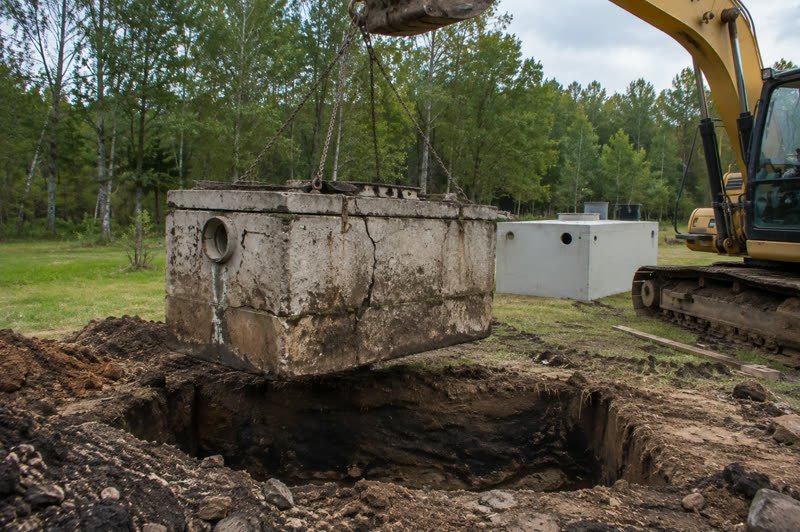
It cannot simply be left in the ground full. There are two legal paths, both codified, and the reason is safety rather than paperwork.
Typical adopted plumbing code language — Omaha's is a clear example — requires that an abandoned tank be pumped of all liquids, the top destroyed, and the tank filled with sand or compacted earth, or removed entirely after pumping.
| Path | What happens | Cost |
|---|---|---|
| Crush and fill in place | Pumped by a licensed hauler, collapsed or punctured so it cannot hold water, filled with clean sand to grade, final inspection | $1,000 – $3,000 |
| Excavate and remove | Dug out entirely and hauled away after pumping | $3,000 – $5,000 |
| Permit and inspection | Florida charges $75 for a DOH abandonment permit; elsewhere $100–$500 | plus final inspection |
Florida requires abandonment within 90 days — after a sewer connection, demolition, or replacement with another tank — with the pumping receipt produced at final inspection. Southern Nevada requires full removal rather than burial if the tank sits within 8 feet of an existing or future structure.
Why the code is this specific: an abandoned tank still holding liquid is a drowning hazard. Deteriorating lids collapse under a person's weight, and this has killed people — often children.
Leaving the contents in place makes it worse rather than better. Unpumped waste corrodes the tank from the inside, accelerating exactly the collapse that causes the accident. If you own a property with an unused tank on it, that is a liability sitting in your yard.
Concrete, plastic or fiberglass?
The unit prices tell you less than you would think, because installation cost moves in the opposite direction to material cost.
| Material | Tank | Lifespan | The catch |
|---|---|---|---|
| Concrete | $800 – $2,000 | 40 – 100 yrs | Up to 10,000 lbs — needs a crane, +$500–$1,500 labor. Vulnerable to hydrogen-sulfide corrosion. |
| Plastic (poly) | $600 – $1,800 | 20 – 30 yrs | Cheapest and shortest-lived. Can float or shift in saturated soil; crushes under vehicle loads. |
| Fiberglass | $1,200 – $3,000 | 30 – 40 yrs | About 300 lbs — places without heavy equipment. The pick for coastal and acidic soils. |
| Aerobic unit (ATU) | $3,500 – $12,000 | varies | Needs power and usually a maintenance contract at $200–$400/yr. |
The short version: concrete is the best overall choice on a standard site. Plastic wins where access is genuinely difficult and a crane cannot reach. Fiberglass is the middle ground and the right answer near the coast.
That weight difference — 300 lbs against 10,000 — drives everything downstream, from whether a crane has to come out to whether your tank tries to float out of the ground after a wet spring.
What about steel tanks?
Steel is no longer installed, on cost and durability grounds, and no state approves it under current material standards. It disappeared through state material standards rather than county-by-county bans — codes specify approved materials, and steel is not among them.
If you have one, it is grandfathered — and living on borrowed time. A steel tank more than 15 to 20 years old has very likely rusted enough to lose its baffles, and possibly rusted through the bottom. Pre-1980 steel tanks routinely show baffle failure and warrant close inspection.
The lid deserves its own warning. A steel cover lasts until it rusts through or somebody drives over it — and it usually gives no notice before it does.
Does it need a permit and an inspection?
Yes, in both states, though the track is lighter than for new construction.
Texas
Any non-emergency modification or replacement requires a permit. Emergency repairs may proceed immediately, but must be reported to TCEQ within 72 hours. Installation must be by a licensed Installer I or II depending on the system type.
Florida
A tank swap is classified as a repair, which carries its own permit — 62-6.015 requires a repair permit on Form DEP 4016 with a site plan. Site evaluations for repairs may be performed by registered septic tank contractors, so you are not pushed into the full new-construction evaluation.
Budget for the fork. A tank swap that reveals a failing drain field mid-permit converts into a full repair permit and possibly a system redesign.
That is not a reason to avoid the permit — it is a reason to have the field assessed before you commit to a number, so the discovery happens at quoting time rather than with an open hole in your yard.
When is a cracked tank worth repairing?
Cracks are repairable if you catch them early, and they lead to failure if you do not. Tank crack repair sits in the $500 to $5,000 major-repair band against $3,500 to $8,500 for replacement.
The rule worth applying:
- Seal it — hairline crack above the waterline, in a mid-life concrete tank.
- Replace it — crack below the waterline, crumbling concrete around the baffles, or a tank past 25 to 30 years (15 for steel) with any failure in the last five.
Past those age triggers you are paying repair money to defer a replacement you will buy anyway, usually at a worse moment.
What makes a quote jump
Access, almost always. The tank went in when the lot was empty; everything built since is now in the way.
- Buried access — $50 to $150
- Tight truck access — $50 to $100
- Steep terrain — $50 to $100
- Under a deck, driveway or patio — demolition and restoration become their own line items
- Old-system removal — bills at $45 to $200 per hour on top of the new system
Restoration follows the same split as every other excavation job on this site: rough grade, topsoil and seed are included. Hardscape, mature planting and anything decorative is yours.
Questions to ask before you sign
- Has anyone actually evaluated my drain field, or are we assuming it needs replacing too?
- Is this quote tank-only or whole-system? Get it in writing — it is a $10,000 distinction.
- What happens to the old tank, and is retiring it in this price?
- Which material, and why that one for my site?
- Is the permit and the final inspection included?
- What happens if the field turns out to be failing once you are digging? Get the answer before, not during.
- What is your license number? Installer I or II in Texas; DEP-licensed in Florida.
And the one that saves the most money: when was the tank last pumped? If the answer is "never," there is a fair chance the field went first and the tank is a symptom rather than the disease.
Where this fits
This page covers one part of a larger job. The service hub explains how the whole thing works, what it costs, and how to hire for it.
Frequently asked questions
How much does it cost to replace a septic tank?
$3,500 to $8,500 to replace just the tank on a 3 to 4 bedroom home, leaving a healthy drain field in place. Replacing the whole system is $9,000 to $18,000 in Texas and $15,000 to $25,000 or more for an engineered Florida system.
That gap is roughly $10,000, and it turns entirely on whether your drain field is still working. Find that out before you accept any quote.
Can I replace just the septic tank and keep the drain field?
Yes, when the field is genuinely healthy — and it is a real, legal, permitted option that many homeowners are never offered.
It works when the tank is cracked, corroded or collapsed but the field still drains normally under load. It does not work when the field is already showing failure, when a failed outlet baffle has been sending solids downstream for years, or when code upgrades force a full redesign.
What happens to the old septic tank?
It gets retired, and there are only two legal ways. Typical adopted code language requires the abandoned tank to be pumped of all liquids, the top destroyed, and the tank filled with sand or compacted earth — or removed entirely after pumping.
This is a safety rule, not paperwork. An abandoned tank still holding liquid is a drowning hazard. Deteriorating lids collapse under a person's weight, and leaving the contents in place corrodes the tank from the inside, which speeds up exactly that failure.
Concrete, plastic or fiberglass — which septic tank is best?
Concrete for most standard sites: it lasts 40 to 100 years and will not float or shift. The catch is weight — a 1,000-gallon concrete tank can run to 10,000 lbs, so it needs a crane and adds $500 to $1,500 in labor.
Plastic is cheapest and easiest to place at $600 to $1,800, but lasts only 20 to 30 years and can float in saturated soil. Fiberglass ($1,200 to $3,000) weighs about 300 lbs and is the pick for coastal and acidic soils.
Does replacing a septic tank need a permit?
Yes, in both Texas and Florida. In Texas, any non-emergency modification or replacement requires a permit — emergency repairs may go ahead immediately but must be reported to TCEQ within 72 hours.
In Florida it is classified as a repair, which has its own permit under 62-6.015 (Form DEP 4016) with a site plan. Registered septic tank contractors may perform site evaluations for repairs, so the repair track is lighter than new construction — but a site look does get triggered.
Is my cracked septic tank repairable, or does it need replacing?
Cracks are repairable if caught early. A hairline crack above the waterline in a mid-life concrete tank gets sealed, in the $500 to $5,000 major repair band.
Replace instead when the crack is below the waterline, when the concrete around the baffles is crumbling, or when the tank is past 25 to 30 years (15 for steel) and has had any failure in the last five. At that point you are buying time, not a repair.
Are steel septic tanks still allowed?
Not for new installation. Steel is no longer installed because of cost and poor durability, and no state approves it under current material standards. If you have one, it is grandfathered.
It is also living on borrowed time. A steel tank over 15 to 20 years old has very likely rusted to the point of lost baffles and possibly a rusted-out bottom. A steel lid lasts until it rusts through or somebody drives over it — which is a genuine safety issue, not just a repair bill.
Get quotes from local contractors
Tell us about the job and we will pass it to licensed contractors who work in your area. No cost, no obligation.