
The short version
- Start to finish
- 6 – 14 weeks and only 3–7 days of that is actual work
- Permit
- always except one narrow Texas exemption, below
- Biggest delay
- the permit queue not weather, not the contractor
- Two agencies
- health + building two queues, two inspectors, two clocks
- Worst season
- a wet spring rain stops excavation and can void a perc test
- Pulls the permit
- your contractor if they ask you to, that is a liability shift
Septic installation is a 6-to-14-week project with about a week of digging in the middle of it. Soil evaluation, system design, permit review and inspector scheduling take the rest, and the permit queue is what actually moves the date.
That gap between what people expect and what happens is the whole problem. Most of what goes wrong on a septic install is a scheduling failure, not a construction failure.
What does a septic installer actually do?
A septic installer builds the system that treats and disposes of your wastewater on your own land, because no sewer line reaches it. Tank, drain field, and the pipe between them.
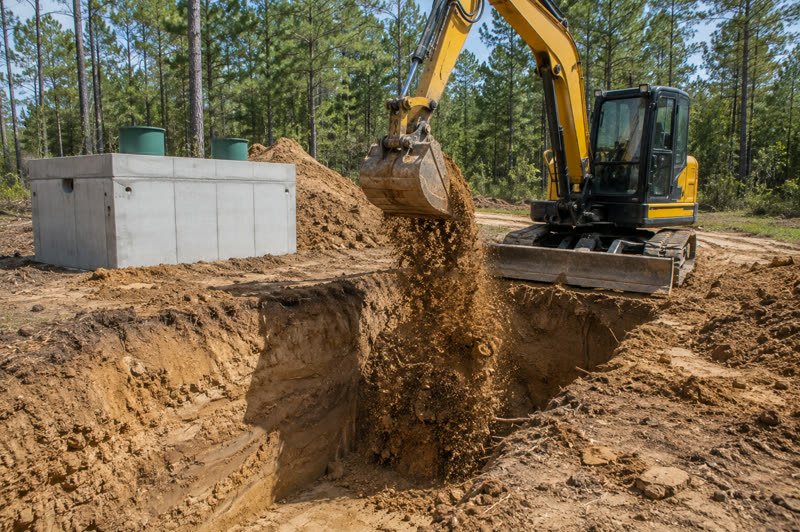
The job is less about machinery than people assume. An installer coordinates a soil evaluation, works to a design set by that soil, pulls a county permit, digs and sets the system, and holds it open for an inspector before covering anything. Four of those five steps are paperwork and scheduling.
Which type of system you get is decided by your soil, not by preference or budget — the six types and how each treats wastewater are covered in our guide to septic system types.
How much does a septic system cost?
Nationally $3,591 to $12,463 installed, averaging $8,023 — and most people finish between $10,000 and $25,000 once the perc test, permits, engineering and site work are counted. Those are two different numbers for two different scopes, which is why quotes online look like they contradict each other.
The full breakdown by system type, the Texas and Florida code tables that set your tank size, permit fees by county, and why soil moves the number more than anything else all sit on the septic system cost guide, with the basis stated for every figure.
When do you need a septic installation?
Two situations, and they run differently enough to be worth separating. A third — swapping a working sewer connection for a septic system — is close to nonexistent, and the reverse is the real question. That gets its own section below.
New construction on raw land
The full sequence, with no time pressure and maximum design freedom. Nothing is pre-approved, so this is the longer path — but you still control where the house sits.
That last point is the one worth acting on. Brush & Blade Grading's advice is to start the soil evaluation before you finalize house plans, because where the system can go may decide where the house can go. Treat septic as a site-planning constraint, not a subcontractor you call later.
Replacing a system that has failed
Same technical steps, compressed, with one expectation to reset early: replacement often does not mean like-for-like.
The site gets re-evaluated against current code, and code may have moved since the original install. Land Perc, writing about Florida, notes that many replacements require a new site evaluation, and that a county may approve a like-for-like swap only where the original permit is available and conditions have not changed.
In plain terms: the system you are replacing might not be legal to rebuild. The upgrade, and its cost, lands on whoever owns the property now.
Emergency pathways exist and they are worth knowing about, but they do not suspend licensing. Repair permits also tend to be short-lived — Clallam County in Washington publishes a six-month expiry on repair permits against three years for new construction, so a failed-system path has a use-it-or-lose-it quality the new-build path does not.
Whether replacement is even the right call is a separate question, and the repair cost guide works through the repair-versus-replace maths component by component.
How long does a septic installation take, step by step?
Published totals cluster between four and fourteen weeks. We are anchoring to the wider figure because the sources that break the job into phases — rather than quoting one headline number — consistently land higher.
| Phase | Calendar time | What decides it |
|---|---|---|
| Contractor selection and site visit | 3 – 10 days | How booked they are |
| Soil evaluation, scheduled to results | 2 – 3 weeks | Evaluator availability and ground conditions |
| System design | 3 – 10 days | An engineer or licensed designer works from the soil result |
| Permit application to issue | 1 – 3 weeks | County backlog — the real variable |
| Site prep and clearing | 1 – 3 days | Access and vegetation |
| Excavation, tank set and field install | 2 – 5 days | Rocky or clay soil digs slower than sand |
| Inspection request to sign-off | 3 days – 2 weeks | Inspector's calendar. The trench stays open until they arrive |
| Total | 6 – 14 weeks | Of which 3–7 days is construction |
Basis: phase figures compiled from Brush & Blade Grading (NC), RCI Septic, Bonzo Excavating and West Coast Sanitation; totals cross-checked against Projul, MAP Engineering and Angi, which range from 4–8 weeks to 2–4 months. These are trade sources, not agency data — treat them as a planning range and ask your own county for its current turnaround.
One planning note that costs nothing and saves a resubmission: soil results and permits both expire. Perc results carry a validity period set by the local health department, and permits have their own clock — Clallam County publishes three years for a new construction permit. An expired permit often cannot be renewed, only reapplied for at full fee.
Where does the delay actually come from?
Five things, and homeowners usually blame the wrong one. Ranked by how much time each genuinely costs:
1. The permit queue, and it is geographic
This is the single biggest variable in the whole project. MAP Engineering describes permitting as the longest component of the timeline, and it worsens in fast-growing counties — Septic & Well Pro names Wake, Durham and Mecklenburg in North Carolina as places where backlog alone adds weeks.
Ask one question before you sign: "what is the current permit turnaround at this county's health department?" A contractor who works there weekly answers instantly. One who deflects is telling you something.
2. Weather, which blocks excavation rather than installation
RCI Septic calls weather the most common source of timeline extensions — rain, frozen ground and extreme temperatures all prevent safe excavation. Note the compounding effect: a wet spring can delay the dig and interfere with the soil evaluation that has to happen first.
3. Inspector scheduling, which is a hard stop
The inspection happens before backfill. Until an inspector signs off, your trench stays open and nobody can cover it. West Coast Sanitation puts this at a few days to a week. Florida's sequence is explicit about the order: the county inspects the completed system before it is covered.
4. Two agencies, two clocks — the one nobody mentions
Writing for general contractors, Projul spells out what this means in practice: two different agencies, two different timelines, two different sets of inspectors. The health department handles the septic permit. The building department handles the building sewer — the pipe from the house.
Florida formalizes the split: a building permit from the local building department covers the building sewer, while the OSTDS permit covers everything from the tank outward. Two queues that do not coordinate with each other, and either one can hold up your certificate of occupancy.
5. Design revisions, which restart the clock
A rejected design does not get corrected in place. Clallam County describes the mechanic plainly: where corrections are needed, the application goes back to the designer for revision or redesign — and then rejoins the review queue at the end.
One thing that reliably lengthens all five: choosing an alternative system. MAP Engineering puts aerobic units, mounds and pressure-dosed fields at 2 to 6 weeks longer than a conventional system, mostly in design and permitting rather than construction. Your system type is also a schedule decision.
Septic or connecting to municipal sewer?
For most readers this resolves in one sentence: if sewer reaches your property line, you usually do not have a choice. Most jurisdictions require connection where sewer is available and will not permit a new septic system instead. Where sewer is not available, septic is the only option regardless of preference.
A genuine choice exists in three narrow cases — sewer newly extended to your area with a voluntary connection window, new construction where the municipality offers both, or a full system replacement where connection is available but not yet mandatory.
In those cases the deciding number is distance. The Septic Guide and SepticTankHub both put lateral installation at $50 to $250 per linear foot. On a rural lot with a long run to the main, that arithmetic answers the question by itself well before any comparison of monthly costs.
Two things to check even if you never connect, both flagged by SepticTankHub: many municipalities require you to abandon a septic system and connect within one to three years once a sewer line comes within a set distance, and a municipality extending sewer often levies an assessment on every property in the district whether or not it connects.
How to choose a septic installer
Start with the license, because septic is state-licensed work and the registers are public. This is a check most homeowners skip and most competitors never mention.
Texas — TCEQ licenses the installer
TCEQ states it directly: to operate as an OSSF installer, apprentice, maintenance provider or maintenance technician in Texas, you must be licensed or registered by the TCEQ. There are two installer classes and the difference is not cosmetic:
| Class | Authorized to install |
|---|---|
| Installer I | Standard systems only — septic tanks, absorptive drain fields, unlined ET drain fields, leaching chambers, gravel-less pipe and pumped effluent drain fields |
| Installer II | All types of OSSF systems |
If your design calls for an aerobic unit, a mound, drip, or anything engineered, an Installer I is not authorized to install it. Ask which class they hold and match it to your design. That single question is checkable in two minutes and almost nobody asks it.
Expect more than one licensed person on the job, which surprises people. A Site Evaluator — TCEQ-licensed or a Texas Professional Engineer — performs the preconstruction evaluation that decides what your site can support. A Designated Representative works for the county, not the contractor, and inspects systems issued an authorization to construct. A Maintenance Provider services aerobic systems under contract. An apprentice may only work under the constant, direct supervision of a licensed installer.
Verify at TCEQ's public database, which searches individuals, groups and company registrations — the company search is usually the one you want, since you are hiring a business. Licenses run three years and most classes require 24 hours of continuing education to renew, so confirm the record is current rather than lapsed.
Verify: TCEQ licensing database · OSSF licensing requirements
Florida — DEP registers the contractor, the county permits the system
Florida splits the job between two agencies, which is the detail that trips people up. DEP registers septic tank contractors and contracting businesses. County-level offices handle permitting and inspection of the system itself.
Two exemptions matter to a homeowner. A state licensed plumber may do the work — DEP's own guidance is precise about the limit, saying the plumber is exempt only from the contractor registration requirement, with every other requirement still applying. And a homeowner may work on their own owner-occupied single-family home, again without any relief from permits or standards.
One consumer point worth more than it looks: Florida registrations expire annually on 30 September, and a registration that lapses reverts to inactive. DEP states that where a registration is inactive, department permitting and inspection services related to septic tank contracting will not be provided. Hiring a lapsed contractor does not just risk poor work — it can mean your job does not get inspected at all.
Check two records, because Florida runs two clocks. The individual's registration expires every 30 September. The certificate of authorization that lets a business contract for septic work expires 31 March of every odd year. You are almost always hiring the business, so the business search is the one that matters — and it is the record people forget exists.
Verify: DEP public searches — individual contractor and business authorization · DEP registration and renewal dates
What a real septic quote looks like
A number is not a quote. Every phase should appear as its own line: soil testing, system design, permit fees, the tank, drain field materials, labor, excavation and any electrical work — a list Land Perc publishes in close to that order.
Add the specifics that make a bid comparable: tank size and material named outright, drain field area or trench footage, system type, spoil haul-off, and restoration. "Septic tank" is not a specification. "1,000-gallon two-compartment precast concrete" is.
The red flags, and why each one matters
- A lump sum with no breakdown. CostFlow's framing is the right one — a single number with no scope description protects the contractor, not you. Land Perc treats a lump-sum bid as a red flag outright.
- No permit line. CostFlow again: either they forgot it, they plan to skip it, or they expect you to handle it. Angi notes most contractors include permit cost in the quote — included is fine, invisible is not.
- A bid 20–30% under everyone else. Not a deal. It is a scope gap, a material downgrade, or change orders waiting to happen. Ask them to walk the difference line by line.
- Scope discussed, not written. If it was agreed in a meeting and only the total appears on paper, the conversation carries no weight later. EZ Cesspool makes the septic-specific version of this point about permits and inspections in particular.
- Vague warranty. Ask what it covers, how long it runs, and what you do to claim on it.
Keep three warranties separate in your head, because they get conflated: the manufacturer's warranty on the tank, the contractor's warranty on workmanship, and — on an aerobic system — the mandatory service contract, which is not a warranty at all but an ongoing obligation.
Three questions separate a real quote from a number: who pulls the permit, what is the tank specified as, and what is excluded. Everything else is detail.
Frequently asked questions
How long does it take to install a septic system?
Six to fourteen weeks from first call to a system you can use, according to the most detailed published breakdown we found — Brush & Blade Grading in North Carolina. Angi says two to four months and notes it can run longer.
The construction itself is only 3 to 7 days. Almost the entire spread is soil testing, design, permit review and inspector scheduling.
Do I need a permit to install a septic system?
Yes, in effectively every US county. Texas has one narrow written exemption: under 30 TAC §285.3, no planning materials, permit or inspection are required for a single-family dwelling on a tract of ten acres or larger, provided the system causes no nuisance and does not pollute groundwater, every part of it sits at least 100 feet from the property line, the effluent stays on the property, and it is the only dwelling on that tract.
Read that as an exemption from the paperwork, not from the engineering. The construction standards in Chapter 285 still apply, and TCEQ tells owners to confirm with the local permitting authority regardless.
Who pulls the septic permit — me or the contractor?
Either can, legally. It should be the contractor.
CostFlow puts the reason plainly: if a contractor tells you to pull your own permit, that shifts liability for the work onto you and can affect your insurance position. The permit names whoever pulled it as responsible for the work meeting code. You do not want that to be you.
How do I check that a septic installer is actually licensed?
Both Texas and Florida publish free public lookups.
Texas: TCEQ licenses OSSF installers directly, and its licensing database searches individuals, groups and company registrations. Florida: DEP registers septic tank contractors and contracting businesses, with separate searches for each. Both are linked in the hiring section above.
Check the class, not just the name. A Texas Installer I cannot legally install an aerobic, mound or engineered system — that requires an Installer II.
Can I install my own septic system?
It depends on the state, and "can" is doing a lot of work in that question.
Florida exempts a homeowner working on their own owner-occupied, single-family home from the contractor registration requirement — but not from permits or from any construction standard. Texas requires a licensed installer for permitted work. In both states the system still has to pass the same inspection, and a failed inspection before backfill means the trench stays open until you fix it.
Can I choose septic instead of connecting to city sewer?
Usually not, if sewer reaches your property line. Most jurisdictions require connection where sewer is available and will not permit a new septic system instead.
Where sewer is not available, septic is the only option and the question does not arise. The genuine choice exists in a narrow band — newly extended sewer with a voluntary connection window, or a full system replacement in an area where connection is available but not yet mandatory.
Get quotes from local contractors
Tell us about the job and we will pass it to licensed contractors who work in your area. No cost, no obligation.