
The short version
- Pump the tank
- every 3 – 5 yrs EPA baseline; household and tank size move it a lot
- Inspect
- every 3 yrs EPA — but yearly if it has a pump, float or alarm
- Effluent filter
- every 6 – 12 mo where one is fitted; the cheapest job on the list
- Water per person
- up to 70 gal/day EPA, current wording — treat it as a ceiling
- One running toilet
- +200 gal/day EPA — more than two extra people in the house
- Additives
- never no evidence they work; some hasten the failure
A septic system needs four things: pump and inspect it on schedule, use water efficiently, keep the wrong things out of the drain, and protect the drain field. That is the EPA's own framing, and for a conventional gravity system it works out at a pump-out every three to five years, an inspection every three, and the effluent filter cleaned every six to twelve months.
The pump-out is the part everyone knows about. It is also the smallest part. Almost every septic failure that arrives as a surprise was built over years by ordinary household habits — what went down the drain, how much water went with it, and what got planted, parked or paved on top of the field.
What does a real septic maintenance calendar look like?
Most maintenance advice is a single line: pump every three to five years. That is true and it is nowhere near enough. Here is the whole routine in one place.
| When | What | Why it matters |
|---|---|---|
| Every wash day | Spread laundry across the week | Whole-week loads in one day hydraulically overload the tank |
| Monthly | Walk the field, check the alarm light, scan for leaks | Catches failure while it is still a cheap problem |
| Every 6 – 12 months | Clean the effluent filter | A blocked filter backs the system up into the house |
| Every 6 months | Full service visit — drip systems, and ATUs where required | Written into state rule in Missouri; recommended in Kansas |
| Annually | Professional inspection of anything with a pump, float, aerator or alarm | Mechanical parts fail silently between three-year visits |
| Every 3 years | Professional inspection, conventional systems | The EPA baseline; MassDEP recommends pumping at this interval |
| Every 3 – 5 years | Pump the tank | The single most valuable thing you will ever do for the system |
| Every 3 – 7 years | Budget an aerator replacement — aerobic systems only | Not "if". It runs 24 hours a day and it is a consumable |
| Never | Additives, of any kind | No evidence they work; some accelerate the failure they claim to prevent |
Basis: US EPA's four maintenance pillars and its inspect-every-3, pump-every-3-to-5 baseline; MassDEP's every-3-years pumping recommendation; Missouri DHSS and Kansas DHE on drip intervals; Humboldt County on additives and aerobic components.
The weekly items are habits, not tasks
Nothing here goes on a calendar. They are things you either do or do not do, and they matter more than the annual jobs because they happen every week for thirty years.
Spread the laundry out. The EPA is unusually direct about this one: try to spread washing machine use throughout the week, because doing all the household laundry in one day might seem like a time-saver but it can harm your septic system. The mechanism is hydraulic. Six loads on a Saturday morning pushes several hundred gallons through the tank in a few hours, and the solids that should have been settling get carried out with it.
Listen for the aerator. If you have an aerobic system, a working aerator hums continuously, roughly like a refrigerator compressor. Silence is the alarm.
The "never" list has exactly one item on it
Additives. Chemical or biological, powder or liquid, sold in the hardware store or by a technician standing in your driveway. County health guidance puts it plainly: avoid the use of any type of chemical or biological septic tank additive, because such products are not necessary for the proper functioning of a septic tank.
It is a large, profitable and entirely unnecessary product category. Some of it is actively harmful, and one state has legislated against it — the detail is on our septic tank pumping cost guide.
What are you actually looking for on the monthly walk?
Ten minutes, once a month, no tools. This is the highest-value habit on the page because every warning sign it catches is cheap, and every sign it misses gets expensive on a schedule you do not control.
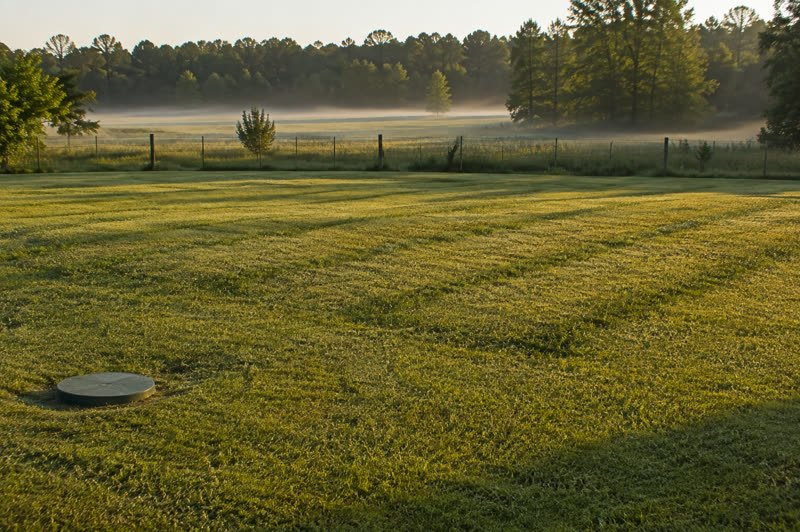
- Soggy ground or standing water over the drain field, especially when it has not rained. Effluent is surfacing instead of soaking in.
- An unusually lush green stripe. Grass growing noticeably faster and darker in lines across the field is being fertilized by effluent that should be lower down. It looks like the healthiest part of your lawn. It is the sick part.
- Odor anywhere near the tank, the field or the vent.
- The alarm panel light, if the system has one. Press the push-to-test button where one is fitted — an alarm nobody has tested is a decoration.
- Anything new on top of the field. A trailer parked over it, a stack of lumber, a trampoline, a load of gravel. Compaction is cumulative and invisible.
- Leaks inside the house. Covered in its own section below, because the numbers are startling.
The lush green stripe is the one worth memorizing. Wet spots and smells read as problems immediately. A vigorous green line across the yard reads as good news, which is exactly why it gets ignored for a season or two — and by then the field is usually the thing being repaired.
How often does the tank really need pumping?
The EPA baseline is an inspection at least every three years and a pump-out every three to five. Agencies disagree around the edges, and the disagreement is informative rather than confusing.
| Source | Recommended interval |
|---|---|
| US EPA | Pump every 3 – 5 years; inspect at least every 3 |
| MassDEP | A properly maintained system pumped out at least once every 3 years |
| Illinois Extension | Every 1 – 3 years; yearly where a garbage disposal is used heavily |
The reason nobody can give you one number is that the real variables are tank size and household size, and they swing the answer enormously. Penn State's extension table — the one the trade actually uses — puts six people on a 900-gallon tank at every 1.3 years and two people on that same tank at every 5.2 years. Same tank. Four times the interval.
The full table, and what a pump-out costs, sit on our septic tank pumping cost guide along with how to verify you got a complete job rather than a partial one.
One practical note that costs nothing: if you have been told "every three years" without anyone asking how big your tank is or how many people live in the house, you have been given a guess rather than an answer.
What should never go down the drain, and why?
Every septic site publishes the same list — grease, wipes, coffee grounds, chemicals, medications, cat litter, floss, paper towels. Almost none of them explain what each one actually does, which is a shame, because the mechanism is more useful than the list.
Everything on every "never flush" list does one of exactly four things. It floats and seals your soil. It sinks and never leaves. It kills the bacteria doing the work. Or it does not break down at all and wraps itself around machinery.
Learn the four categories and you stop needing the list.
1. Things that float, and end up sealing your soil
Grease, fats, cooking oil.
Grease does not sink and it does not get digested. It joins the floating scum layer at the top of the tank, and every pour thickens that layer downward. When the scum depth reaches the outlet baffle, grease starts leaving the tank with the effluent — and once it is in the drain field it coats the soil's infiltrative surface, sealing the pore spaces that do the actual treating.
Here is the part that reframes it. Grease does not clog the pipe the way people picture. It clogs the soil — and soil cannot be snaked. A blocked pipe is a service call. A sealed infiltrative surface is a new drain field.
2. Things that sink, and never leave
Coffee grounds, cat litter, eggshells.
These are dense, so they drop straight to the sludge layer, and they are highly resistant to anaerobic digestion — so unlike food waste, they essentially never break down. Every pot of grounds is a permanent deposit that shortens the interval to your next pump-out.
Cat litter is the worst of the three, because clumping litter is designed to absorb liquid and hold its shape. It does that inside a septic tank too.
3. Things that kill the bacteria doing the work
Bleach, drain openers, antibacterial cleaners, solvents, oil-based paints, pesticides, antifreeze, gasoline — and medications.
A septic tank is a live bioreactor. The causal chain is worth spelling out because it is slower and less obvious than a clog: kill the bacteria, digestion stops, sludge accumulates faster than it should, you pump sooner than you planned, and solids reach the drain field earlier than they ever would have.
The EPA calls out chemical drain openers specifically — for a clogged drain, use boiling water or a drain snake instead. And if you have an aerobic system, the exposure matters more than it would otherwise: aerobic bacteria are more sensitive to bleach and antibacterial products than the anaerobic bacteria in a sealed conventional tank.
Medications are a separate problem wearing the same coat. Antibiotics and antimicrobials suppress the bacterial population the same way household chemicals do. But the tank-and-soil system was never designed to remove pharmaceutical compounds at all, so what is not digested simply passes through toward groundwater. Montana's environmental agency says it directly: do not flush leftover medications into your septic system — some pharmacists will dispose of them for you.
4. Things that never break down at all
"Flushable" wipes, dental floss, feminine hygiene products, condoms, diapers, cotton swabs, cigarette butts, paper towels.
This failure is mechanical rather than biological. Toilet paper and human waste break down inside the tank. Many items labeled "flushable" do not, and they sit there.
What they consume is settling volume — the space the tank needs in order to separate solids from liquid. Less settling volume means shorter retention time, and shorter retention time means solids carrying over into the drain field. The tank still looks like it is working right up until the field stops.
There is a second failure mode that costs far more. Wipes and floss rope together and wrap around pump impellers and float switches. On a conventional gravity system there is nothing for them to wrap around. On a mound, drip or aerobic system there is, which is why the same handful of wipes is a very different bill depending on what you own.
Does a garbage disposal really make that much difference?
Yes, and the sources put the penalty in different units, which is worth showing rather than flattening into one number.
- Penn State's extension table shortens the pumping interval by roughly 20 percent where a disposal is fitted.
- Commercial septic sources put solids accumulation up to 50 percent higher.
- Illinois Extension goes furthest: tank cleaning should be done yearly if a disposal is used extensively.
Those measure different things — an interval versus an accumulation rate — so they are not strictly in conflict. They also all point the same direction. The honest read is that a lightly used disposal costs you about a fifth of your pumping interval, and a heavily used one can cost you most of it.
If you have a mound system, treat it as settled. Humboldt County's homeowner guidance says the use of a garbage disposal is highly discouraged on a mound, because it increases the solids entering the tank and demands more frequent pumping — and on a mound, solids escaping the tank do not just fill the field. They clog the pump, then the distribution pipes, then the sand.
Why does water use matter as much as what you flush?
Because a septic tank does its work by holding wastewater still long enough for solids to settle. Push water through faster and the settling stops — not gradually, but as soon as the flow exceeds what the tank volume can hold back.
The EPA's figure for indoor use is up to about 70 gallons per person per day. Worth reading the exact wording, because it has softened over the years: the current page says average indoor water use "can be as much as" 70 gallons per individual per day, where older versions said "nearly." Treat it as a ceiling, not an average. Design engineers size systems on a slightly lower band, 60 to 75 gallons per person per day, which is why a four-bedroom house on a 1,000-gallon tank is genuinely tight rather than merely conservative.
The arithmetic on one running toilet
This is the number that makes the whole section land.
| Source of flow | Gallons per day |
|---|---|
| Four people, at the EPA ceiling | up to 280 |
| One leaky or running toilet | up to 200 |
| Total | up to 480 — a 71% increase |
Basis: US EPA — "the average indoor water use in a typical single-family home can be as much as 70 gallons per individual, per day" and "just a single leaky or running toilet can add as much as 200 gallons of water per day."
Read that as household members rather than gallons and it lands harder: one running toilet is roughly the same hydraulic load as moving three extra adults into the house — without any of the warning you would get from three extra adults. Retention time collapses, solids stop settling, and they migrate into the drain field.
This is why the EPA lists overloading a system with water among the leading causes of failure, and it is why water conservation belongs in a maintenance guide at all. It is not virtue. It is drain field protection.
Where the water actually goes
Toilet use accounts for 25 to 30 percent of household water use. Many older homes have toilets with 3.5- to 5-gallon reservoirs, while newer high-efficiency toilets use 1.6 gallons or less per flush — so on an older house, swapping toilets is not a marginal gain. It can take a fifth of the hydraulic load off the system permanently.
Smaller leaks add up quietly too. A dripping faucet wastes roughly 2,000 gallons a year according to county health guidance, which is a rounding error next to a running toilet but is still a bathtub a month you are pushing through the tank for no reason.
The free version of this check: write down your annual water total once a year. A rising baseline with no change in how the household lives is a leak, and you will spot it long before it announces itself.
What can you plant over a drain field?
Grass, and that is not a consolation prize. A layer of vegetation over the drain field is recommended because it holds the soil in place and increases the efficiency of the system — the lawn is a working part of the installation, not just cover for it.
The EPA's guidance is to plant grass or keep existing native vegetation as the best cover for a drain field: fescue, ordinary lawn, ornamental grasses and wildflower meadow mixes, with shallow-rooted ground covers such as bugleweed, cotoneaster, kinnikinnick and periwinkle for sunny areas. What it rules out is trees, shrubs and vegetable gardens.
The rule of thumb that replaces every plant list
UGA Extension's rule: use the ultimate mature height of the tree as the minimum planting distance from the drain field — then increase it.
A tree that matures at 40 feet goes at least 40 feet away. It is one sentence, it needs no species table, and it is far easier to apply at the garden center than a list you left at home.
Why roots reach three times further than you think
Most people place trees by eye, using the canopy as the guide. NC State Extension's number demolishes that instinct: tree roots extend three times or more the width of the canopy.
Their worked example is worth carrying around. A tree with a 30-foot canopy has a drip line at 45 feet — and a root spread of 90 feet or more. The part of the tree you can see is less than a third of the part that matters, and the invisible two-thirds is what finds your drain lines.
Root spread is directly proportional to tree size, which is why smaller trees — those maturing under 25 feet — are the better option near a field, at a minimum distance of 25 to 30 feet.
Setback distances, by what you are planting
| What you are planting | Minimum distance | Source |
|---|---|---|
| Grasses and shallow ground covers | Directly over the field is the preferred cover | US EPA |
| Any woody plant — general rule | Its ultimate mature height, then more | UGA Extension |
| Small ornamental trees, mature under 25 ft | 25 – 30 ft | NC State Extension |
| Crabapple and similar fruiting ornamentals | 25 ft minimum; 50 – 75 ft better | UGA Extension |
| Water-seeking trees — willow, poplar, elm, silver and red maple, birch, beech | 50 ft or more | UGA / NC State |
| Anything woody, near a mound system | Never on the mound; 20 ft from the edge, 50 ft if water-seeking | Cooperative Extension |
| Vegetables and edible plants | Not over the field at all | US EPA, UGA, Clemson |
Each row carries its own source because these figures come from different state extension services and do not agree perfectly. Where two sources differ, the table shows the more conservative distance.
The trees that are already there
This is the uncomfortable answer, and NC State Extension gives it without hedging: it is best to remove trees in the drain field, and removal is recommended for trees growing within 30 feet of one. Two reasons — the roots are already in the lines, and any repair work damages the root plate badly enough that the tree becomes an uprooting risk afterward.
Dieback in the canopy is the classic symptom of root damage, so a tree near a field that has started thinning from the top is telling you something about both the tree and the field.
If you do remove one, cut it at ground level or grind the stump. Do not pull it. Dragging a root plate out of the ground next to a drain field is a good way to turn a tree problem into a pipe problem.
If you insist on a tree, use a root barrier properly
Clemson's Home & Garden Information Center gives the geometry: keep the root barrier at least five feet from the drain line, and then at least another five feet from the planting hole.
And one thing not to do — never run the barrier in a circle around the root ball. It creates problems for the tree as it grows, and a tree strangled by its own barrier is a hazard you installed on purpose.
What must never go on top of a drain field?
A drain field breathes. Oxygen has to reach the soil for the bacteria to work, and moisture has to evaporate upward. Almost everything on this list breaks one of those two, and the frustrating part is that most of them are the tidy option.
- Plastic sheeting, bark, gravel or fill. The EPA's landscaping guidance is explicit — do not put plastic sheets, bark, gravel or other fill over the drain field. Clemson's version explains the why: keep any mulch layer to a minimum so as not to restrict evaporation of soil moisture.
- Landscape fabric. Same mechanism. It is sold as a weed solution and it works as a lid.
- Extra soil. Never add soil over a drain field beyond the minimum needed to repair an eroded patch — depth to the surface is part of the design.
- Vehicles, trailers, equipment, stacked material. Compaction crushes the pore space the field depends on and it does not recover.
- Walkways, patios, paths and paving. Same problem, made permanent.
- Ponds and water features. Saturated soil cannot accept effluent.
- Deep rototilling or double digging. UGA flags this specifically — drain lines are shallower than gardeners assume.
- Overwatering new plantings. Adds hydraulic load and compacts the surface at the same time.
The one nobody thinks about until the truck arrives: pumper access. Most pumpers want the truck within about 50 feet of the tank, and hose runs beyond that get billed by the foot.
Fences, gates, raised beds and hedges get installed without anyone measuring that distance, and then every pump-out for the next thirty years costs more than it needs to. Check the access route before you landscape, not after.
Does your system type change the routine?
Substantially, and in some states the change is a legal requirement rather than a recommendation.
Everything above is the floor for a conventional gravity system. Add a pump, a blower, a float switch or an alarm and the intervals tighten: annual professional inspection instead of triennial, and for some types a schedule written into state rule. Missouri requires drip dispersal systems to be inspected at least every six months. Texas requires the owner of an aerobic system to hold a maintenance contract within 30 days of installation, with the provider reporting at least every four months.
If you are not certain which of the six types you own — and plenty of people who bought an existing house are not — start with our guide to septic system types and how each one works. The maintenance schedule follows from the answer.
What records should you keep, and for how long?
The EPA's instruction is short: save your system's maintenance records. The useful question is which ones, and the answer splits cleanly into two tiers.
Keep permanently — these describe the property, not the service
- The original construction permit. The foundational legal record for the system.
- The as-built drawing. Most jurisdictions require the installer to file one within 30 to 90 days of completion. Without it, the first thing any future contractor does is charge you to find your own tank.
- The final inspection certificate. It establishes that the system met code at the time it was built.
- Soil evaluation and perc test results. This is the document that determined your design, and you will need it again if you ever add a bedroom.
- Modification permits. A tank replacement, field expansion or added treatment unit generates a new permit that becomes the governing document for that component. Archive the superseded records rather than throwing them out.
Keep rolling — the service history
Pump-out receipts, inspection reports, filter cleanings, and pump, aerator or panel replacements. For an aerobic or other alternative system, add the operating permit and every operator visit report.
Keep at least the last three pumping cycles — roughly 10 to 15 years. Here is why that specific number matters: sludge accumulation rate is only readable across multiple intervals.
One receipt tells you nothing. Three tell you whether your five-year interval should actually be three — and that is the difference between managing the system and reacting to it.
Two practical notes. Scan everything to cloud storage, because paper in a rural garage has a predictable lifespan. And if you have inherited a house with no paperwork at all, you are probably not starting from zero — your local health department usually holds a file copy of the permit and as-built, and you can request certified copies.
There is a resale argument too. Septic inspections are not only a home-buying formality; they are a three-yearly habit for as long as you own the place. A documented service history is what separates a clean closing from a renegotiation on the buyer's terms.
Where can you get a checklist for your own system?
Several state and county agencies publish homeowner checklists free, and they are better than almost anything sold commercially. Worth knowing they exist, because most people never find them.
- US EPA — the SepticSmart homeowner guide, a new homebuyer's guide to septic systems, and the "Proper Landscaping On and Around Your Septic System" factsheet.
- Montana DEQ — A Montana Homeowner's Guide to Septic Systems, the best plain-English troubleshooting and alarm-response document we found.
- Illinois Extension and MassDEP — maintenance schedules with intervals that differ slightly from the EPA's, which is useful for seeing the range.
- Clallam County, Washington — a fillable do-it-yourself septic inspection checklist, including a version specifically for mound systems.
- San Juan County, Washington — a mound pressure system inspection and maintenance checklist.
- Humboldt County, California — Understanding and Maintaining Mound Systems, source of the annual pump-chamber routine referenced above.
- UGA Extension C1030 and NC State Extension — the two landscaping publications behind the setback table on this page.
Your own county health department is worth one phone call as well. Requirements are set locally, and several publish a maintenance sheet specific to the soils and system types in your area.
The one thing to take away
Septic maintenance is not really a schedule. It is a set of habits with a schedule attached to the end of it.
The pump-out is genuinely important and it is also the part you can buy. Everything that actually decides whether your drain field reaches thirty years or fifteen happens in between — what goes down the drain, how much water goes with it, and whether anything got planted, parked or paved on top.
If you only change one thing after reading this, make it the monthly walk. Ten minutes, no tools, and it is the only part of this routine that catches a problem while it is still measured in hundreds of dollars.
Where this fits
This page covers one part of a larger job. The service hub explains how the whole thing works, what it costs, and how to hire for it.
Sources
Every figure on this page traces back to one of these. Open them and check us — that is what they are here for.
- US EPA — Septic Systems Federal guidance on onsite wastewater treatment.
- US EPA — How to Care for Your Septic System Pumping intervals and maintenance guidance.
- 30 TAC Chapter 285 — On-Site Sewage Facilities The Texas rule chapter governing septic design, siting and permitting.
- TCEQ — OSSF Advice for Homeowners What Texas tells homeowners before they install or buy.
- Florida Administrative Code Chapter 62-6 Standards for onsite sewage treatment and disposal systems.
- Purdue University Extension Land-grant university research on onsite wastewater systems.
Links verified August 2026. Tell us at info@landclearingandexcavation.com if one has moved.
Frequently asked questions
What maintenance does a septic tank need?
Four things, in the EPA's own order: inspect and pump frequently, use water efficiently, dispose of waste properly, and maintain your drain field. For a conventional gravity system that means a pump-out every three to five years, an inspection every three, and the effluent filter cleaned every six to twelve months.
Anything with a pump, float switch, aerator or alarm moves to an annual professional inspection — and in several states that inspection is a condition of your permit, not a suggestion.
What can I put in my septic tank to keep it healthy?
Nothing. A working septic tank already contains the bacteria it needs, delivered continuously by the household. There is no product that improves on that, and the widely repeated advice to flush baking yeast is folk wisdom rather than an evidence-based practice.
Yeast is a biological additive, and county health guidance is blunt about the whole category: avoid any chemical or biological septic tank additive, because they are not necessary for a tank to work properly. Some are worse than useless — additives that break scum and sludge into fine particles send those particles into the drain field.
If you want to do something useful for the bacteria, stop killing them. Be sparing with bleach, antibacterial cleaners and drain openers.
How often should a septic tank be pumped?
Every three to five years as the EPA baseline, and every three years as MassDEP's recommendation for a properly maintained system. Illinois Extension goes tighter still — every one to three years, and yearly if a garbage disposal gets heavy use.
The honest answer depends on tank size and how many people live in the house, and the spread is wider than most people expect: the same tank can be a 1.3-year job for six people and a 5.2-year job for two.
What are the signs that your septic tank is full?
The cheap warnings come first — drains slowing across the whole house at once, gurgling from fixtures, and odor near the tank or over the field.
Standing water, unusually lush green stripes or sewage surfacing over the drain field are a different category entirely. That is field damage rather than a full tank, and it is the expensive version — thousands of dollars rather than hundreds. The point of the monthly walk on this page is to catch the first set before the second set arrives.
How much should it cost to have a septic tank pumped out?
$350 to $600 for a standard pump-out on a known tank with the lid at grade, with the most common extra being a buried lid that has to be found and dug up.
Our septic tank pumping cost guide breaks down the extras, the disposal fees that explain regional price gaps, and how to tell a full pump-out from a partial one.
Can you plant trees near a septic drain field?
Only at a real distance, and the rule of thumb from UGA Extension is easier to remember than any species list: use the tree's ultimate mature height as the minimum planting distance from the drain field — then increase it. A 40-foot tree goes at least 40 feet away.
Water-seeking species — willow, poplar, elm, silver and red maple, birch — want 50 feet or more. NC State Extension recommends removing trees already growing within 30 feet of a drain field.
Get quotes from local contractors
Tell us about the job and we will pass it to licensed contractors who work in your area. No cost, no obligation.