
At a glance
- Yard / surface drain
- $10 – $35 / ft the cheapest job called a french drain
- Exterior to footing
- $30 – $90 / ft excavated to foundation depth
- Interior basement
- $40 – $100 / ft the concrete floor has to come up
- Full basement system
- $4,000 – $17,000 including the sump pump
- The outlet
- $0 – $5,200 free if you have slope, four figures if you do not
- Restoration
- 15 – 30% of total sod, mulch and paver resets, usually billed separately
A french drain costs $10 to $100 per linear foot installed. That tenfold spread is not vagueness — "french drain" is one name for five different jobs, and which one you need decides almost everything about the price.
Shallow yard drain: $10 to $35 a foot. Dug to the foundation footing: $30 to $90. Interior basement, floor slab up: $40 to $100, or $4,000 to $17,000 for a whole basement.
| Which job you mean | Typical range | Average | Basis |
|---|---|---|---|
| Curtain drain | $10 – $25 / ft | — | shallow, intercepts surface water before it reaches the house |
| Yard / surface drain | $10 – $35 / ft | — | shallow, under 2ft — the cheapest true french drain |
| Exterior, to the footing | $30 – $90 / ft | — | excavated to foundation depth; the depth is the cost |
| Trench / channel drain | $30 – $90 / ft | — | hard-armored grate for driveways and patios |
| Interior perimeter | $40 – $100 / ft | — | floor slab broken and re-poured; sump pump required |
Last updated: · Reviewed by Nisar Dalvi
Depth is the single biggest driver in that table. A shallow exterior drain under two feet runs $10 to $35 a foot; the same trench taken down to the footings runs $30 to $90. You are paying for cubic yards of excavation, not for pipe.
Which of the five do you actually need?
Before you compare quotes, work out what you are buying. Contractors use these names loosely, and two "french drain" quotes can be for completely different work.
| Type | What it is | Use it when |
|---|---|---|
| Swale | Shaped dirt — a graded, vegetated open channel. No pipe at all. | You have room and slope, and want the cheapest option |
| Curtain drain | Shallow buried pipe, sodded over and invisible | Surface water is reaching the house from uphill |
| French drain | Deeper buried pipe in a gravel envelope | Groundwater, or water in the soil rather than on it |
| Trench drain | Surface channel with a metal or polymer grate | Sheet flow off a driveway, patio or garage apron |
One line to remember it by: swale = shaped dirt · curtain = shallow pipe for surface water · french = deep pipe for groundwater · trench = surface grate for pavement.
Where does the water actually go?
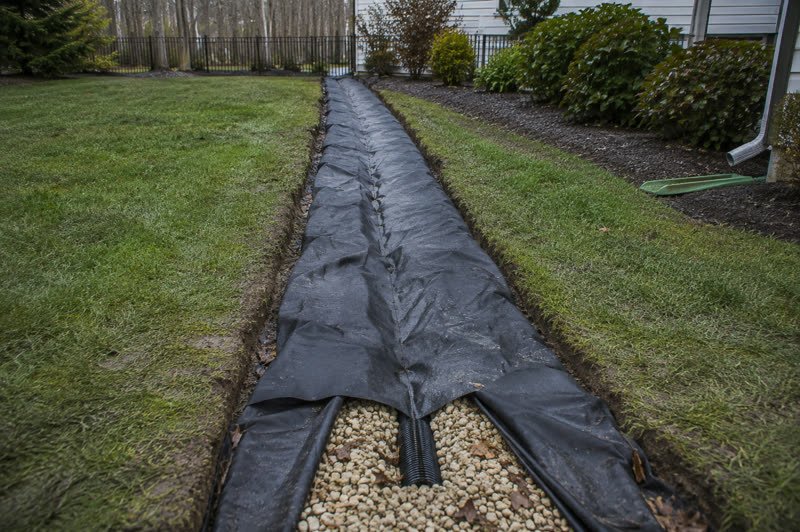
This is the question that separates a real quote from a cheap one, and almost nobody publishes it. A french drain collects water. It does not make it disappear. It has to come out somewhere, and that exit is a line item of its own.
A drainage contractor put it plainly: "Where the water goes matters. A French drain needs an outlet. Sometimes that's a simple pop-up emitter. But in more complex jobs we might need to tie into a dry well, install a sump pump and discharge line, or run 50 to 100 feet of pipe to daylight or a storm drain. The more complex the outlet, the more labor and materials involved."
| Outlet | Cost | Needs |
|---|---|---|
| Daylight to a slope | Near free — the pop-up emitter is a $20 to $40 part | A lower spot on your own land |
| Dry well | $1,200 – $5,200 installed | Soil that will actually absorb |
| Storm sewer tie-in | $275 connection, plus $100–$375 permit; curb cut $400–$500 | Permission, and inspection if you touch the right-of-way |
| Sump pump and pit | $600–$2,500 to an existing system; $1,200–$2,500 for a new pit | Plus $150–$600 for a dedicated GFCI circuit and $50–$250 permit |
The flat-lot problem. Daylighting is free when you have grade. Plenty of lots have no lower spot at all, which rules it out entirely — and then you are buying a pumped exit.
A $2,000 yard drain that needs a $2,500 pumped outlet has not gone slightly over budget. It has doubled. Ask where the water goes before you ask the price per foot.
Is it legal to drain onto your neighbor or into the street?
In Texas, there is a statute, and it is unusually direct. Texas Water Code §11.086:
"No person may divert or impound the natural flow of surface waters in this state, or permit a diversion or impounding by him to continue, in a manner that damages the property of another by the overflow of the water diverted or impounded."
A neighbor whose property is injured "has remedies at law and in equity and may recover damages." Equity includes an injunction — a court order to undo the drainage work you just paid for.
"Surface water" here has a specific meaning: water diffused over the ground from falling rain or melting snow, and it stays surface water until it reaches a bed or channel where water usually flows. Which is exactly what a french drain collects and moves.
A permit does not immunize you. A job can comply fully with local permitting and still expose the owner to civil liability for unlawful diversion. Those are two separate tests and you have to pass both.
Florida takes a different route to a similar place: the reasonable use doctrine, built from case law rather than one clean statute, plus municipal codes that vary by city. The practical guidance is the same in both states — do not design a system whose answer to "where does it go" is "next door."
One more that catches people: discharging into the sanitary sewer is illegal in most jurisdictions. Storm water overwhelms treatment plants during exactly the weather that produces it. If a contractor proposes tying your drain into a sewer cleanout, that is a reason to stop.
What is included per foot, and what is always extra?
The per-foot number conventionally covers the build itself: trenching, filter fabric, gravel, perforated pipe and rough backfill.
A properly built drain goes in as a fabric-lined trench, a gravel envelope around the pipe, then the fabric folded over the top with about a 12-inch overlap, backfilled and graded away from the foundation, with solid pipe carrying water to the outlet and a pop-up emitter if it discharges to lawn.
What is not in that number:
- The outlet — the whole section above. Dry well, sump, or a long run to daylight.
- Restoration. In a contractor's words: "Trenching through sod, mulch, or decorative stone creates a mess. Full sod replacement, new mulch beds, or paver resets add to the cost. On some jobs, restoration can be 15 to 30 percent of the total."
- Spoil hauling — the excavated soil has to go somewhere.
- Permits — see the figures further down.
What makes a quote jump after the site visit?
- Outlet complexity — the single biggest one, and the reason to settle it early.
- Distance to a legal discharge point — 50 to 100 feet of extra pipe is common.
- Depth to the footing on foundation work. This is the $10-a-foot to $90-a-foot jump.
- Hardscape in the trench path — patios, walkways and driveways have to come up and go back.
- Rock and tree roots in the trench line.
- Buried utilities forcing hand-digging instead of machine work.
- Landscaping restoration — that 15 to 30 percent again.
Two real jobs for scale: a 45-foot foundation drain with a pop-up emitter and regrading came to $5,400. A 25-foot drain tied into a downspout came to $3,100.
What does an interior basement system cost?
$4,000 to $17,000 at $40 to $100 per foot, and a crawl space version is $2,000 to $8,000. It is the most expensive version of this job for one reason: the concrete floor around the perimeter has to be broken out, the drain laid, and the slab re-poured.
An interior system always includes a sump pump, and that is not an upsell. The perimeter channel sits below floor level, so collected water has nowhere to go by gravity. It has to be lifted out. If a basement quote does not include a pump, ask why.
Two things worth buying at the same time:
- A battery backup, $600 to $1,200 added to an existing pit. The storms that flood basements are the ones that knock the power out. A mains-only pump is offline for exactly the hour you need it.
- A water-backup endorsement on your insurance, roughly $50 to $150 a year. Without it, a flood claim caused by pump failure is likely to be denied.
Do you need a permit?
If the drain begins and ends on your own property, usually not. If it touches the public right-of-way, a storm system, or involves electrical work, expect one.
| Item | Fee |
|---|---|
| Drainage permit | $100 – $375 |
| Curb cut for a new street outlet | $400 – $500 |
| Storm-drain connection | about $275 |
| Sump installation permit | $50 – $250 where electrical work is involved |
These are typical ranges rather than a named county's schedule. Fees are set locally, so call your city before you budget. Inspection fees apply on top wherever you touch the public right-of-way.
How long does it last, and can it be cleaned?
A well-built french drain is pitched to last 20 years or more. Keeping it there takes very little: inspect every two to three years, flush the pipe from an upstream cleanout with a garden hose to move silt through, and check the pop-up emitter, which collects debris and can seal itself shut without anyone noticing.
Insist on a cleanout at the high end, at install time. It costs almost nothing while the trench is open.
Without one, a fabric-wrapped system that has fully silted up cannot be meaningfully jetted back to life. The fix is re-excavation — you pay for the entire drain a second time.
Questions to ask before you sign
- Which of the five is this? Get the depth in writing, not just the length.
- Where exactly does the water discharge, and is that included in the price?
- If there is no slope, what is your plan — dry well or pump? What does it add?
- Does any of this cross into the right-of-way or a storm system, and who pulls the permit?
- Is there a cleanout at the high end? If not, ask for one.
- What restoration is included — bare soil, seed, or sod?
- What happens to the excavated spoil?
And the one nobody asks: where does this water end up relative to my neighbors? A contractor who has not thought about that has not finished designing your drain.
Where this fits
This page covers one part of a larger job. The service hub explains how the whole thing works, what it costs, and how to hire for it.
Frequently asked questions
How much does a french drain cost per foot?
Between $10 and $100 per linear foot, and the honest answer is that the question is underspecified. A shallow yard drain is $10 to $35. An exterior drain dug to the foundation footing is $30 to $90. An interior basement system is $40 to $100 because the concrete floor has to come up.
Depth is the price. Everything else is detail.
How much does a french drain cost for a basement?
$4,000 to $17,000 for a full interior perimeter system at $40 to $100 per foot, including the sump pump. A crawl space version is cheaper at $2,000 to $8,000.
Interior systems always need a pump. The perimeter channel collects water below floor level, so there is no gravity path out — the water has to be lifted. Add a battery backup for $600 to $1,200, because the storms that flood basements are the same ones that cut the power.
Can I drain water onto my neighbor's property?
No, and in Texas there is a statute with your name on it. Texas Water Code §11.086 says no person may divert or impound the natural flow of surface waters "in a manner that damages the property of another by the overflow of the water diverted or impounded."
The neighbor can recover damages and seek an injunction — a court order making you undo the work. Holding a local permit does not protect you: a job can be fully permitted and still create civil liability.
What is included in the price per foot?
Trenching, filter fabric, gravel, perforated pipe and rough backfill. That is the standard build and it is what a per-foot quote covers.
Nearly always extra: the outlet (dry well, sump, or a long run to daylight), restoration — which can be 15 to 30 percent of the total on a landscaped lot — plus spoil hauling and permits. Ask about all four before you compare two quotes.
What is the difference between a french drain and a curtain drain?
Depth and what they catch. A curtain drain is shallow, handles mainly surface water, and is placed to intercept water before it reaches the house. A french drain is deeper and handles groundwater as well.
The visual tell: a surface french drain shows its gravel at grade. A curtain drain is sodded over and invisible.
How long does a french drain last?
20 years or more when it is built properly and inspected every two to three years. Maintenance is flushing the pipe from an upstream cleanout with a garden hose, and checking the pop-up emitter, which collects debris and can seal itself shut.
Insist on a cleanout at the high end at install time. A fabric-wrapped system that has fully silted up cannot be meaningfully jetted back to life — the fix is re-excavation, which is the whole job again.
Do I need a permit for a french drain?
For a drain that stays entirely on your own land, usually not. The moment you touch the public right-of-way or a storm system, yes.
Typical figures: a drainage permit runs $100 to $375, a curb cut for a new street outlet $400 to $500, a storm-drain connection adds about $275, and sump installations often need a permit at $50 to $250 where electrical work is involved.
Get quotes from local contractors
Tell us about the job and we will pass it to licensed contractors who work in your area. No cost, no obligation.