
The short version
- What it measures
- minutes per inch how long water takes to drop one inch
- Test holes
- 3 or more dug where the drain field will actually go
- Presoak
- 4 – 24 hours 12+ in clay; days in dry clay soil
- Readings
- every 30 min until the rate stops changing
- Realistic duration
- 2 – 3 days the presoak is the reason, not the test
- Sand vs clay
- 10 vs 0.05 in/hr a 200x spread in infiltration rate
A perc test — short for percolation test, and written just as often as "perk test" — measures how fast water soaks into your soil. The result is a number in minutes per inch: how long the water level takes to drop one inch in a presoaked hole. Percolation test, perc test, perk test and percolator test are all the same procedure under different regional shorthand. (And no, it has nothing to do with the unrelated slang meaning, which is a genuine search collision worth clearing up in one line.)
The more useful clarification is a different one. "Perc test" and "soil test" get used interchangeably in the trade, and they are not the same procedure. A perc test times water. A soil evaluation reads the dirt itself from a machine-dug pit. Some states now require both, and a few have dropped the perc test altogether in favor of the soil evaluation.
What does a perc test actually measure?
One thing: the rate at which saturated soil accepts water, in minutes per inch — MPI. A low number means fast soil. A high number means slow soil.
It matters because of where septic treatment actually happens. The tank only separates solids; the real work is done by bacteria in the unsaturated soil beneath your drain field. That soil has to accept your household's daily flow without flooding, and it has to hold the effluent long enough to treat it. The perc rate is how a county decides whether your ground can do both.
Every specific number on this page is representative, not universal. States do not agree on the depth or number of observation holes, the depth of permeable soil required beneath the field, the separation between the water table and the bottom of the field, the size of the percolation hole, or the rate at which water must percolate.
So read what follows as "this is what a perc test involves." Your county sets the actual figures, and they are the only ones that count.
For what a given rate lets you build — and where the pass and fail lines sit — see our perc test cost guide, which also covers who is legally allowed to run one and how long a passing result stays valid.
How is a perc test performed, step by step?
Six steps. Two of them are the ones amateurs skip, and both make bad soil look good.
Step 1 — Dig the holes, where the drain field will actually go
Not where it is convenient to dig. The test has to be taken in the area where the absorption system will be constructed, and typically that means three or more holes distributed across it. Some jurisdictions want six.
| Jurisdiction | Diameter | Depth |
|---|---|---|
| Alabama (420-3-1-.45) | 4 – 8 in | Not less than 12 in, per soil testing depth rules |
| Iowa county practice | 4 – 12 in | About 36 in |
| San Diego County | 12 – 48 in | Minimum 10 ft, or below the proposed dispersal field |
| Typical engineering practice | About 6 in | Varies with the design |
The depth logic is the part worth understanding. Hole depth is not arbitrary — it has to match the anticipated depth of the trench or bed bottom, and account for soil properties below that point and the seasonal high water table. Practice is to excavate to within about 13 inches of the actual test depth.
And one rule that catches people out: where the soil type changes within five feet of the proposed depth, a test is performed in the least permeable layer found. You are tested on your worst stratum, not your average one.
Step 2 — Scratch the sidewalls rough
This is the first skipped step, and it silently ruins results. Digging smears and compacts the hole wall, creating a glazed seal that water cannot cross — so perfectly good soil returns a slow, failing number.
The requirement is written into code: glazed or burnished spots on the walls must be scratched or roughened to provide a natural soil interface for absorption, and all loose material removed. The field technique is unglamorous — nails driven through the end of a 1×2 make a good scratching tool — but it is not optional.
Step 3 — Add gravel to the bottom
About two inches of coarse sand or gravel, to stop the falling water from scouring the hole bottom and disturbing what you are trying to measure.
Note what this does to every measurement that follows: water depth is now measured above the gravel, not above the raw hole bottom.
Step 4 — Presoak, and take it seriously
The second skipped step, and the one that decides whether the whole result is real.
A working drain field is continuously wet. Dry ground is not, and dry ground will drink the first fill of water at a rate it could never sustain. The presoak saturates the surrounding soil so the test measures steady-state behavior instead of a one-time thirst.
| Situation | Presoak |
|---|---|
| General practice | Keep 12 in of water over the bottom for a minimum of 4 hours, preferably overnight |
| Clay soils (Nebraska Extension) | At least 12 hours, so the clay can swell |
| Dry soil over 30% clay | Several days of saturation for an accurate reading |
| Pennsylvania (25 Pa. Code § 73.15) | Two stages — 8 to 24 hours undisturbed at 12 in, then 6 in readjusted every 30 min for 1 hour |
| Sandy soils | None needed — if 12 in drains away twice in under 10 minutes, test immediately |
The clay detail is the one to carry away. Clay does not just drain slowly, it swells as it wets, and a swollen clay percs slower than a dry one. Test dry clay and you measure a soil that will not exist once the system is running.
Step 5 — Run the test
Reset the water to a standardized 6 inches over the bottom, then measure the drop from a fixed reference point outside the hole — a stable platform representing the center of the hole, not a stick jammed in the side.
- Read every 30 minutes, refilling back to 6 inches after each reading.
- Keep going until the rate stops changing. Pennsylvania wants eight readings or a stabilized rate, whichever comes first — with "stabilized" defined as ¼ inch or less difference across four consecutive readings. Alabama allows no more than ⅛ inch variation across three.
- Only the last drop counts. Early readings still contain leftover dry-soil absorption. The stabilized rate is the only real one.
- Measure precisely. San Diego County requires reporting to the nearest 1/16 inch and encourages water level detectors, requiring them beyond 60 inches deep.
Step 6 — Calculate the rate
Divide the time interval by the drop.
Worked example: a ¾ inch drop over 30 minutes is 30 ÷ 0.75 = 40 minutes per inch.
Then combine the holes — and here is the rule that surprises people. You average the final rate from each hole to get the site rate, unless the rates vary by more than 20 MPI. If they do, you do not average at all: the slowest hole governs the design.
One bad hole can therefore dictate the entire system, which is exactly why the number of holes and where they are placed is not a formality.
There is also a floor. Where the drop is too slow to measure at all, Pennsylvania assigns a rate of 240 minutes per inch. That is what "failed" looks like as a number rather than a verdict.
How long does the whole thing really take?
The test itself is one to four hours. The presoak is 4 to 24 hours, and several days in dry clay. So a perc test is a two-day minimum proposition and often three — a fact almost nobody states up front, and one that reshapes a closing timeline.
Add the scheduling. Evaluators in busy rural counties book weeks out in spring, and some counties require the evaluator to be present for the entire presoak, which you are paying for by the hour.
Why does sand perc fast and clay perc slow?
Everyone publishes "sand drains well." The actual mechanism is more interesting, and it contains one fact that reverses most people's intuition.
It is about pore size, not particle size
Particle size is the cause; pore size is the mechanism. Soil texture is classified by particle size — clay smallest, then silt, then sand — and texture controls the size of the gaps between particles. Those gaps are what water actually travels through.
Sandy soils have large pores, so water infiltrates almost immediately. Pour water on beach sand and it vanishes. Clay soils have very small pores, so water tends to pond on the surface before gradually soaking in. USDA NRCS treats soil texture as the single most important inherent factor controlling infiltration.
The counterintuitive part: clay has MORE total pore space
Clay is not slow because it is full. Clay has more total void space than sand does — the small pores are far more numerous, and they add up to more.
It is slow because water is gripped by surface tension inside narrow pores and has to move against that resistance. Sand's big pores do not grip, so gravity wins instantly.
This is worth sitting with, because it reframes what a drain field failure in clay actually is. The soil is not incapable of holding the water. It is incapable of holding it fast enough to keep up with a household's daily flow. In light rain or slow snowmelt clay may hold more water than sand — but it drains between events so slowly that it can stay saturated from one storm to the next.
The numbers, so this is not hand-waving
| Soil | Infiltration rate |
|---|---|
| Coarse sand | Up to about 10 in/hr |
| Gravels and coarse sands | More than 0.8 in/hr |
| Silty clay loams and clays | Less than 0.2 in/hr |
| Clay | As low as 0.05 in/hr |
Basis: general soil-physics ranges plus Cornell's crop-adviser reference for the 0.8 and 0.2 figures. USDA NRCS publishes steady infiltration rates by texture group in its Soil Quality Kit. That is a 200-fold spread from one end to the other, which is why perc rates run from single digits to the 240 MPI ceiling.
Why two neighbors get different results
Texture is not the whole story, and these three modifiers explain most of the "but my neighbor passed" conversations:
- Structure. How particles clump into aggregates matters as much as the particles themselves. Granular and blocky structures break apart and let water through. Massive or platy structures resist it and force ponding.
- Antecedent moisture. Dry soil has cracks and open pores that take water faster; as it wets, infiltration slows to a steady rate governed by the most restrictive layer. This is precisely why the presoak exists — the two sections of this page are describing the same physics from different ends.
- Compaction. Construction traffic over the future drain field destroys structure and can fail a site that would otherwise have passed. Keep machinery off it before the test, not just after.
If you want to know what you are standing on before anyone digs, the USDA soil texture triangle classifies soil by its mix — roughly 40 percent silt, 40 percent sand and 20 percent clay is "loam," the target. County codes defer to it directly: San Diego's rule requires test hole soils to be described using the textural triangle in the USDA Soil Survey Manual, Handbook 18.
How is a deep hole test different from a perc test?
They answer different questions, they are usually done on the same visit, and in a growing number of states the deep hole has replaced the perc test outright.
| Perc test | Deep hole / soil profile | |
|---|---|---|
| Question answered | How fast does water move? | Is there enough clean soil, and how deep? |
| Method | Timed water drop in a small hole | Machine-dug pit, read visually |
| Depth | At the proposed trench depth, often 24 – 36 in | Often 7 to 10 ft, sometimes more |
| Output | A number in minutes per inch | Soil horizons, texture, structure, limiting layer depth |
| Who reads it | Anyone with a stopwatch | A trained soil evaluator |
The deep hole needs a backhoe, an operator and water on site, and utility marking is required before any excavation — 72 hours' notice in most places. What the evaluator is looking for is the seasonal high water table and any rock ledge or impermeable layer that would block absorption.
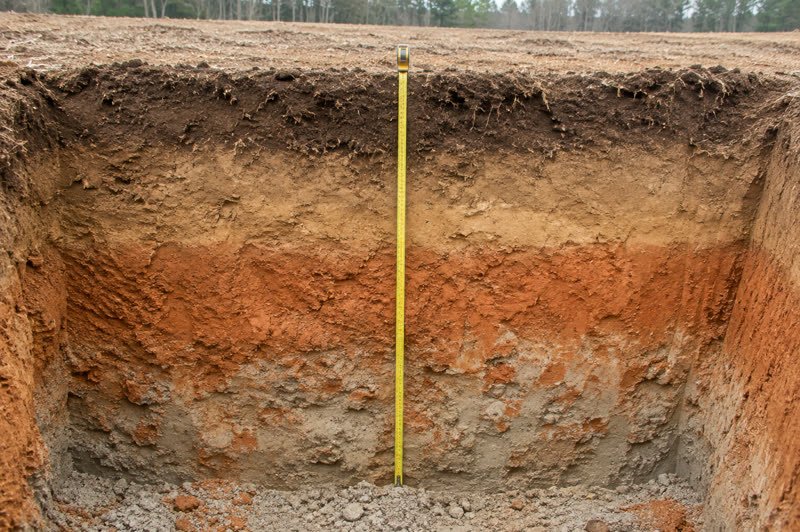
The output that governs the design is the limiting zone: the depth of the shallowest layer unsuitable for treating sewage. The three usual culprits are seasonal high groundwater, glacial till or hardpan, and ledge rock. Everything about the system — how deep, how big, what type — is calculated from that depth.
A safety note this site should make, because it is our trade. An open 10-foot test pit is a genuine hazard. Never climb into one. Evaluators read the profile from the surface or from a shored face, and unshored trench walls collapse without warning. The pit is backfilled as soon as the profile is recorded, for exactly this reason.
How can a soil evaluator read the water table in August?
By reading color. This is the most elegant part of the whole process and almost nobody explains it.
Iron in soil is orange when it has oxygen and gray when it does not. Ground that is well-drained and aerated year-round stays in bright reds, yellows and browns. Ground that stays saturated long enough each year for the iron to be chemically reduced turns gray or bluish — a process called gleying.
Soil that is saturated only part of the year gets both, and the result is mottling: rust-colored splotches mixed through gray. That mottled pattern is a permanent chemical record of where the water table sits in spring, and it is still legible in a dry August.
The depth at which mottling first appears is often the legal limit on how deep your drain field can go.
This is also why the deep hole is the more reliable of the two tests. A perc test run during a drought measures a water table that has dropped, and can hand back a number that flatters the site. North Carolina's regulators made exactly that argument when they moved away from perc testing — in dry spells a perc test may not account for a high water table or expansive clays, both of which decide how the system performs in February.
Does every state still require a perc test?
No, and there are three distinct regimes. Knowing which one you are in is the single most useful thing in this section.
- Both required — the most common. A soil evaluation establishes the limiting zone and a perc test measures the rate. Massachusetts digs at least two deep holes per lot; Vermont requires observation holes seven feet deep.
- Soil evaluation has replaced the perc test. North Carolina now relies on comprehensive soil evaluations. South Carolina does not require a traditional perc test for permits. Michigan's county health departments run open-cut soil test holes, and the state is explicit that the modern soil test is more comprehensive and more telling than the hand-dug perc test it replaced.
- No perc test even as a screen. Some jurisdictions do not require one at all.
One more thing worth knowing before you buy: many states also require a reserve area to be tested. You are often proving out a second, future drain field location as well as the first one — so a lot that passes in one spot can still fail on the reserve requirement.
Can you run your own perc test?
Read this before the method, not after.
- It is not a perc test and it has no permitting value. In most states only a certified inspector, installer, soil evaluator, registered environmental health specialist or licensed professional engineer may legally conduct one.
- It cannot see the two things that most often kill a site — the seasonal high water table and depth to bedrock. Those need a machine-dug pit and someone who can read mottling.
- A good result means "worth paying for the real test." A bad result means "budget for an alternative system, or walk." Neither one is a verdict.
There is a real temptation to flatter your own land here, and it is worth naming. If you game the procedure into a better number than the soil deserves, what you have bought is an undersized drain field that fails, or one that pollutes groundwater in wet weather. The person harmed by an optimistic DIY result is the person who then builds on it.
The stakes are not abstract, and you can price them without needing a horror story. A rate north of 90 minutes per inch takes a conventional field off the table. What replaces it is a mound or an engineered system, and that swap adds roughly $4,000 to $10,000 over a conventional install — before the extra design work and the season you lose waiting on an engineer. You can borrow more money. You cannot borrow better dirt.
The screening method
- Call 811 first. Always, no exceptions, before a shovel touches ground.
- Dig about 12 inches across and 18 to 24 inches deep, roughly where a drain field would go. Hand auger or post-hole digger. Stay well under four feet — deeper hand-dug holes are genuinely dangerous.
- Scratch the sidewalls and clear the loose dirt. Skipping this is the number one way to hand yourself a false failure.
- Add two inches of gravel to protect the bottom from scouring.
- Presoak. Fill to 12 inches over the gravel and keep it topped up at least 4 hours — overnight is better, 12 hours minimum in clay. This is the step every DIY blog post skips, and skipping it is what produces wildly optimistic numbers.
- Run it. Refill to 6 inches. Lay a board flat across the hole as your fixed reference. Record the drop every 30 minutes, refilling each time, for at least four readings and preferably eight.
- Calculate from the last interval only. Time divided by drop.
- Do three holes, not one — and apply the professional rule: if the rates vary by more than 20 MPI, do not average. The slowest one governs.
A hole that fills with water on its own, or will not drain at all, is telling you something clear enough that you do not need the arithmetic.
What your number means — and where the pass and fail lines actually sit — is on the perc test cost guide, along with what your options are if the land fails.
What can you check for free, before you dig anything?
Two things, and they are arguably more useful than the hole.
Pull the USDA Web Soil Survey for the parcel. It will not substitute for a site test, but it gives you the mapped soil series, its texture class and its known limitations before you have spent a dollar. If the survey says the parcel is a heavy clay series with severe limitations for septic absorption, you have learned something important for the price of ten minutes.
Walk the lot after heavy rain in early spring. Standing water tells you where the water table is. So does the vegetation — rushes, sedges and cattails are wetland plants, and volunteer willows are notorious for thriving in wet ground. If the natives growing on the parcel are water-lovers, believe them. They have been running a longer test than you can.
Both of these are screening, not proof. But they cost nothing, they can be done before you make an offer, and they are how you decide which parcels are worth paying to test at all.
The one thing to take away
A perc test looks trivially simple — a hole, some water, a stopwatch — and that simplicity hides how easy it is to get a meaningless answer. Two steps do almost all the damage: not scratching the glazed sidewalls, and not presoaking long enough. Both make bad ground look good.
So the practical order for anyone buying land is: check the soil survey free, walk it wet, then pay for a real test with a contingency in the contract — and expect the result to select your system rather than the other way round. What comes back from the ground decides which of the six septic system types you are allowed to build, and that decision is worth tens of thousands of dollars.
Where this fits
This page covers one part of a larger job. The service hub explains how the whole thing works, what it costs, and how to hire for it.
Sources
Every figure on this page traces back to one of these. Open them and check us — that is what they are here for.
- USDA NRCS — Web Soil Survey Free soil series and percolation data for any US parcel.
- 30 TAC 285.91 — Tables (design criteria) Tables II and III — soil classification and drain field sizing.
- TCEQ — On-Site Sewage Facilities Texas program pages: permitting, licensing and designated agents.
- F.A.C. Rule 62-6.008 — System Size Determinations How Florida sizes a system, including the laundry-waste provisions.
- US EPA — Septic Systems Federal guidance on onsite wastewater treatment.
Links verified August 2026. Tell us at info@landclearingandexcavation.com if one has moved.
Frequently asked questions
What is a perc test and why do I need one?
A perc test measures how quickly water soaks into your soil, expressed in minutes per inch. You need one because a septic drain field does its treatment in the soil — if the ground cannot accept water at the rate your household produces it, the system fails.
On rural land with no municipal sewer, a failed test can mean no house can be built at all. That is why it belongs before you close, not after.
How is a perc test actually done?
Six steps: dig at least three holes where the drain field will go, scratch the glazed sides rough, add a couple of inches of gravel, presoak for 4 to 24 hours, then refill to 6 inches and measure the drop every 30 minutes until the rate stabilizes. The rate is the time interval divided by the drop.
The exact hole size, hole count and timings are set by your county, not nationally — states do not even agree on how deep the holes should be.
Why does the hole have to be presoaked?
Because dry soil drinks the first fill of water misleadingly fast. The presoak saturates the surrounding soil so the test simulates a working drain field, which is continuously wet, rather than ground that has not seen water in weeks.
Skip it and marginal land looks like good land. Clay needs the longest soak — Nebraska Extension calls for at least 12 hours so the soil can swell, and several days where dry soil holds more than 30 percent clay.
What is the difference between a perc test and a soil test?
They answer different questions. A perc test asks how fast water moves, and produces a number. A deep hole or soil profile test asks whether there is enough clean soil and how deep — a machine-dug pit, often 7 to 10 feet, read visually by a trained soil evaluator.
Most states now require both. Some, including North Carolina, have replaced the perc test with a full soil evaluation entirely.
Is there a DIY perc test that tells you anything useful?
Yes, as a screening tool — and no, as anything else. A careful hole in the ground will tell you whether it is worth paying for the real test. It will not produce a result any health department accepts, and in most states you are not legally permitted to run the official one.
It also cannot see the two things that most often kill a site: the seasonal high water table and depth to bedrock. Both need a machine-dug pit and a trained eye.
What is mottling in soil?
Rust-colored splotches mixed with gray — and it is a permanent record of where the water table sits in spring. Iron in soil is orange when it has oxygen and gray when it does not. Ground that is saturated part of the year gets both.
That is why a soil evaluator can read your wet-season water table in a dry August, and why the deep hole test does not much care what the weather did on test day.
Get quotes from local contractors
Tell us about the job and we will pass it to licensed contractors who work in your area. No cost, no obligation.