
The short version
- The code standard
- 6 in. of fall in 10 ft measured away from the foundation wall
- Order of work
- grade first, pipe second the building code says so, not just contractors
- Drainage license
- no such thing it is captured by contractor rules that differ by state
- Texas
- no state license for drainage — but irrigation needs a TCEQ licensed irrigator
- North Carolina
- $30,000 the threshold above which a landscape license is required
- Before any digging
- call 811 TX 2 working days · FL 2 business days · NC 3 working days
Site drainage is the business of deciding where water goes before it decides for itself. Grading, french drains, dry wells, catch basins and sump pumps are the five tools, and picking the wrong one is what makes drainage the trade with the widest gap between a good job and an expensive one.
The gap comes down to one question a homeowner can ask on the first visit: what did you measure before you recommended that?
What does a drainage contractor actually do?
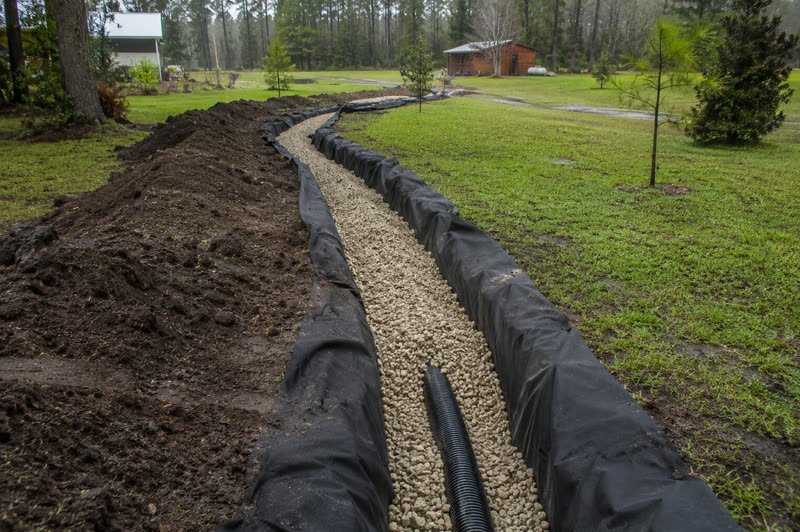
A drainage contractor works out where water is entering your property, where it is collecting, and where it can legally go — then builds the shortest path between those points.
Most of the value is in the first half of that sentence. Installing pipe is a day's work for a competent crew. Deciding which pipe, at what depth, on what slope, discharging where, is the part that determines whether the job still works in five years.
The trade sits next to two others that overlap it. Grading contractors reshape ground. Waterproofing contractors treat the building. A drainage contractor works the ground in order to protect the building, which is why the good ones start by measuring the ground rather than by describing a product.
How much does drainage work cost?
It ranges across roughly a tenfold spread, because "drainage" covers everything from a $40 downspout extension to an interior perimeter system with a pump.
Every figure, including what is in a per-foot price and what is always extra, sits on the french drain cost guide — which also separates the four different jobs that all get quoted as a "french drain," and covers permit fees and outlet costs.
How does a drainage contractor assess a site?
In a fixed order, because each step decides the next. A contractor who skips to step four has guessed at steps one through three. This sequence is the single most useful thing on this page, because it lets you evaluate the assessment rather than the quote.
1. Where is the water coming from?
Not where it is sitting — where it originates. There are only three answers, and they map onto three different solution families:
- Surface grade directing water toward the house or into a low spot instead of away from it.
- Concentrated roof water — downspouts discharging at the foundation, or somewhere with no path to daylight.
- A subsurface condition — clay-heavy soil, a hardpan layer, or a high seasonal water table preventing infiltration.
That framing comes from the drainage firm Joyce|Cline, and it is the cleanest published version we found. Identifying which one drives the problem determines the correct solution. Everything after this step is downstream of getting it right.
Our guide to what a french drain is and what it treats carries the homeowner version of the same test — whether the water appears during rain, after rain, or always.
2. Does the grade meet code at the foundation?
This is the measurement that separates an assessment from a sales visit, and it has a number attached.
IRC section R401.3: "Lots shall be graded to drain surface water away from foundation walls. The grade shall fall a minimum of 6 inches within the first 10 feet."
Impervious surfaces — patios, walks, driveways — within 10 feet of the foundation must slope at least 2 percent away from the building. Older houses frequently fail this on at least one face, and settled soil beside a foundation is one of the commonest ways they get there.
Then read what the code says next, because it is the whole argument of this page: "Where lot lines, walls, slopes or other physical barriers prohibit 6 inches of fall within 10 feet, drains or swales shall be constructed to ensure drainage away from the structure."
Drains are what the code asks for when grading is impossible. They are not an alternative you choose because they sound more thorough. A drain installed on ground still sloping toward the house inherits a load it was never sized for — and correcting the grade afterwards means paying twice.
3. What will the soil actually absorb?
Soil texture and infiltration rate decide whether half the solution set is available to you at all. A dry well needs soil that accepts water. A french drain in tight clay is collecting from a much smaller catchment than the same trench in loam.
This is the same soil science that governs a septic drain field, which is a useful thing to know if you are buying rural land: one soil evaluation answers both questions. Our perc test guide explains how a soil evaluator measures infiltration rate and the seasonal high water table, and what the numbers mean.
4. Where can the water legally go?
Find the outlet before designing anything. This is the step that kills more projects than any other, because every solution except a dry well needs somewhere lower to discharge to — and "lower" has to be legal as well as physical.
If there is no daylight outlet, the solution set changes completely: a dry well or a pumped system, not a gravity drain. And where the water lands matters. Texas puts it in statute — Water Code §11.086 makes diverting surface water onto a neighbor actionable — which is covered in full on the cost guide, alongside street and storm-system connections.
5. What is already in the ground?
Plenty of properties already have drainage that stopped working, and the previous owner never mentioned it. A contractor should trace an existing system from inlet to outlet before proposing to replace it — a camera inspection will show whether a buried outlet line is healthy or crushed.
The failure mode this prevents is expensive and common: a new system built around a hidden blockage that was the actual cause all along.
Two things to have ready before they arrive
Both are free, and both make you a better client than most:
- Film the yard during the next heavy rain. Storm footage shows how water actually behaves on your property, which no dry-day site visit can reproduce. The drainage firm DrainDesigns asks for it specifically.
- Run a garden hose where you think the water goes. It is a crude visualization and it is remarkably good at proving you wrong about the direction of a slope.
Grading, french drain, dry well, catch basin or sump pump?
Trade articles write these up as competitors. They are not — they are components with different jobs, and real systems routinely combine two or three. What actually decides selection is what each one requires to function.
| Solution | What it does | Needs slope? | Needs an outlet? | Soil-dependent? | Needs power? | Maintenance |
|---|---|---|---|---|---|---|
| Grading / regrading | Changes where surface water goes before it collects | Creates it | No | No | No | None |
| French drain | Intercepts subsurface water along a run and conveys it away | Yes | Yes | Partly | No | Flush the cleanout |
| Catch basin + pipe | Captures water at one visible low point, fast | Yes | Yes | No | No | Clear the sump and grate |
| Dry well | Stores collected water and lets the soil absorb it | No | No — that is the point | Completely | No | Silt eventually fills it |
| Sump pump | Lifts water that gravity cannot move | No | Yes, but it can be uphill | No | Yes | Test it; expect to replace it |
Read the table by elimination rather than by preference. No fall available and no daylight outlet rules out three of the five immediately. Dense clay rules out the dry well. No power at the discharge point rules out the pump.
The dry well caveat is worth its own line, because it is the commonest expensive mistake in residential drainage.
A dry well only works if the surrounding soil can absorb water. In sand it is very effective. In dense clay, or where the seasonal water table sits high, it fills faster than it empties and becomes a buried bathtub — a phrase from the drainage trade that describes the outcome exactly. Check the soil before anyone digs the hole.
On the pump, the trade rule is worth repeating because it is right: gravity does not break down. A gravity system keeps working in a power cut and costs nothing to run. A pump is the correct answer when water sits below the outlet elevation — and the wrong answer whenever slope would have done the job.
Note what the table does not separate: swales, curtain drains, french drains and trench drains are four different jobs that all get quoted as a "french drain," and telling them apart is what stops you comparing two incomparable bids. That breakdown is on the cost guide.
How urgent is a drainage problem?
Less urgent than a septic failure, and worth being honest about that. Drainage problems rarely need a call tonight. What they do is progress — and standing water, a wet basement and a cracking foundation are usually the same problem observed at three stages rather than three different problems.
| What you are seeing | What it means | Who to call | Realistic timeline |
|---|---|---|---|
| Standing water in the yard | Surface water with nowhere to go. Kills grass, breeds mosquitoes, and saturates the soil beside the foundation | Drainage contractor | Plan it properly. Does it clear in 24–48 hours, or sit? |
| Damp walls or water in a basement or crawl space | Now a building problem. Damp walls without standing water usually mean moisture migrating through saturated soil; water on the floor is a different job | Drainage and waterproofing | This season — moisture compounds into mold and material damage |
| Cracking, settling, movement | The drainage problem has already caused structural damage. In clay soils the wet-dry expansion cycle drives pressure against foundation walls | Drainage and a structural engineer | Assess both in parallel |
The third row carries the point people least expect: fixing the drainage stops the cause but does not repair the effect. At that stage a drainage contractor is no longer the only professional you need, and any contractor who says otherwise is selling outside their competence.
Is drainage work licensed?
There is no drainage contractor license. Not in any state we checked. Each state folds drainage into whichever general contractor or landscaping rule it already has — and our three launch states answer it three completely different ways.
Texas — no state license for the work itself
Texas issues no state landscaping or drainage contractor license. A residential drainage job is generally governed by local permits rather than a state credential.
One credential does exist, and people confuse it for a drainage one: TCEQ licenses irrigation. A person may not sell, design, install, maintain, alter, repair, service or inspect an irrigation system in Texas unless licensed as a Landscape Irrigator, or working as a registered Irrigation Technician under one. If your job touches sprinklers, that license is a real requirement — the drainage half of the same job is not.
Verify: TCEQ landscape irrigator licensing
Florida — drainage ditches are written out of the contracting chapter
Florida is explicit, and the exemption is easy to miss. F.S. 489.103(10)(a) exempts "any construction or operation incidental to the construction or repair of irrigation and drainage ditches" from the state construction contracting chapter entirely.
That does not make the work unregulated. It moves the regulation to the county and the water management district, where stormwater and discharge rules sit. Ask about the permit, not the license.
Verify: Florida Statutes §489.103, exemptions
North Carolina — a real license, above a real threshold
North Carolina is the strict one of the three. The NC Landscape Contractors' Licensing Board licenses landscape contracting under G.S. Chapter 89D, and the licensed scope covers finish grading, preparation of plots and areas of land, and landscape drainage systems.
The threshold is $30,000 in contracts for labor, material and other items at a given job site in any consecutive 12-month period. Below it, no license is required.
Which means most residential drainage jobs in North Carolina fall under the line — so "are you licensed?" often has a legitimate answer of "not required at this price." Knowing the threshold is what lets you tell that apart from an evasion.
Several groups are exempt regardless of price, including licensed general contractors, professional engineers, landscape architects, and property owners working on their own property. Erosion control is separately exempted.
Verify: NC Landscape Contractors' Licensing Board — licensing and exemptions
The requirement that applies everywhere: call 811
This one is not optional, not waived by scale, and applies to a homeowner with a shovel exactly as it applies to a crew with an excavator. It is also a scheduling fact, because the notice window is a wait:
| State | Notice | Authority |
|---|---|---|
| Texas | 2 working days — 48 hours excluding weekends and holidays, and no earlier than 14 days ahead | Tex. Utilities Code §251.151 |
| Florida | 2 full business days | F.S. Chapter 556 |
| North Carolina | 3 full working days | N.C.G.S. §87-122 |
Basis: state statutes and the state notification centers, read 2026-08-07. Confirm the current window with your own 811 center before scheduling — dial 811, or use Sunshine 811 in Florida and NC811 in North Carolina. Subaqueous work carries much longer windows in both states.
Use it as a competence signal as well as a legal one. A contractor who proposes to dig tomorrow has not filed the ticket.
How to choose a drainage contractor
Because the licensing answer is often "none required," the useful checks are different from the ones that work in a licensed trade. Four things carry the weight:
- Ask what they measured. The fall at the foundation, the soil, the outlet elevation, the existing system. A contractor who quotes without measuring the grade has priced a product, not solved a problem. This is the highest-signal question on the list.
- Ask about the permit, not the license. Grading, excavation and stormwater permits are far more universally required than any license, and they carry lead times.
- Ask for the certificate of insurance — general liability, direct from the insurer, current. Where licensing is absent this is the real backstop, and a serious contractor produces it without a reminder.
- Ask when they filed the 811 ticket. Legally required, universally applicable, and instantly revealing.
One red flag above all the others: a french drain quoted before anyone measured the grade.
Level One Grading describes the outcome plainly — a grading deficiency partially addressed with a french drain, installed without correcting the grade first, is one of the most expensive mistakes property owners make. The building code agrees, and puts grading first for the same reason.
Get written scope on all four points before you compare prices. Two drainage bids for different scopes are not comparable, and drainage is a trade where the difference hides underground.
Frequently asked questions
How much fall should a yard have away from the house?
Six inches within the first ten feet. That is the residential building code standard, not a rule of thumb — IRC section R401.3 requires that lots be graded to drain surface water away from foundation walls, with the grade falling a minimum of 6 inches within the first 10 feet.
Paving counts too. Impervious surfaces within 10 feet of the foundation must slope at least 2 percent away from the building.
A long straightedge and a line level will tell you where you stand in about ten minutes, and it is the single most useful thing to know before any contractor arrives.
Should I regrade or install a french drain?
Check the grade first. The building code takes that position itself.
R401.3 requires the 6-inch fall, and only then adds an exception: where lot lines, walls, slopes or other physical barriers prohibit that fall, drains or swales shall be constructed instead. Drains are what the code asks for when grading is impossible — not an alternative you pick because it sounds more thorough.
A drain installed on ground still sloping toward the house inherits a problem it was never sized for.
Do drainage contractors need a license?
There is no drainage contractor license anywhere we found. Drainage gets caught by whichever general rule applies in your state, and our three launch states answer it three different ways.
Texas has no state landscaping or drainage license at all — though irrigation work does require a TCEQ licensed irrigator. Florida exempts work incidental to constructing or repairing drainage ditches from its contracting chapter. North Carolina requires a landscape contractor license once a job site passes $30,000 in a 12-month period.
So "are you licensed?" is often the wrong question. Ask about the permit, the insurance certificate and the 811 ticket instead.
Does a dry well work in clay soil?
Usually not, and this is the most common expensive mistake in residential drainage.
A dry well stores water and lets the surrounding soil absorb it. In sand that works well. In dense clay, or where the seasonal water table sits high, it fills faster than it can empty and becomes what one drainage firm accurately calls a buried bathtub.
The deciding factor is the same soil science that governs a septic drain field — how fast your soil actually accepts water. A perc test measures it.
Do I need to call 811 before installing a french drain?
Yes, and it is a legal requirement rather than a courtesy — it applies to homeowners doing their own digging as well as to contractors.
The notice window differs by state: Texas two working days (48 hours, excluding weekends and holidays, and no earlier than 14 days ahead) under Utilities Code §251.151 · Florida two full business days under Chapter 556 · North Carolina three full working days under G.S. §87-122.
Build the wait into the schedule. A contractor who plans to dig tomorrow has not called it in.
Can standing water in the yard damage a foundation?
Not immediately, but it is the first stage of a progression rather than a separate problem.
Standing water saturates the soil beside the foundation. In clay soils that soil expands when wet and contracts when dry, and the repeated movement puts pressure against foundation walls. Water in a basement or crawl space is the same problem observed later; cracking and settling is the same problem observed later still.
The useful test at the first stage is simple: does the water clear within 24 to 48 hours of the rain stopping, or does it sit?
Get quotes from local contractors
Tell us about the job and we will pass it to licensed contractors who work in your area. No cost, no obligation.