
The short version
- What it really is
- a void-space highway stone has more open space than soil
- Minimum slope
- 1% — 1/8 in per foot 2% is the working target
- Perforations
- face down though most residential pipe is holed all round
- Fabric
- non-woven geotextile 8 – 12 oz/sq yd in clay soils
- Never use
- crusher run stone dust clogs it from day one
- Cleanouts
- every 20 – 50 ft the only way to inspect or jet it later
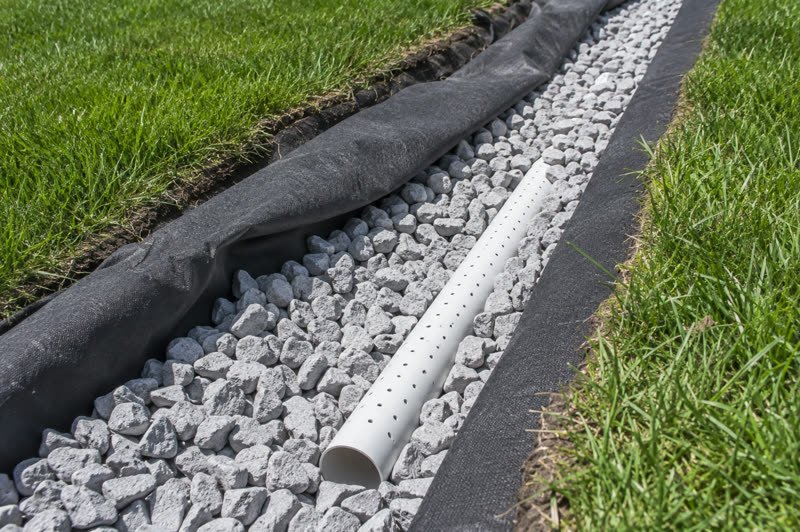
A french drain is a sloped trench filled with clean angular stone, usually with a perforated pipe running along the bottom. Water in the surrounding soil migrates into it, collects, and runs downhill to somewhere you would rather have it.
That is the whole idea, and it is 3,000 years old. What decides whether a particular one works for twenty years or two is a short list of unglamorous details — slope, the type of stone, the type of fabric, and whether anyone left a way to inspect it.
How does a french drain actually work?
Not by sucking water in. Water is not attracted to a drain, and nothing about a trench of rocks pulls on it.
Water moves toward the path of least resistance, and a trench of clean angular stone is a far easier path than compacted soil. That is the entire mechanism. Everything else on this page is a detail hanging off it.
The stone is a highway, not a filter
This is the single most common misunderstanding, and it changes what you buy. The gravel in a french drain is not there to strain dirt out of water. It is there to be empty — to provide open void space that groundwater can travel through with almost no resistance.
Which is why the specification is clean, angular, washed stone, and why the wrong stone destroys the drain before it is even backfilled. More on that in the failure section, because it is the mistake that does the most quiet damage.
So why is there a pipe at all?
Because stone alone eventually silts up.
A gravel-only trench works, and worked for centuries — French's own book was mostly about stone and clay tile. But over time fine soil particles migrate into the voids and the highway closes. A perforated pipe holds open a guaranteed clear channel at the bottom of the trench, doing the job the old clay tiles did: it is the one part of the system that stays open even as the stone above it slowly loads with fines.
Useful way to hold it in your head: the stone collects, the pipe conveys. The stone's job is to give water in the soil an easy way in from all sides. The pipe's job is to move it out fast enough that the trench does not simply become a long, thin pond.
Slope is what turns collection into conveyance
Without fall, all you have built is an underground reservoir. Water will find its way into the stone perfectly well and then sit there.
- Minimum 1 percent — one-eighth of an inch of drop per foot of run.
- 2 percent is the working target — a quarter inch per foot, and the figure most installers design to.
- Over a 50-foot run, 2 percent means the outlet end sits a foot lower than the start. That is not a detail you can fudge on site.
Slope is also the constraint that decides whether the job is simple or expensive, because the trench has to end somewhere lower than it starts. On a lot with fall, that is free. On a flat lot it is the single biggest line item — see the outlet section of our french drain cost guide, which prices each of the four exits.
Should the holes face up or down?
Down. But the honest version of that answer is more interesting than the answer, and it is worth two minutes because this is the internet's favorite drainage argument.
The case for holes down
Water settles at the bottom of the trench, so that is where you want the openings. With perforations facing down, water enters as soon as it reaches the underside of the pipe. With them facing up, the stone envelope has to flood all the way to the top of the pipe before a single drop can get in — which means the drain is not dewatering the soil below that level at all.
That is the real argument, and it is why manufacturers specify it. A secondary one: with the holes down, water enters along a gentler path and is less likely to drag silt in with it.
The case for holes up, which is not nonsense
If groundwater is mounding above the top of the pipe — a genuinely saturated site rather than a damp one — upward-facing perforations let gravity help pull water down out of the soil voids into the pipe. In that specific condition, holes up drains marginally better.
The practical resolution: most residential corrugated pipe is perforated all the way around, so the decision disappears the moment you open the bundle.
Where it does apply, install it holes down. Then stop thinking about it, because slope, clean stone and the right fabric each matter more than orientation by a wide margin.
One field observation worth carrying, from an expert witness who investigates retaining wall failures: perforated pipe turns up installed holes-up in a majority of the walls they open. It is not the reason those walls failed. It is a reasonable proxy for how carefully the rest of the drainage was done.
And a limit that applies whichever way the holes face: once silt fills the pipe to the level of the perforations — roughly half the pipe diameter — it stops taking on water entirely. The drain is then a decorative trench.
Why do french drains fail?
Four mechanisms, and they share a family resemblance: each one makes the trench a harder path than the surrounding soil. Once that happens, water routes around it and the drain is over.
1. Fines migration — the number one killer
Silt and clay particles wash out of the surrounding soil, into the stone, and fill the voids. What was a highway becomes mud. Systems dug up after failure are routinely found clogged solid, and the cause is almost always that nothing was keeping the dirt out.
This is what the geotextile fabric is for — and it is where the second mistake lives.
2. The wrong fabric, which is worse than no fabric
Weed-barrier fabric is not drainage fabric. Some of it is close to impermeable, and a drain wrapped in it cannot take water in at all. The trench fills, the water goes around, and the homeowner concludes french drains do not work.
The correct product is non-woven geotextile, with the opening size matched to the soil it is filtering. Clay soils generate high sediment loads and want a heavier fabric — 8 to 12 ounces per square yard is the usual specification. A double-punched geotextile also does noticeably less to hold roots out, which matters below.
3. The wrong stone, which fails on day one
This one never announces itself, because the drain has never worked properly and so there is no "before" to compare against.
Never use crusher run, dense-graded aggregate, quarry process or anything containing stone dust in a french drain. Those products are designed to compact into a solid mass — that is the whole point of them under a driveway.
In a drainage trench that is exactly wrong. The fines fill the voids immediately, and the drain runs at a fraction of design capacity from the moment it is backfilled.
It is a genuinely easy mistake to make, because "gravel" at a yard covers both products and the compacting one is often cheaper. Ask for washed, angular, single-size stone and confirm it is not a dense-graded blend.
4. Slope errors, in both directions
Too shallow and water stagnates in the trench, which accelerates silting and, in cold climates, gives standing water something to do in February.
Too steep is the less obvious failure: water arrives at the outlet fast enough to erode the discharge point, which undercuts the pipe end and eventually collapses it. A blown-out daylight outlet is a common find on steep lots and it is a slope problem, not a materials problem.
Roots, which find it because it is the best real estate on the property
A working french drain is a permanently moist, well-aerated, loosely packed corridor. There is nothing a root would rather grow into. Over time they enter through the perforations or colonize the stone bed directly, and an inadequate fabric barrier loses its ability to stop them.
Worth siting a new drain with the mature spread of nearby trees in mind, not their current size.
No cleanout, which is what makes all four of the above terminal
Every failure above is at least partly recoverable if you can get a hose or a jetter into the pipe. Without an access point you cannot inspect it, cannot flush it, and cannot even confirm which end has failed.
Cleanouts every 20 to 50 feet, and one at the high end without exception. They cost almost nothing while the trench is open, and they are the difference between a maintenance visit and re-excavating the entire drain.
One more that is not a design fault at all
Routing a downspout straight into a french drain. A roof delivers an enormous volume in a very short time, and the drain — designed for steady seepage — is overwhelmed in the first ten minutes of a storm. Water backs up out of the stone and surfaces.
If roof water has to join the system, it goes through a catch basin ahead of the drain, so the surge is buffered and the debris is caught somewhere you can reach it.
| Cause | What is happening underground | The surface symptom |
|---|---|---|
| Fines migration | Silt has filled the voids in the stone | Gradual return of the original wet spot, over years |
| Wrong fabric | Water cannot enter the trench at all | Never worked — wet ground from the first season |
| Wrong stone | Voids were never open to begin with | Underperformed from day one; often blamed on "too small a drain" |
| Too little slope | Water standing in the pipe | Slow drainage, silt building fastest at the low end |
| Too much slope | Discharge point eroding | Washout, exposed pipe end, sinkhole at the outlet |
| Roots | Pipe and stone bed colonized | Sudden decline near a specific tree |
| Downspout tied in directly | Surge exceeds capacity | Water surfacing over the trench during heavy rain only |
Read the last column first. Almost every one of these is diagnosable from when the wetness appears, without digging anything up.
Which drainage problem do you actually have?
Before you price a drain, work out what is wetting the ground. A french drain is a specific tool for a specific condition, and the most expensive mistake in residential drainage is buying one for a problem it does not solve.
The question that sorts almost every case: does the water appear DURING rain, AFTER rain, or ALWAYS?
- During — surface water. It is running across the ground, not through it. Regrading, a catch basin or a longer downspout run is usually the answer.
- After — subsurface water moving through the soil. This is french drain territory.
- Always — a high water table. Also french drain territory, but the trench has to be set below the wet zone, which usually means a deeper and more expensive job.
| What you are seeing | Where the water is coming from | What treats it |
|---|---|---|
| Seepage at the basement floor-wall joint after rain | Hydrostatic pressure against the foundation | Footing drain — exterior or interior. The job French designed for. |
| Puddles in the lawn lingering a day or more | Surface water with no fall away | Shallow yard drain — but check a regrade first |
| Ground spongy even in dry weather, rushes or moss growing | High water table | A dewatering trench set below the wet zone |
| Water sheeting off a slope or a higher neighboring lot | Flow arriving from uphill | Curtain drain across the slope above the problem |
| Wet ring around the house, worst under downspouts | Roof water | Gutter extensions first. This is often a $40 fix. |
That last row deserves its own sentence, because it is the one people skip. A large share of "I need a french drain" calls are roof water landing four feet from a foundation. Run the downspouts ten feet out, wait for one wet season, and then decide.
The "always wet" row is the one worth investigating before you spend anything. A high water table is a property-wide condition, not a drainage detail — it decides how deep a trench has to go, and on rural land it also decides what kind of septic system you are allowed to build. A soil evaluator can read where yours sits in any month of the year, which is explained in the perc test guide.
For what each of these jobs costs once you have identified it — and they range across a tenfold spread — see the french drain cost guide.
Can you build one yourself?
Part of it, genuinely. And a specific part of it, genuinely not.
Reasonable to do yourself
A shallow yard drain, 18 to 24 inches deep, running away from the house to a daylight outlet on a lot that already has fall. That is mostly shovel work plus discipline about two things: keeping the slope honest with a string line and a level, and buying the right stone.
Call 811 before you dig. Always, no exceptions, no matter how shallow. It is free, it is a phone call, and the alternative is a struck gas or fiber line.
Not reasonable to do yourself
- Anything against a foundation footing. Get it wrong and you have undermined the thing holding your house up.
- Any trench deep enough to stand in. Unshored walls collapse without warning and trench collapse kills people every year. This is not a caution, it is the line.
- Any run with no legal outlet lower than the trench. If you cannot answer "where does the water go" before you start, you do not have a design yet.
- Sump-dependent designs, which bring electrical work and a pump that has to be sized to the inflow.
- Retaining wall drainage. Get it wrong and the wall fails, which is a much larger bill than the drain.
- Anything discharging toward a neighbor. That is a legal exposure rather than a technical one, and in Texas there is a statute attached to it.
The honest split: the digging is DIY-able. The hydraulic judgment usually is not.
Deciding where the trench goes, how deep it needs to be to intercept the water, and where it can legally discharge is the part that decides whether the drain works — and it is the part that takes experience rather than a weekend.
Why is it called a french drain?
Not after France. After a man from New Hampshire, and the story is better than the trivia suggests.
Henry Flagg French (1813–1885) was a lawyer and judge from Chester, New Hampshire, educated at Pinkerton and Pembroke Academies and Harvard Law. He later became Assistant Secretary of the US Treasury and the first president of the Massachusetts Agricultural College — now UMass Amherst.
In 1859 he published Farm Drainage: The Principles, Processes, and Effects of Draining Land with Stones, Wood, Plows, and Open Ditches, and Especially with Tiles, written from The Pines in Exeter, New Hampshire. The full text is on Project Gutenberg, which is unusual and rather nice for a 167-year-old drainage manual.
Two details worth knowing:
- He did not name it after himself, and did not call it a french drain. His own term was a "cellar drain." The name attached to him later.
- He did not invent it either, and said so. His book traces drainage practice back through the Roman Empire to ancient Mesopotamia. What he did was document and popularize the method for American farmers, which is a different and arguably more useful contribution.
His motivation was medical, by the standards of 1859: French believed vapors rising off swampy farmland caused disease, which is what sent him to Britain and the Netherlands to study their drainage before writing the book. The theory was wrong. The engineering was right, and we are still installing it.
And the fact that makes the whole thing stick: his son was Daniel Chester French, who sculpted the seated Lincoln in the Lincoln Memorial. One family, two things everyone in America has encountered and neither of which they associate with the name.
Is a septic drain field the same thing?
They look nearly identical in an open trench — stone, perforated pipe, fabric — and on rural land people mix them up constantly. The structures are cousins. The jobs are opposites.
A drain field is a french drain running in reverse. One is built to take water out of the ground. The other is built to put water into it.
That single sentence gets you most of the way, but two of the build rules actually invert, and this is where confusing them causes real damage:
- Slope inverts. A french drain must have fall — 1 to 2 percent — or it does not convey. A septic leach line is installed level, deliberately, so effluent distributes along the whole trench instead of running to the far end and overloading it.
- Fabric inverts. A french drain is wrapped in geotextile to keep soil out. In a septic lateral you do not put fabric under the stone, because the biological layer that forms there would sit on the fabric and seal the trench bottom — killing the percolation the whole system depends on.
So if you have ever watched a septic crew shoot grades and wondered why they were fussing over a trench that ends up dead level, that is why. If you want the design side of that — how field size is calculated, and what the biological layer is doing — it is in the drain field guide.
The one thing to take away
A french drain is not a machine. It is a preference — you are offering water an easier route than the one it is currently taking, and hoping it accepts.
Every failure mode on this page is the same failure in different clothes: something made the trench a harder path than the surrounding soil. Dust-laden stone, sealed fabric, silt in the voids, no fall to move water out. Get those four right and the drain keeps its offer open for decades.
So before you compare quotes, settle three questions in this order: what is wetting the ground, where can the water legally go, and is there a cleanout in the specification. Then look at the price per foot — which is the last thing that should decide this job, and usually the first thing anyone asks.
Where this fits
This page covers one part of a larger job. The service hub explains how the whole thing works, what it costs, and how to hire for it.
Frequently asked questions
What is a french drain and how does it work?
A french drain is a sloped trench filled with clean angular stone, usually with a perforated pipe at the bottom. It works because water moves toward the path of least resistance, and open stone has far more void space than compacted soil.
Groundwater migrates sideways into the trench, drops to the bottom, enters the pipe and runs downhill to an outlet. The stone collects. The pipe conveys. The slope is what turns one into the other.
What are the downsides of a french drain?
Three real ones. It has a service life and no obvious way to inspect it — everything that matters is buried, so a drain can be silting up for years before anyone notices. Install cleanouts and that problem mostly goes away.
It handles steady seepage well and sudden downpours badly. A french drain is a dewatering device, not a storm sewer. And it has to put the water somewhere — on a flat lot with no lower ground, that becomes the expensive part of the job.
Should french drain holes face up or down?
Down is the correct default, and it is what manufacturers and drainage engineers specify. Holes down means the stone does not have to flood to the top of the pipe before water can get in, so the drain dewaters the soil to a lower level.
There is a genuine counter-argument when groundwater sits above the pipe, and most residential corrugated pipe is perforated all the way around anyway, which makes the question moot. Slope, clean stone and the right fabric matter far more than orientation.
Where does a french drain empty?
Somewhere lower than the trench — and finding that somewhere is the design problem. The four options are daylight on a slope, a dry well, a storm system connection, or a sump pump when the lot is flat and gravity has nothing to work with.
What it must not do is empty onto a neighbor. In Texas that is a statute, not an etiquette question. Our french drain cost guide prices each outlet and covers the law.
When should you use a french drain?
When the water is in the ground rather than running across it. Spongy lawn in dry weather, seepage at the basement floor-wall joint after rain, a hillside feeding water toward the house — those are french drain problems.
Puddles that appear during a downpour and vanish an hour later usually are not. That is surface water, and a catch basin, a regrade or a longer downspout extension often fixes it for a fraction of the money.
Why is it called a french drain?
After a man, not a country. Henry Flagg French (1813–1885) — a New Hampshire lawyer and judge who became Assistant US Treasury Secretary and the first president of what is now UMass Amherst — described the method in his 1859 book Farm Drainage.
He did not invent it and did not name it after himself; he called his own version a "cellar drain," and his book traces drainage back to Rome and Mesopotamia. His son Daniel Chester French sculpted the seated Lincoln at the Lincoln Memorial.
Get quotes from local contractors
Tell us about the job and we will pass it to licensed contractors who work in your area. No cost, no obligation.