
At a glance
- National average
- $1,900 across depths and pump types
- Shallow jet pump
- $800 – $1,800 installed, wells to about 25ft
- Submersible, 100–200ft
- $1,500 – $3,000 the most common job
- Submersible, 300–400ft
- $2,800 – $5,500 labor and pipe outweigh the pump
- Every extra 100ft
- +$500 – $1,000 drop pipe, wire and labor
- Check first
- $25 a pressure switch fixes many "dead pumps"
Well pump replacement costs $800 to $5,500 installed, averaging about $1,900. Depth is what moves it: a shallow jet swap is $800 to $1,800, a submersible at 300 to 400 feet is $2,800 to $5,500.
Before you spend any of that — check the cheap things first. A $25 pressure switch is behind a lot of pumps that get declared dead.
Check these before you buy a pump
This is the most useful section on the page, so it goes first. The symptoms of a failed pump, a failed switch, a failed tank and a wiring fault overlap almost completely. Work up from the cheapest cause and you will sometimes stop at rung two.
| Check | The tell | Cost to fix |
|---|---|---|
| 1. Breaker and wiring | Find the pump breaker, usually 20–30 amp. If it holds and the pump runs, done. If it trips instantly, that is electrical. | Free to check · $300 – $800 to repair |
| 2. Pressure switch | Watch the contacts. A visible spark that starts the pump points straight at the switch. They last 10–15 years. | ~$25 part · $75 – $150 labor |
| 3. Pressure tank | Pulsing water. Press the air valve on top — water instead of air means the bladder is gone. Rapid on-off cycling is the other sign. | From about $200 |
| 4. Control box / check valve | Constant pressure fluctuation and repeated switch clicking suggests a failing check valve. | Control box $400 – $900 |
| 5. The pump | Complete silence, breaker trips on reset, gauge at zero. | $1,500 – $4,500 by depth and type |
| 6. The well itself | Pump runs but delivers little or nothing. Water table, silting or casing. | See the section further down |
It cuts both ways, and an honest technician will say so. A $25 part fixes plenty of "dead pumps" — but replacing only the switch will not help if the real problem is a failing tank, the pump, or a wiring fault.
What you want is someone who proves the diagnosis before selling the expensive fix. Asking "how did you rule out the tank and the switch?" is a completely reasonable question, and the answer tells you a lot.
A diagnostic service call typically runs $250 to $500, and is usually credited against the repair. Worth paying for before you authorize a pump.
| Well depth and pump type | Typical range | Average | Basis |
|---|---|---|---|
| Shallow jet pump, to ~25ft | $800 – $1,800 | — | pump sits above ground; cheapest to swap |
| Deep-well jet, 50–100ft | $500 – $1,400 | — | unit price; above-ground, noisier, less efficient |
| Submersible, 100–200ft | $1,500 – $3,000 | $1,900 | national average across all types |
| Submersible, 300–400ft | $2,800 – $5,500 | — | reaching $4,000–$6,000+ at a true 400ft |
| Each additional 100ft | +$500 – $1,000 | — | drop pipe, wire and crew time |
| Same-day or weekend call-out | +25 – 50% | — | scheduled work costs materially less |
Last updated: · Reviewed by Nisar Dalvi
Why depth costs more than the pump does
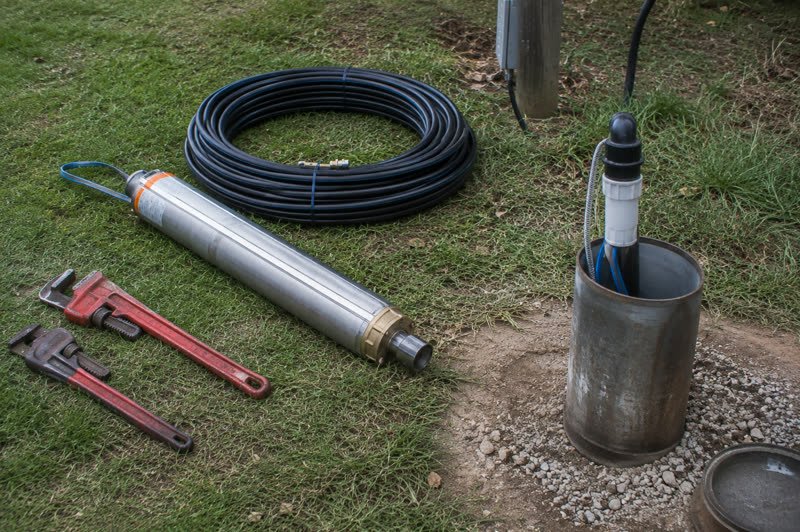
Here is the line item nobody quotes up front: pulling the old pump. On deep wells that is the bill, and the new pump is almost an afterthought.
For wells of 200 feet or more, labor is the largest single component — a service truck, a two-person crew, and four to eight hours of work. Add drop pipe and wiring, and past roughly 250 feet those three together outweigh the cost of the pump unit itself.
| Component | Cost |
|---|---|
| The pump unit | $300 – $1,500 |
| Pulling, drop pipe, wire, reinstall | the balance — comfortably four figures |
| Finished job, 300–400ft | $2,800 – $5,500, reaching $4,000 – $6,000+ at a true 400ft |
The useful rule of thumb: every additional 100 feet adds roughly $500 to $1,000 in pipe, wire and crew time. A 100-foot job costs about half a 400-foot job for the same pump.
This is worth knowing for one practical reason. If the pump is out of the well anyway and it is 12 years old, replacing it while it is on the surface costs a fraction of doing it as a separate job later. The expensive part has already been paid for.
Submersible or jet — what decides which you have?
Depth, almost entirely.
- Jet pumps sit above ground. Shallow-well jets serve wells to about 25 feet at $400 to $1,000; deep-well jets reach 50 to 100 feet at $500 to $1,400. They are noisier and less efficient, but you can walk up to one, which makes service cheap.
- Submersibles sit at the bottom of the well and push water up. They run quieter and more efficiently and serve 200 to 300+ feet, at $1,000 to $2,500 installed for common depths.
The cost gap between the two is not really about the unit price. It is about whether someone has to pull 300 feet of pipe to reach it.
What if the well is the problem, not the pump?
Sometimes the pump is fine and the water isn't there. This ladder also starts cheap, and it is worth walking it in order rather than jumping to the end.
- Lower the pump — a few hundred dollars. If the water table has dropped, a technician can calculate how far down to move the pump and add drop pipe so it reaches deeper water. Always the first thing to ask about.
- Hydrofracturing — $1,500 to $7,000. High-pressure water clears silt and opens fractures in the aquifer, adding 1 to 10 gallons per minute when it works. Success depends heavily on local geology, so ask your driller what it does in your rock, not nationally.
- Deepening — $3,000 to $10,000. Depends on how much depth you add, and it is not guaranteed to find water. The driller has to confirm the existing casing's condition and diameter make it viable at all.
- A new well — $8,000 to $20,000. The answer when the existing well is structurally compromised: failed casing, a bad grout seal, or persistent contamination.
The decision rule worth remembering: deepen if you need only 50 to 100 more feet and the casing is sound. Drill new if you need 150+ feet, have casing problems, or if deepening would cost more than about 60 percent of a new well.
And budget for the epilogue — the old well has to be properly decommissioned under local rules. An abandoned open well is a direct route for surface contamination into the aquifer everyone nearby is drinking from.
How long should a well pump last?
10 to 15 years, against 40 or more for the well itself. Expect to buy two or three pumps over the life of one well.
Three things shorten it, and all three are fixable:
- Short-cycling. A pump switching on and off constantly between narrow pressure bands is cycling itself to death. A pressure tank that failed early is the clearest sign this is happening.
- Sediment. Hard, sand-heavy water wears impellers and seals faster.
- Wrong sizing. An oversized pump on a low-yield well draws the water level down faster than the well recovers, so it runs dry and cycles — the two worst things you can do to a pump, at the same time.
Who is allowed to do the work?
This is licensed work in both states, and the registries are public. Looking a contractor up takes two minutes and is the cheapest protection available.
Texas
Water wells are regulated by the Texas Department of Licensing and Regulation under Occupations Code chapters 1901 and 1902, with rules in 16 TAC chapter 76. A license is required both to drill a water well and to install a pump — pump work is not a lesser category you can hire anyone for.
Licenses carry endorsements by well type, and applicants need at least two years under a licensed driller or installer plus documented installations. Separately, around 181 of Texas's 254 counties also sit inside a Groundwater Conservation District with its own rules, so check locally as well as at state level.
Florida
Florida is unusually clean here. F.S. 373.323 requires every water well contractor to be licensed by their water management district — and that district license is the only water well contractor license required in the state for construction, repair or abandonment. Licensed contractors may also install and repair pumps and tanks.
The program is administered by DEP through the five water management districts, and a permit from the district is required before construction, repair or abandonment. Unlicensed well work is illegal under the same statute, and districts can issue cease-and-desist notices — including to anyone who employs an unlicensed person to do it.
Should the water be tested afterward?
Yes, and in Florida it is close to standard practice. After equipment is installed the well is shock-chlorinated and flushed, then sampled for laboratory testing of coliform bacteria and nitrates. Anything that opens a well casing has introduced whatever was on the equipment.
Shock disinfection is typically a one-to-three-hour job for a licensed technician, longer on older or hard-access wells, and is commonly billed as a service in the low hundreds. A basic bacteria and nitrate lab panel is a modest add-on. Prices vary enough by region that it is worth asking for both as line items rather than assuming.
The Florida Department of Health recommends testing private well water annually regardless. In DEP-delineated contamination areas, the permit applicant bears the cost of sample collection, shipping and analysis.
How to get a quote you can trust
- Ask how they ruled out the switch, the tank and the wiring. The answer tells you whether you are talking to a diagnostician or a salesperson.
- Ask how deep the pump is set. It is the number that drives the price, and they should know it before quoting.
- Ask what is included in the pull — new drop pipe? New wire? A new check valve? Those are the usual add-ons.
- Ask whether the pressure tank is being replaced too. If it is the original and the pump has been short-cycling, it probably should be.
- Ask about disinfection and testing, and whether it is in the price.
- Ask for the license number and look it up — TDLR in Texas, your water management district in Florida.
- Ask if it can wait until a scheduled slot. Same-day and weekend call-outs run 25 to 50 percent more.
That last point deserves an honest note. If you have no water at all, waiting may not be realistic, and nobody should pretend otherwise. But if you have some pressure, or a second source, or a neighbor with a hose — a scheduled appointment is materially cheaper for identical work.
What comes next?
Land preparation runs in a sequence. Getting the order wrong is the most expensive mistake on a raw lot — grading before the septic is sited means paying to move the same dirt twice.
Sources
Every figure on this page traces back to one of these. Open them and check us — that is what they are here for.
- US EPA — Private Drinking Water Wells Federal guidance for private well owners.
- Texas Water Development Board — Water Well Drillers Database Submitted well reports: real depths and yields near a parcel.
- Texas TDLR — Water Well Drillers and Pump Installers Texas licensing program for well drillers.
Links verified August 2026. Tell us at info@landclearingandexcavation.com if one has moved.
Frequently asked questions
How much does it cost to replace a well pump?
$800 to $5,500 installed, averaging about $1,900. A shallow jet pump swap is $800 to $1,800. A submersible at 100 to 200 feet is $1,500 to $3,000. At 300 to 400 feet it is $2,800 to $5,500.
Depth drives it, not the pump. Every extra 100 feet adds roughly $500 to $1,000 in drop pipe, wire and labor.
How do I know if my well pump is bad?
Often it isn't. Work up from the cheap end before anyone quotes you a pump.
Check the breaker first — free. Then the pressure switch, a roughly $25 part. Then the pressure tank: press the air valve on top, and if water comes out instead of air, the bladder has failed. A genuinely dead pump usually means complete silence, a breaker that trips on reset, and a pressure gauge sitting at zero.
Why is replacing a deep well pump so expensive?
Because most of the bill is getting the old one out. On wells past about 200 feet, labor is the largest line item — a service truck, a two-person crew and four to eight hours of work. Past roughly 250 feet, the labor and drop pipe outweigh the pump itself.
To put it in scale: the pump unit might be $300 to $1,500. The finished job at 400 feet is $4,000 to $6,000 or more. The extraction alone is comfortably four figures.
Submersible or jet pump — which do I have?
Depth decides it. Under about 25 feet, a jet pump is standard: it sits above ground, costs $400 to $1,400, and is cheap to swap because you can reach it. Beyond that, a submersible is the norm at $1,000 to $2,500 installed.
Submersibles are quieter and more efficient and serve 200 to 300+ feet. They cost more to service for one reason: they live at the bottom of the well.
How long does a well pump last?
10 to 15 years. The well itself commonly lasts 40 or more, so you should expect to replace a pump two or three times over the life of a well.
What shortens it: short-cycling — a pump switching on and off constantly is cycling itself to death, and a prematurely dead bladder tank is the tell. Also sediment-heavy water, and a pump oversized for a low-yield well, which runs dry and cycles.
What if the problem is the well, not the pump?
Then you climb a different ladder, and it also starts cheap. If the water table has dropped, a technician can lower the pump and add pipe for a few hundred dollars. Hydrofracturing uses high-pressure water to open aquifer fractures at $1,500 to $7,000. Deepening runs $3,000 to $10,000 with no guarantee of water.
A new well is $8,000 to $20,000. Rough rule: deepen if you need 50 to 100 more feet and the casing is sound; drill new if you need 150+ feet, have casing problems, or deepening would cost more than about 60% of a new well.
Do I need a licensed contractor to replace a well pump?
Yes, in both Texas and Florida. In Texas, only a TDLR-licensed Water Well Driller or Pump Installer may install a pump on a private well, under Occupations Code chapters 1901 and 1902.
In Florida, F.S. 373.323 requires a water well contractor license from your water management district, and that license is the only one required statewide for construction, repair or abandonment. A permit from the district is required before the work. Look your contractor up before you hire.
Get quotes from local contractors
Tell us about the job and we will pass it to licensed contractors who work in your area. No cost, no obligation.