
At a glance
- Typical replacement
- $5,000 – $20,000 most people land near $10,000
- National average
- $10,000 – $12,000 SepticTankHub 2026
- Rejuvenation first
- $1,000 – $5,000 try this before you accept a replacement quote
- Labor share
- about 60% averaging roughly $3,600 of the total
- Old field removal
- $500 – $2,000 the line item nobody quotes up front
- Lifespan
- 20 – 30 years the field fails long before the tank does
Drain field replacement costs $5,000 to $20,000, and most people pay about $10,000. Engineered and mound fields run $10,000 to $20,000 and up. Labor is roughly 60 percent of the bill.
Before you accept a replacement quote, get a second opinion on whether the field can be rejuvenated for $1,000 to $5,000. It does not always work — but the company quoting you a new field has no reason to bring it up.
What are the warning signs your drain field is failing?
Six signs, and they usually arrive in roughly this order. The first two are the ones homeowners walk past for months.
- Soggy, spongy ground over the field when it has not rained. The soil has stopped absorbing, so effluent is sitting near the surface. This is the earliest reliable sign and the easiest to dismiss.
- A bright green stripe of grass. Grass directly over the trenches growing faster and greener than the rest of the lawn means it is being fertilized by wastewater that should be lower down.
- Sewage smell outdoors, near the field. A smell indoors is usually a trap or vent problem. A smell over the field is the field.
- Slow drains and gurgling everywhere in the house. One slow sink is a clog. Every fixture draining slowly, with gurgling, means the system has nowhere to push to.
- Backups that start at the lowest drain. The basement floor drain or a ground-floor shower goes first, because sewage backs up to the lowest point.
- Standing water or effluent surfacing. Dark water pooling over the field is the end stage. At this point it is a health hazard, not a maintenance question.
If you are on a private well, add a seventh: a bacteria or nitrate hit on a water test. A failing field near a well is a drinking water problem before it is a plumbing problem.
Seeing one or two of these? Get an inspection before you get quotes. You want the full grade, not the basic visual — $400 to $700, or $500 to $800 for a loaded dye test that pushes the field under real flow. It tells you whether you are looking at a $500 distribution box, a $3,000 rejuvenation, or a $10,000 replacement — and stops you from buying the most expensive answer to the cheapest problem.
| Field type | Typical range | Average | Basis |
|---|---|---|---|
| Conventional gravity | $5,000 – $15,000 | $10,000 | TheSeptic.Guide; SepticTankHub avg $10,000–$12,000 |
| Chamber | $5,000 – $15,000 | — | within the conventional band |
| Engineered / mound | $10,000 – $20,000+ | — | TheSeptic.Guide 2026 |
| Alternative (drip, ATU) | $15,000 – $30,000+ | — | TheSeptic.Guide 2026 |
| Rejuvenation instead | $1,000 – $5,000 | — | jetting, aeration or treatment — not always possible |
| Removing the old field | $500 – $2,000 | — | abandonment permit $100–$250; excavation $1–$5/sq ft |
Last updated: · Reviewed by Nisar Dalvi
What does the old drain field cost you?
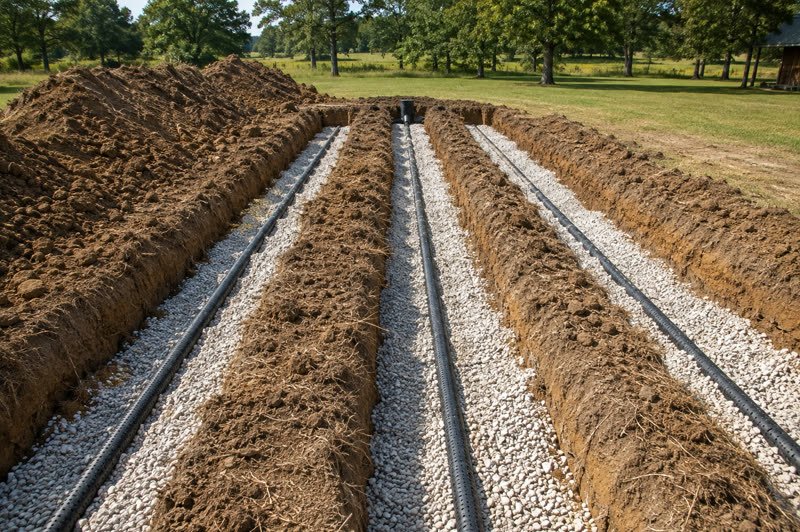
Here is a four-figure line item that appears in almost no published price, and it is the first question worth asking a contractor.
Usually the old field stays in the ground. It is abandoned in place rather than dug out. Some jurisdictions require the old trenches to be covered with hydrated lime to neutralize pathogens and then topsoil; others allow the lines to stay undisturbed. Either way there is an abandonment permit at $100 to $250 and a health department inspection before the new system goes live.
The old field only comes out when the new one needs that same ground. Then you are paying to excavate it — $1 to $5 per square foot — plus $0.40 to $2.00 per square foot to fill and regrade. All in, removing or properly abandoning the old field adds $500 to $2,000 to the project.
| Approach | What happens | Cost |
|---|---|---|
| Abandon in place | Lime and cover, or leave undisturbed; permit and inspection | $100 – $250 permit |
| Excavate and remove | Dig out, haul to a licensed landfill, fill and regrade | $1 – $5 / sq ft, plus $0.40 – $2.00 / sq ft to restore |
Ask which one your quote assumes. Two quotes that look $1,500 apart are sometimes the same job priced with different assumptions about the old field.
Can the new field go where the old one was?
Usually not, and that is by design. Most lots are supposed to have a reserve area — ground kept clear specifically so the field can be rebuilt when it fails.
Florida puts a number on it. Under Chapter 62-6 of the Florida Administrative Code, the minimum unobstructed area must be at least 1.5 times the required drain field absorption area. A 200 square foot drain field therefore needs 300 square feet of unobstructed area, inclusive of the field itself. Unobstructed soil between the trenches counts toward it.
And the clause that catches people out: the permit can be administratively revoked if any part of that required unobstructed area is later covered with impervious material.
Pave over your reserve area for a shed pad, a patio or an extra parking space, and you have not just lost your rebuild room — you have put your permit at risk.
Florida repairs run under 62-6.015, which requires a repair permit on Form DEP 4016 with a site plan showing the existing and proposed drain field repair areas and anything obstructing replacement or relocation.
Texas is honest to report and less tidy. We found no statewide reserve-area mandate in 30 TAC Chapter 285. Where the requirement exists in Texas it is county-level, written into the local OSSF order. Check your county's rules rather than assuming you have rebuild room — and if you are still choosing a lot, ask before you buy.
Do you need a new permit and a new perc test?
A permit, effectively always. A fresh soil evaluation, usually — because the county is approving a new field, and the ground has had twenty or thirty years of effluent since anyone last looked at it.
Budget for it in the quote instead of letting it surprise you: a perc test runs $250 to $600 in Texas and $750 to $1,900 in Florida, and permit fees run $30 to $710 in Texas and $475 to $525 in Florida.
One Florida wrinkle worth knowing: registered septic tank contractors may perform site evaluations for repairs — which a field replacement is — but not for new construction. So on this job, unlike a new build, your septic contractor may be qualified to do the evaluation themselves.
How many days will you be without a working system?
Shorter than you fear, and most people stay in the house.
The construction window is 2 to 5 days for a standard system and 5 to 10 days for an advanced one. During those days the tank still holds waste, and a pump-out at $300 to $700 is required anyway when a new drain field goes in — which resets your holding capacity right when you need it.
So the practical answer is: stay put, and cut water use hard. No laundry, short showers, run the dishwasher at a friend's house. For longer jobs a portable toilet is the usual bridge, though we have not sourced a reliable rental price to publish.
The schedule risk is not the dig. It is the permit queue in front of it — 2 to 6 weeks in Texas, 4 to 12 weeks in Florida. If your field is failing now, start the paperwork now.
Should you replace the tank at the same time?
Ask the question before the excavator leaves, because the answer gets expensive afterward.
Some counties force the issue. Charlotte County, Florida requires that for a repair or replacement permit the tank be pumped by a registered pumper and its capacity and structural integrity verified by the contractor on an Existing System Evaluation form — with the contractor signing a certification that the tank is certifiable. If it cannot be certified, it goes too. That is the mechanism that turns a $10,000 job into a $15,000 one.
The economics favor doing both at once when the tank is questionable. The excavator, crew and permit visit are already on site, and doing it later means paying for a second mobilization on ground you just restored.
Rule of thumb: field failed, and the tank is 20 years old or older — or steel at any age — get it certified or replace it while the ground is open. Steel tanks are the clearest case; rusted baffles are why pre-1980 steel tanks have such a poor reputation.
Can you rejuvenate instead of replacing?
Sometimes, for $1,000 to $5,000 against $10,000 or more. It is the first thing to investigate and the last thing a replacement contractor will raise.
The usual approaches are high-pressure jetting of the lines, soil fracturing or aeration systems that inject air to open compacted soil, and biological or chemical treatments aimed at breaking down the biomat — the clogging layer that forms where effluent meets soil.
What decides whether it works: rejuvenation addresses a clogged biomat when the soil beneath is still sound. It does not fix hydraulic overload, crushed and compacted soil, roots through the lines, or a field that has simply reached the end of a 30-year life.
A straight warning on the numbers. Published success rates for these treatments come from the companies selling them, and we are not going to repeat a vendor's percentage as if it were independent data. Get an inspection from someone who does not sell the treatment, then decide.
What actually causes a drain field to fail?
Almost always something preventable. In rough order of how often it is the culprit:
- Not pumping the tank. Solids overflow into the field and permanently seal the soil. This is the single biggest cause, and it costs $350 to $600 every three to five years to avoid.
- Hydraulic overload. More water than the soil can process — marathon laundry days, a running toilet, a leaking fixture.
- Compaction. Vehicles, trailers, livestock or heavy foot traffic crush the soil structure the field depends on.
- Surface water. Gutters, downspouts and sump pumps discharging near the field flood soil that is already working.
- Roots. Trees and shrubs find the wettest, most nutrient-rich ground on your property and grow straight into it.
- Grease, chemicals and wipes. Grease coats the soil, harsh chemicals kill the bacteria doing the treatment, and wipes never break down regardless of the word "flushable."
How do you make a drain field last longer?
Eight things. The first one is worth more than the other seven combined.
- Pump every 3 to 5 years, $350 to $600. The field that dies at 20 years under a 40-year tank is nearly always the one that was never pumped.
- Keep everything off it. No vehicles, no trailers, no storage. Soil compaction is a top failure cause, and nothing reverses it.
- Redirect gutters, downspouts and sump pumps away from the field.
- Spread water use out. Two loads of laundry a day beats eight on a Saturday.
- No grease, chemicals or wipes, and go easy on the garbage disposal — food waste dramatically increases solids.
- Fix a failing distribution box early, $500 to $1,500. One overloaded section will take the whole field down with it.
- Deal with roots properly — remove the tree or install a barrier, or they come back.
- If you have a dual field, alternate it. A diverter valve costs $150 to $400, and resting one field for 6 to 12 months lets the biomat oxidize and recover.
What will the yard look like afterward?
Rougher than you would like, and the split between what is included and what is not catches people out.
Included: after the health department inspection, the contractor backfills, grades the site, adds topsoil and seeds or sods the disturbed area. That is rough restoration and it is normal.
Billed separately: sod over the field runs $1 to $2 per square foot, tree removal $400 to $1,200, and any real regrading of the yard is its own four-figure project. Plants, beds, fencing and hardscape are yours.
Plan for the field to look like a construction site for a season. And do not landscape over it heavily afterward — you will only be paying to remove it in twenty years.
Does homeowners insurance cover it?
Almost never, and it is better to know that now.
Insurers treat septic components as a maintenance responsibility rather than an insurable risk. Gradual deterioration, deferred maintenance and age-related failure are excluded as wear and tear, and failing drain fields, saturated-soil failures and slow leaks are specifically the kind of thing policies name. A $5,000 to $15,000 bill lands entirely on the homeowner.
The narrow exceptions are real, though. Sudden accidental damage from a covered peril does pay — a delivery truck crushing the field, or a windstorm dropping a tree through the septic lines, are both claims that have been covered. A service line endorsement can cover septic lines for qualifying events. A water backup rider typically pays for interior damage only, not the field itself.
Worth ten minutes with your policy before you assume either way.
How to get a quote you can actually compare
- Does the price include a new soil evaluation and the permit, or are those billed on top?
- Does the old field stay in the ground, or come out? That is a $500 to $2,000 swing.
- Is the tank being certified, and what happens if it fails certification? Get the answer in writing before work starts.
- Where exactly is the new field going, and does that leave any reserve area for next time?
- Is the pump-out included? It is required anyway, at $300 to $700.
- What restoration is included — backfill and seed, or sod?
- Has anyone independently assessed whether this field can be rejuvenated instead?
That last one is the one that occasionally saves someone $9,000. Ask it of somebody who does not stand to sell you a new field either way.
Where this fits
This page covers one part of a larger job. The service hub explains how the whole thing works, what it costs, and how to hire for it.
Sources
Every figure on this page traces back to one of these. Open them and check us — that is what they are here for.
- US EPA — Septic Systems Federal guidance on onsite wastewater treatment.
- 30 TAC 285.91 — Tables (design criteria) Tables II and III — soil classification and drain field sizing.
- F.A.C. Rule 62-6.008 — System Size Determinations How Florida sizes a system, including the laundry-waste provisions.
Links verified August 2026. Tell us at info@landclearingandexcavation.com if one has moved.
Frequently asked questions
How much does it cost to replace a drain field?
$5,000 to $20,000, and most people land around $10,000. HomeGuide puts the range at $3,000 to $15,000; SepticTankHub puts the national average at $10,000 to $12,000. An engineered or mound field runs $10,000 to $20,000 and up.
Labor is roughly 60 percent of the bill, averaging about $3,600. This is an excavation job with some pipe in it, not a parts job.
What are the signs of a failing drain field?
Six, and the first two are the ones people miss: soggy or spongy ground over the field when it has not rained, and a bright green stripe of grass growing faster than the rest of the lawn.
Then: sewage smell outdoors near the field, slow drains and gurgling throughout the house, backups starting at the lowest drain, and standing water or effluent surfacing on the ground. If you also have a well, a bacteria or nitrate hit on a water test is a serious warning.
Can a drain field be repaired instead of replaced?
Sometimes, and it is worth $500 to find out. Jetting, aeration and biological treatment run $1,000 to $5,000 against $10,000 or more for replacement.
It works when the problem is a clogged biomat and the soil underneath is still sound. It does not work when the field is hydraulically overloaded, crushed by compaction, or simply worn out. Be aware that published success rates for these treatments come from the companies selling them, so treat any number you are quoted as marketing until an independent inspection backs it up.
Can the new drain field go in the same place?
Sometimes, but the default answer is no — you build in the reserve area, and the failed field is usually left where it is.
Florida requires the unobstructed area to be at least 1.5 times the required drain field absorption area, so a 200 square foot field needs 300 square feet kept clear. Texas has no statewide reserve rule we could find in Chapter 285 — that one is county by county.
How long will I be without a working septic system?
The dig itself is 2 to 5 days for a standard system and 5 to 10 for an advanced one. Most families stay in the house and cut water use hard — no laundry, short showers — because the tank still holds waste during the work.
The real wait is in front of the dig, not during it. Permits take 2 to 6 weeks in Texas and 4 to 12 in Florida.
Does homeowners insurance cover drain field replacement?
Almost never. Insurers treat septic components as maintenance, not insurable risk, so gradual deterioration, deferred maintenance and age-related failure are excluded as wear and tear. That leaves a $5,000 to $15,000 bill entirely on you.
The exception is sudden accidental damage from a covered peril — a delivery truck crushing the field, or a windstorm dropping a tree through the lines. Both are real paid claims. A service line endorsement may also cover septic lines for qualifying events; a water backup rider usually pays for interior damage only, not the field.
How long does a drain field last?
20 to 30 years under normal use. A concrete tank lasts 40 years or more, which is why a well-maintained tank routinely outlives two fields — and why "my septic failed" almost always means the field.
What shortens it: skipping pump-outs, driving on it, and sending roof or surface water into it. All three are avoidable and all three are common.
Get quotes from local contractors
Tell us about the job and we will pass it to licensed contractors who work in your area. No cost, no obligation.