
At a glance
- National range
- $300 – $1,900 Angi 2026; midpoint around $1,300
- Most people pay
- $1,000 – $1,300 SepticTankHub 2026
- Texas
- $250 – $600 Texas Septic Guide 2026 — the cheapest state we found
- Florida
- $750 – $1,900 averaging about $1,300
- Per extra hole
- $150 – $300 hand-dug; $150 machine-dug, Angi
- Passing rate
- under 30 MPI EPA workable range is 1–60 minutes per inch
A perc test costs $300 to $1,900, and most people pay $1,000 to $1,300. A single hand-dug hole is $150 to $300. Bring in a backhoe and you start around $550. In Texas the whole test typically runs $250 to $600; in Florida, $750 to $1,900.
It is the cheapest test in the entire land-buying process and the only one that can tell you the ground is unbuildable. Pay for it before you close, not after.
| How it is dug | Typical range | Average | Basis |
|---|---|---|---|
| Hand-dug, per hole | $150 – $300 | — | Angi 2026 |
| Hand-dug, whole test | $200 – $1,500 | — | HomeGuide 2026 |
| Machine-dug (backhoe) | from $550 | — | Angi 2026; add about $150 per extra hole |
| Machine-dug, complex | $500 – $3,000+ | — | HomeGuide 2026 — steep, rocky or remote sites |
| Texas, typical | $250 – $600 | $425 | Texas Septic Guide, updated 2026 |
| Florida, typical | $750 – $1,900 | $1,300 | Orlando runs $556 – $1,668 |
Last updated: · Reviewed by Nisar Dalvi
What makes one perc test $300 and another $1,900?
Four things, and only one of them is the evaluator's rate. The rest is how much digging your site demands.
- How many holes the county wants. Some require three, others six or more. Evaluators price per hole, so this alone can triple a bill.
- Hand tools or a machine. A hand-dug hole is $150 to $300. Once the soil is too hard or the holes too deep to dig by hand, a backhoe shows up and the floor jumps to about $550.
- Rock and hard ground. Caliche, limestone and dense clay all slow digging down and sometimes need special equipment.
- Access and travel. A remote parcel with no cleared path costs more to reach, and some counties require the evaluator to sit through the entire 24-hour presoak — which you are paying for by the hour.
Sources: Angi and HomeGuide 2026 national figures; Texas Septic Guide, updated 2026, for the Texas cost drivers.
Why is a perc test cheaper in Texas than in Florida?
Because they are not quite the same job. Texas runs a percolation test as part of a site evaluation and typically prices it at $250 to $600. Florida's process leans on a fuller site evaluation with soil profiling and water-table determination, and lands at $750 to $1,900, averaging around $1,300.
Florida has a seasonal high water table to establish, and that measurement drives the entire system design. It is more work, so it costs more. Orlando specifically runs $556 to $1,668, which is a useful sanity check against any quote you get.
What is the test actually measuring?
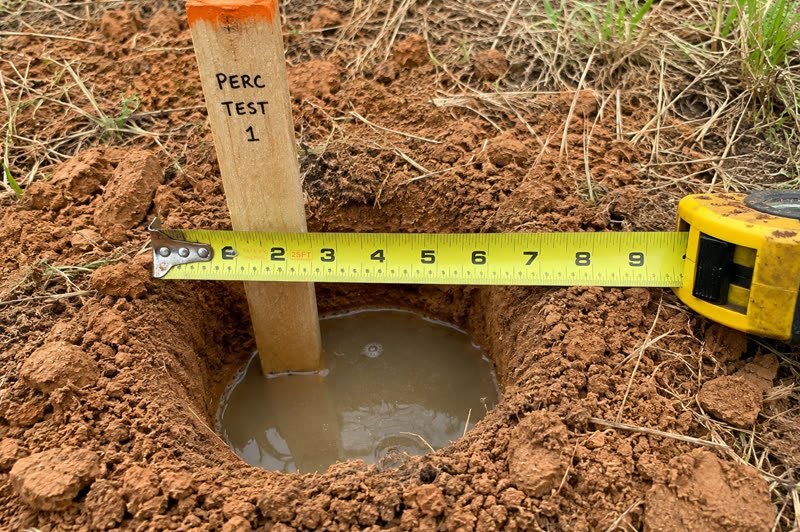
How fast water disappears into your soil, in minutes per inch — MPI. The evaluator digs a hole, presoaks it until the soil saturates, refills it, and times the drop.
| Rate | What it means | What you can build |
|---|---|---|
| Under 1 MPI | Too fast — sand, gravel or fractured rock | Usually fails; effluent reaches groundwater untreated |
| 1 – 30 MPI | The sweet spot | Conventional gravity system |
| 30 – 60 MPI | Slow, but workable | Often pushed to an aerobic or engineered system |
| Over 60 MPI | Too slow — heavy clay | Typically fails; mound or engineered system, if anything |
Basis: the EPA puts the workable range for a conventional system at 1 to 60 minutes per inch. Exact thresholds are set by your county, not by the EPA.
The counterintuitive part is that fast soil fails too. Buyers hear "sandy soil drains well" and assume that is good news. Drain too fast and wastewater slips into the groundwater before the soil has treated it, which is exactly what the rules exist to prevent.
Who is legally allowed to run a perc test?
Not you, and not your builder. Both states name who is qualified, and a result from anyone else is worth nothing at the permit counter.
Texas
A preconstruction site evaluation, including soil analysis and percolation testing, must be done by a TCEQ-licensed Site Evaluator or a Texas Professional Engineer. To hold the site evaluator license at all, a person must already carry one of: Installer II, Designated Representative, Texas PE, Texas Professional Sanitarian, Certified Professional Soil Scientist, or a Texas Professional Geoscientist license in soil science — and then pass the soil analysis exam on top.
Florida
Site evaluations must be performed at the owner's expense by an engineer with soils training licensed under Chapter 471 F.S., a master septic tank contractor, a professional soil scientist registered with the Florida Association of Environmental Soil Scientists, a person certified under s. 381.0101 F.S. (a Certified Environmental Health Professional), or department staff.
One detail worth knowing before you hire anyone: registered septic tank contractors may perform site evaluations for repairs only — not for new construction. If you are building on raw land and a septic contractor offers to do your evaluation, that is the wrong person for this job.
How long does a passing result stay valid?
Longer than people fear in Florida, and less certain than people assume in Texas.
Florida writes it down, statewide. Under Chapter 62-6 of the Florida Administrative Code, a site evaluation must be no earlier than 180 days before the department receives the permit application. Once the permit is issued, the evaluation stays valid for the life of that permit — and the construction permit runs 18 months from the date of issue, plus a further 90 days where building construction has already commenced.
| County | What their office states |
|---|---|
| Santa Rosa | Permit good for 18 months; site evaluation good for 6 months if the permit is not issued |
| Nassau | Permit valid 18 months; the $520 package includes the county site evaluation |
| Pasco | Publishes the Chapter 62-6 standard directly — the same 18-month and 180-day rules |
Sources: Chapter 62-6 F.A.C.; Santa Rosa County DOH application form; Nassau and Pasco county health department pages. Retrieved August 2026.
Texas is looser. We could not find a statewide expiry in 30 TAC Chapter 285. Plenty of sites quote five years, but that reflects county practice rather than a state rule, so we are not going to publish it as one. Call your county's designated representative and ask before you lean on an old result.
One live-rule note most competitors have missed. Florida's septic standards now live in Chapter 62-6 under the Department of Environmental Protection. The old 64E-6 chapter under the Department of Health has been transferred. If a page you are reading still cites 64E-6, it has not been updated.
What are your options when the land fails?
This is the section you came for, and almost nobody writes it. A failed test is not automatically the end — it is a ladder, and you should climb it from the bottom.
1. Retest a different part of the lot — $250 to $600
Start here, because it is cheap and it works more often than people expect. One section of a property can fail while another passes comfortably. Before you pay for anything, pull the county health department file: they may already hold a test on that parcel, and it will tell you where the previous evaluator dug.
Practical move — ask the evaluator to assess alternative-system suitability during the same visit. It saves an entire second trip fee.
2. Replace the bad soil — several thousand dollars
Florida writes this into the rule. Under 62-6.008, moderately or severely limited soil can be excavated and replaced with better material, provided the replacement area is at least two feet wider and longer than the drain trench or absorption bed, and the soil is satisfactory to a minimum depth of 54 inches beneath the bottom of the proposed drain field.
It is also what installers actually do. ACE Septic in Tampa excavates unsuitable soil and brings in septic-quality sand as part of installation. Dillon Septic in Texas puts imported sand and specialized topsoil at several thousand dollars added to the job.
3. Aerobic treatment unit — adds $3,000 to $8,000
An ATU treats wastewater before it reaches the soil, so the soil has less work to do. In Texas that lands you at roughly $9,000 to $15,000 all-in. Budget for the strings attached: aerobic units usually need a maintenance contract at $200 to $400 a year and $10 to $20 a month in electricity.
4. Mound or engineered system — adds $4,000 to $10,000
If the soil cannot be worked with, you build above it. A mound system in Texas runs $15,000 to $25,000 total. This is the rung where the project stops being a line item and starts being a decision about whether to buy the land at all.
5. Holding tank — check first, and be skeptical
A holding tank stores waste for pump-out instead of treating it. Most jurisdictions allow them only as a temporary measure, and the pumping bills are relentless. We could not verify Texas and Florida rules on residential holding tanks well enough to publish a cost, so treat any contractor who leads with this option as someone to question closely.
6. The land will not take a septic system
It happens, and it is brutal. A failed perc test can cut a rural parcel's value by 50 percent or more and make it close to unmarketable for residential development. That is the whole reason the next section matters.
Does a failed perc test follow the land forever?
Effectively, yes — and this is the most expensive thing on this page.
The county health department keeps every perc test and site evaluation on file, and those files are public records. The standard advice to check county records before buying rural land exists precisely because the health department may already hold a test for that parcel, including previous failures. The failure attaches to the ground, not to the seller.
Disclosure law is weaker than most buyers assume. Real-estate attorneys generally tell sellers to disclose a failed test and avoid a contract dispute, but statutory disclosure duties for vacant land are patchy — Washington, for one, exempts unimproved land from the seller disclosure statement entirely. We are not going to state Texas or Florida disclosure law without a legal source, so here is the version that is true everywhere:
The county record is permanent and searchable. Disclosure law may not save you. Pull the file yourself before you close.
It costs nothing, it takes one phone call, and it is the only step in this process that is free.
Never buy land without a perc contingency
A perc contingency makes your obligation to buy conditional on the land passing. If it fails, you walk and your earnest money comes back. This is standard, citable contract language — sample clauses make the buyer's obligations contingent on results showing the property will support a standard septic system and drain field, with the buyer filling the test holes and bearing the cost.
It is not theoretical, and you can price the risk it covers. A rate over about 60 minutes per inch takes a conventional field off the table. What replaces it is a mound or an engineered system, which adds roughly $4,000 to $10,000 over a conventional install — and on a springs-protection or nutrient-reduction site, considerably more. A contingency costs nothing and caps that exposure at the price of the test.
In Texas, the vehicle is the feasibility and termination-option framework in the TREC Unimproved Property Contract. Check the current paragraph numbering against TREC's published form with your agent, because it changes.
Should the buyer or the seller pay?
The buyer, usually, as part of due diligence. The seller cooperates by granting access and having utility lines marked before digging starts. Everything here is negotiable — just get it in writing.
If you are selling rural land, paying for a passing test yourself is often worth it. It removes the single biggest unknown a buyer has, and you can put the result in the listing.
When should you schedule it?
Early — earlier than feels necessary. Two reasons.
First, the result changes what the land is worth to you, so you want it before you are emotionally committed and before your option period runs out. Second, evaluators in busy rural counties book out weeks ahead in spring, and the permit queue behind the test is longer still: two to six weeks in Texas, four to twelve in Florida.
Some counties also require testing during the wet season, when the water table is at its highest, because that is the honest test of the site. If your county does, missing the window can cost you half a year. Ask when you book.
What to ask before you pay
- How many holes does my county require? The answer sets the price.
- Is this hand-dug or machine-dug? The difference is roughly $300 versus $550 to start.
- Does the county require you on site for the full presoak? That is billable time.
- Is the written report and county filing included, or billed separately?
- Can you assess alternative-system suitability on the same visit? Saves a second trip fee if the site is marginal.
- What is your license number? Then look it up. In both states this is a licensed activity.
And the one that matters most: has anyone tested this parcel before? Ask the seller, then ask the county anyway.
Where this fits
This page covers one part of a larger job. The service hub explains how the whole thing works, what it costs, and how to hire for it.
Sources
Every figure on this page traces back to one of these. Open them and check us — that is what they are here for.
- 30 TAC 285.91 — Tables (design criteria) Tables II and III — soil classification and drain field sizing.
- TCEQ — On-Site Sewage Facilities Texas program pages: permitting, licensing and designated agents.
- F.A.C. Rule 62-6.008 — System Size Determinations How Florida sizes a system, including the laundry-waste provisions.
- USDA NRCS — Web Soil Survey Free soil series and percolation data for any US parcel.
- US EPA — Septic Systems Federal guidance on onsite wastewater treatment.
Links verified August 2026. Tell us at info@landclearingandexcavation.com if one has moved.
Frequently asked questions
How much does a perc test cost?
Nationally, $300 to $1,900, with most homeowners paying $1,000 to $1,300. A single hand-dug hole runs $150 to $300. Bringing a backhoe in starts around $550.
Where you are matters more than you would expect. Texas averages $250 to $600. Florida runs $750 to $1,900 for the same test.
What is a good perc rate?
Under 30 minutes per inch generally passes for a conventional system. The EPA puts the workable range at 1 to 60 minutes per inch. Between 30 and 60 you are usually pushed toward an engineered system, and past 60 most counties fail the site outright.
Too fast fails too. Soil that drains in under about a minute per inch — loose sand, gravel, fractured rock — moves effluent into groundwater before it has been treated. Counties reject those sites for the opposite reason.
How long is a perc test good for?
It depends entirely on your county, and the range is wide. In Florida the rule is statewide and precise: under Chapter 62-6, Florida Administrative Code, the site evaluation must be no more than 180 days old when the department receives your permit application, and it then stays valid for the life of that permit — 18 months from issue.
Texas has no equivalent statewide expiry that we could verify in Chapter 285. Five years gets quoted often, but it is county practice rather than state rule. Ask your county before you rely on an old result.
What happens if my land fails a perc test?
You are not necessarily finished. In rough order of cost: retest a different part of the lot ($250 to $600), replace the bad soil where the county allows it, fit an aerobic unit (adds $3,000 to $8,000), or build a mound or engineered system (adds $4,000 to $10,000).
At the bottom of the ladder, some lots genuinely cannot be built on with a septic system. A failed perc test can cut a rural parcel's value by half.
Who pays for the perc test when buying land?
Usually the buyer, as part of due diligence. The seller's job is to grant access and get utility lines marked before anyone digs. All of it is negotiable, as long as it is negotiated in writing.
A seller who already holds a passing result should show it. It genuinely adds value to a rural listing, because it removes the buyer's biggest unknown.
Can I do my own perc test?
You can dig a hole in the yard to satisfy your curiosity. You cannot produce a result any county will accept.
In Texas the evaluation must be done by a TCEQ-licensed Site Evaluator or a Texas Professional Engineer. In Florida it must be an engineer with soils training, a master septic tank contractor, a soil scientist registered with FAESS, a certified environmental health professional, or department staff. A DIY hole tells you whether to be worried. It will not get you a permit.
How long does a perc test take?
The visit is usually a few hours. The waiting is the part people underestimate: the holes have to be presoaked so you are measuring saturated soil rather than dry ground drinking water, and some counties require the evaluator to be present for the full 24-hour presoak. Those counties cost more, for the obvious reason.
Getting on the schedule is the real delay. In spring, evaluators in busy rural counties book weeks out.
Get quotes from local contractors
Tell us about the job and we will pass it to licensed contractors who work in your area. No cost, no obligation.