
At a glance
- Standard pump-out
- $350 – $600 a known, exposed tank on a normal lot
- How often
- every 3 – 5 yrs 1.3 to 5.2 years by household and tank size
- Buried lid
- +$50 – $200 to locate and dig it out, per visit
- Riser fixes that
- $200 – $400 once — pays for itself in 2 to 3 pump-outs
- Disposal alone
- $30 – $200 tipping fees, before the truck starts work
- What it prevents
- $5,000 – $20,000 a failed drain field, the usual result of skipping it
Septic tank pumping costs $350 to $600 for a standard job — a known tank, lid at grade, normal access. Add $50 to $200 if the lid is buried and has to be found and dug out.
Here is the part worth internalizing: this is the service that prevents the expensive one. Not pumping is the single biggest cause of drain field failure, and a new field runs $5,000 to $20,000.
| Job | Typical range | Average | Basis |
|---|---|---|---|
| Standard pump-out | $350 – $600 | $450 | known tank, lid at grade, normal access |
| Locate and dig a lid | +$50 – $200 | — | per visit; a riser at $200–$400 ends it permanently |
| Compacted sludge | up to 2× | — | when pumping is years overdue — extra time or a second trip |
| Long hose run | per foot | — | beyond roughly 100ft from the truck |
| Disposal / tipping fee | $30 – $200 | — | $0.03–$0.15 per gallon at the receiving station |
| Effluent filter cleaning | +$50 – $100 | — | some include it — ask before you book |
Last updated: · Reviewed by Nisar Dalvi
How often does a septic tank actually need pumping?
Every 3 to 5 years is the standard advice, and the EPA's baseline is to inspect every 3 years and pump every 3 to 5. But that single number hides an enormous range.
Penn State's Cooperative Extension publishes the table the industry actually uses. It is calculated to keep a minimum of 24 hours of wastewater retention in the tank, assuming 50 percent digestion of the retained solids — which is the difference between a rule of thumb and an engineering figure.
| Situation | Pump every |
|---|---|
| 6 people, 900-gallon tank | 1.3 years |
| 4 people, 1,000-gallon tank | about 2.6 years |
| 4 people, 1,250-gallon tank | 3.4 years |
| 2 people, 900-gallon tank | 5.2 years |
| Any of the above, with a garbage disposal | roughly 20% sooner |
Sources: Penn State Cooperative Extension (A.R. Jarrett, Professor of Agricultural Engineering), Table I; University of Minnesota Extension for the 1,000-gallon figure; US EPA for the inspect-every-3-years baseline.
The practical read: one person on a 1,500-gallon tank can genuinely go six to eight years. A family of five on a 750-gallon tank needs it every one to two. If you have been told "every three years" without anyone asking how big your tank is or how many people live in the house, you have been given a guess.
Where does the waste actually go?
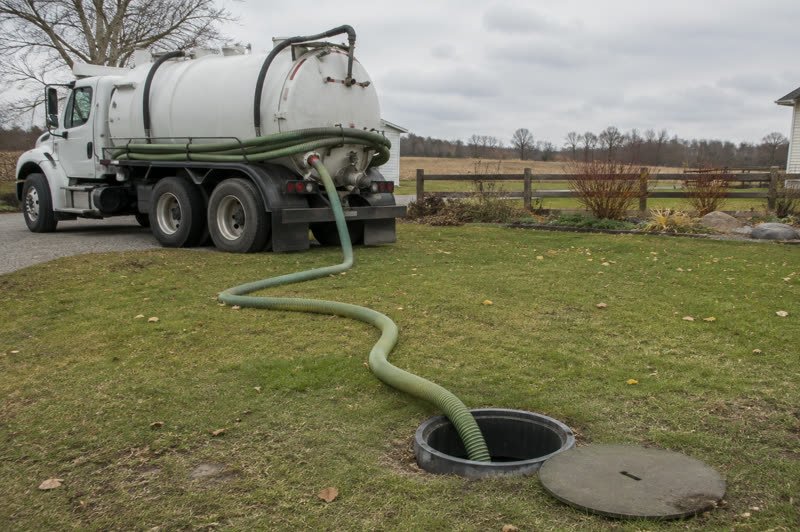
Two legal destinations: a treatment plant, or permitted land application. Nobody writes about this, and it turns out to explain a lot about why quotes differ.
Haulers discharge at designated septage receiving stations at publicly owned treatment works, and they pay tipping fees of roughly $0.03 to $0.15 per gallon. On a 1,000-gallon load that is $30 to $150 of your bill before the truck has done anything. In infrastructure-limited areas it runs $50 to $200 per load.
This is why regional prices look arbitrary. Many smaller treatment plants have stopped accepting septage because it disrupts their processes, so haulers now drive to larger regional plants. That extra distance and fee lands on the homeowner's invoice.
Land application is the traditional alternative, and it is under growing pressure as farmland gets developed. States with stricter environmental rules — California, Washington, Massachusetts — carry the highest disposal fees. In Pennsylvania, companies near expensive disposal facilities pass the cost straight through, which is one reason the southeast of the state runs dearer than rural areas with a nearby transfer station.
If you want to check what your area actually charges, some public utilities publish their septage rates outright — King County, Washington is one.
How do you know you got a real pump-out?
This is the least comfortable section on this page and the most useful. There is a documented practice of charging for a full pump-out and delivering a partial one.
Van Delden Wastewater Systems, in business in the Texas Hill Country for over 85 years, puts the distinction in writing: pumping means removing the liquid and some floating solids. Cleaning means removing all the water and the compacted sludge. Some companies, they say, insert the hose and only suck out the liquids.
The tank design makes it easy to get away with. Tanks built since the late 1980s have two compartments, and the dividing walls are not watertight — so an operator can pump nearly all the liquid out and leave the solids sitting there. Some charge to pump both sides while actually pumping one, on the assumption the homeowner will never know.
It is not a fringe concern. Pumper, the industry's own trade magazine, lists the "no-pump pump job" — claiming to pump while removing nothing, or doing a partial pump-out — among known scams in the trade, alongside fear-tactic tank replacement pitches and cash-only operators who leave no invoice.
What a proper job looks like
- Watch for the tool. A real cleaning uses a long-handled hoe to scrape and stir the bottom sludge into the liquid so the vacuum can lift it. A technician who simply pumps hard is removing effluent while the sludge stays put.
- Both compartments get opened. If the invoice says two, two lids should come off.
- Solids and liquids both leave, and the crew rinses the tank.
- It takes under an hour. A normal cleaning is not a ten-minute job.
- Look in afterwards. A correctly cleaned tank holds only a little liquid and a black bacterial film on the walls. Leave that film alone — it is the working bacteria.
Ask to see inside before they leave. A good operator holds the lid open and shows you the first time you ask.
The buried lid problem — and the fix that pays for itself
If your tank lid is under six inches of lawn, somebody has to find it and dig it up every single time. That is $50 to $200 per visit, and if nobody knows where the tank is at all, many companies bill a separate locate fee for probing or running an electronic locator.
A riser brings the lid permanently up to grade for a one-time $200 to $400. The math is not close:
| Option | Cost over 25 years |
|---|---|
| Keep digging | ~$100 per visit, every 3–4 years — $300 to $1,500 in digging fees alone |
| Fit a riser | $200 – $400 once, then nothing |
Breakeven lands at the second or third pump-out. Everything after that is savings — and it also makes inspections and repairs cheaper for the rest of the system's life.
If a company quotes more than about $150 just to locate a tank on a standard suburban lot, ask them to explain what makes yours difficult.
What is included, and what gets added
The base rate covers a straightforward pump of a known, exposed tank. Here is what legitimately gets added on top:
- Buried or sealed lid — $50 to $150
- Compacted sludge from delayed pumping — extended time or a second trip, which can double the cost
- Long hose runs beyond roughly 100 feet — billed per foot
- Disposal — sometimes itemized separately at $25 to $75 per load
- Effluent filter cleaning — $50 to $100, though some include it
- Basic inspection add-on — $100 to $300
- Same-day or after-hours — $100 to $300
- Additional tanks or compartments — priced per compartment
Watch for the teaser price. A documented pattern in this trade is a $150 to $300 advertised rate that arrives on site and balloons toward $1,200 through "excessive water," "excessive sludge" and digging charges added without asking.
Get the base price, the lid situation and the disposal fee agreed on the phone. Then ask the one question that settles it: what could make this cost more, and will you call me before you do it?
Do additives work?
No. University of Minnesota Extension reviewed them and found no evidence that additives extend pumping intervals. They are not a substitute for pumping.
Several are worse than useless. Additives that break scum and sludge into small particles do not make the solids disappear — they send them into the drain field, which raises the risk of premature failure. You have paid money to accelerate the exact outcome you were trying to avoid.
Washington State legislated on this. In 1993 the legislature found that most additives do not help, and can contaminate groundwater aquifers, render drain fields dysfunctional and cause costly repairs. RCW 70.118 makes it illegal to use, sell or distribute an additive that is not on the Department of Health's approved list.
Worth knowing what approval means there: DOH approval only certifies that a product is not harmful or toxic. It is explicitly not an endorsement that the additive does anything useful.
Pumping is not an inspection
A common and expensive misunderstanding. Emptying the tank tells you almost nothing about the condition of the system.
What pumping covers: the truck empties the tank. A good operator will glance at the baffles while the lid is off — some include a quick visual of baffle and tank condition, others charge for it.
What it does not cover: sludge depth measured and tracked over time, the distribution box, probing the drain field, a hydraulic flow test, or a written report. That is all inspection scope, and it is a different service at a different price.
One habit worth building: ask your pumper to look at the baffles every single time. It takes 30 seconds while the tank is already open, it costs nothing, and a failed outlet baffle is precisely what lets solids escape and destroy a drain field.
What to ask before you book
- What is the base price, and what is your disposal fee? Get both.
- Is the lid at grade? If you do not know, say so and ask what locating costs.
- How many compartments does my tank have, and will you open all of them?
- Do you scrape the sludge, or just pump? The answer tells you a lot.
- Is the effluent filter cleaning included?
- Will you check the baffles while the lid is off?
- What could make this cost more, and will you call me first?
And keep the receipts. Pumping records have real value later — in Massachusetts they extend a Title 5 inspection's validity from two years to three, and anywhere in the country they are your evidence that somebody maintained the system when you come to sell.
Where this fits
This page covers one part of a larger job. The service hub explains how the whole thing works, what it costs, and how to hire for it.
Frequently asked questions
How much does it cost to pump a septic tank?
$350 to $600 for a standard pump-out on a known tank with the lid at grade. The single most common extra is a buried lid, which adds $50 to $200 to find and dig up.
A surprising share of the bill is disposal. Haulers pay $0.03 to $0.15 per gallon at the receiving station, so a 1,000-gallon load carries $30 to $150 in tipping fees before anyone has done any work.
How often should a septic tank be pumped?
Every 3 to 5 years as a rule, but the honest answer depends on your tank size and how many people live there. Penn State's extension table puts six people on a 900-gallon tank at every 1.3 years — and two people on that same tank at every 5.2 years.
A garbage disposal cuts the interval by roughly 20 percent. There is a full table further down this page.
How do I know if they actually pumped my tank properly?
Watch for the tool. A proper job uses a long-handled hoe to scrape and stir the compacted sludge off the bottom so the vacuum can pull it out. A technician who just drops the hose in and pumps is removing liquid while the sludge stays exactly where it was.
Both compartments should be opened. A correctly cleaned tank is left with only a little liquid and a black bacterial film on the walls. The whole job normally takes under an hour.
Do septic tank additives work?
No. University of Minnesota Extension's review found no evidence that additives extend pumping intervals, and they are not a substitute for pumping.
Some are actively harmful: additives that break scum and sludge into small particles send those particles into the drain field, raising the risk of premature failure. Washington State regulates them by law — under RCW 70.118 it is illegal to sell, distribute or use an additive that is not on the Department of Health's approved list.
What happens to the waste after the truck leaves?
One of two legal destinations: a treatment plant, or permitted land application. Haulers discharge at septage receiving stations and pay by the gallon.
This is why prices differ by region for no visible reason. Many smaller treatment plants have stopped accepting septage because it upsets their processes, so haulers drive further to larger regional plants — and that cost lands on your invoice.
Is a pump-out the same as an inspection?
No, and assuming otherwise is expensive. A pump-out empties the tank. A good operator will glance at the baffles while the lid is off, but that is a courtesy, not an inspection.
What it does not cover: sludge measurement tracked over time, the distribution box, probing the drain field, a flow test, or a written report. Ask your pumper to look at the baffles every time — it takes 30 seconds while the tank is open and costs nothing.
What are the signs my septic tank needs pumping?
The cheap warnings first: slow drains across the house, gurgling, and odor near the tank. Act on those and you are still looking at a $400 problem.
Wet spots over the drain field or sewage surfacing are a different category — that is field damage, not a full tank, and it is the $5,000 to $20,000 version. Sludge that overfills a tank flows into the field and clogs it permanently.
Get quotes from local contractors
Tell us about the job and we will pass it to licensed contractors who work in your area. No cost, no obligation.