
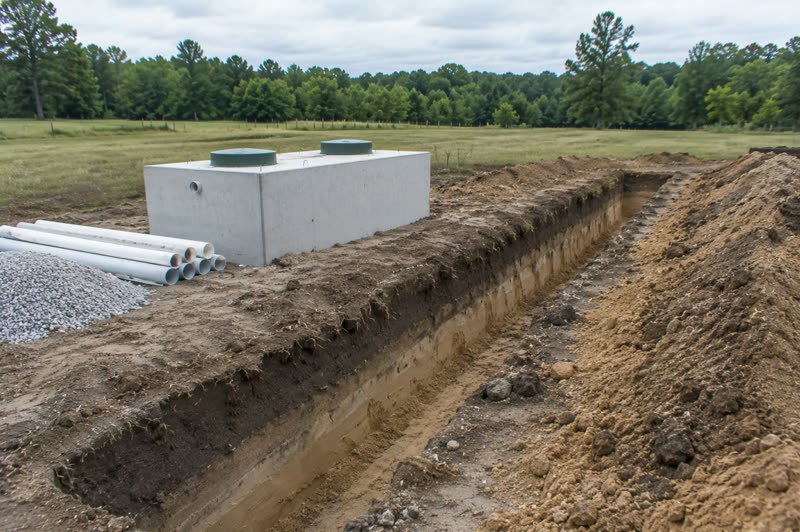
The short version
- Types in common use
- 6 EPA sorts them into conventional and alternative
- Run without power
- 2 of 6 conventional and chamber; the rest need a pump or blower
- ATU aerator lifespan
- 2 – 10 years sources disagree — economy units 2–4, premium 7–10
- Aerator replacement
- $500 – $1,000 The Septic Guide 2026, parts and labor
- Texas, new installs
- 55% aerobic TGPC white paper Jan 2019, citing 2016 data
- Florida, systems live
- 2.6 million FDEP — the vast majority still conventional
Six septic system types cover almost every residential install in America: conventional gravity, chamber, aerobic treatment unit (ATU), mound, drip distribution, and engineered or performance-based. The EPA groups them as conventional and alternative. The practical dividing line is electricity — two of the six run on gravity alone, and the other four have a pump, a blower, or both.
Your soil picks the system, not your budget. If your land passes a perc test with room for a full drain field, conventional is almost always the right answer. Everything else on this page exists because some sites cannot do that.
What are the six main types of septic systems?
All six do the same two jobs in the same order: separate the solids, then treat the liquid. What changes is where the treatment happens and how hard the equipment has to work to get effluent there.
| Type | What makes it different | Needs power? | Chosen when |
|---|---|---|---|
| Conventional | Gravity only; treatment happens in the soil under a gravel trench | No | Deep, well-drained soil and room for a full field |
| Chamber | Open-bottom plastic arches replace the gravel in the trench | No | Same sites as conventional; gravel is costly or hard to haul |
| Aerobic (ATU) | A blower forces air in so aerobic bacteria do the treatment | Yes — 24/7 | Small lots, poor soil, or a sensitive water body nearby |
| Mound | The drain field is built inside imported sand above natural grade | Yes — dosing pump | Shallow water table, bedrock or hardpan close to the surface |
| Drip distribution | Filtered effluent is timed-dosed through shallow emitter tubing | Yes — pump and timer | Thin soil, steep slopes, tight clay, or no room for a mound |
| Engineered | A custom treatment train designed to hit a numeric effluent standard | Usually | A state or county rule sets a pollutant number, not a design |
Basis: the EPA's own taxonomy of septic system types, which lists conventional systems (septic tank, conventional system, chamber system) alongside alternative systems including drip distribution, aerobic treatment units, mound systems, recirculating sand filters, evapotranspiration beds, constructed wetlands and cluster systems.
How does a conventional septic system work?
Everything from the house drains by gravity into a buried watertight tank, and physics does the sorting. Heavy solids settle into a sludge layer on the bottom. Grease and lighter solids float into a scum layer on top. The relatively clear liquid in between — effluent — leaves through an outlet baffle positioned to draw from that middle band.
From there the effluent runs into perforated pipe laid in gravel-filled trenches. The gravel is not treating anything. Its only job is to hold open void space so effluent can spread along the full length of the trench instead of pooling at the first hole it finds.
Treatment happens in the unsaturated soil below the trench. Oxygen-breathing bacteria living in that soil consume the organic load, and the soil itself physically filters what the bacteria leave behind. That is why depth to groundwater matters so much: the treatment zone is the dry soil between your trench and the water table. Too little of it and the system fails at its actual job even while it is draining perfectly well.
No electricity. No moving parts. The whole thing runs on head pressure, which is why it remains the cheapest system to own by a wide margin.
How is a chamber system different from a conventional one?
Same tank, same soil treatment, different trench. Instead of gravel packed around a perforated pipe, the trench holds a row of arched, open-bottom plastic chambers sitting directly on the trench floor.
Effluent runs down the inside of each arch and contacts native soil across the chamber's entire footprint, because nothing is occupying that space. Three practical consequences follow: no gravel to truck in and place, far more open storage volume per linear foot to absorb a surge — four loads of laundry on a Saturday morning — and no gravel fines migrating down to clog the infiltrative surface.
Worth stating plainly, because sales copy sometimes will not: a chamber system is a media substitution, not a treatment upgrade. It treats wastewater exactly as well as gravel does, no better. You choose it for install logistics and surge capacity.
How does an aerobic treatment unit (ATU) work?
An ATU adds an active treatment step ahead of the soil. A compressor or diffuser injects air into the treatment chamber, feeding aerobic bacteria — organisms that work faster and more thoroughly than the anaerobic bacteria inside a sealed conventional tank.
A typical residential unit runs three stages:
- Trash or pretreatment compartment. Heavy solids drop out, exactly as they would in a conventional tank.
- Aeration chamber. A motor-driven blower bubbles air through the liquid, 24 hours a day.
- Clarifier. The biological floc settles out and returns to the aeration chamber.
Many units add a disinfection stage after that, using chlorine tablets or UV. Industry comparisons put ATU contaminant removal at roughly 85 to 98 percent against 60 to 80 percent for a conventional tank and field. Those are directional numbers from commercial sources rather than lab results — but the direction is not in dispute, and it is the entire reason the system exists.
Because the effluent arrives cleaner, the soil has less work to do, so the dispersal field can be smaller or shallower. On a half-acre lot that is the difference between building and not building.
The trade-off is that you have bought a small electrically powered treatment plant. It stops treating the moment the power stops. Aerobic bacteria are also more sensitive than anaerobic ones — to temperature extremes, to bleach and antibacterial products going down the drain, and to an extended outage that shuts the blower off long enough to kill the colony.
How does a mound system work?
A mound is the answer when there is not enough clean soil below grade, so you build the soil above it. Sand fill goes on top of the natural surface and the drain field is constructed inside that fill. Effluent now has to travel uphill, so a mound always has a pump.
- The septic tank separates solids as normal.
- A separate pump or dosing chamber collects the effluent.
- The pump pushes a measured dose up through small-diameter pressurized laterals.
- Effluent leaves through drilled orifices into a gravel bed near the top of the mound.
- It trickles down through one to two feet of engineered sand — that sand is the treatment zone.
- It enters the plowed native soil surface at the base and spreads sideways.
The dosing is the part people miss. Continuous trickle would channel through one spot and run straight past the sand's treatment capacity. Measured doses wet the whole bed evenly, which is the only way the sand does its job at all.
One thing Purdue Extension says out loud that installers rarely do: mounds demand more care in site selection, design and construction than conventional systems — partly because the site is marginal to begin with, and partly because contractors tend to have less experience building them. That is a real part of why mound quotes vary so widely on identical-looking lots.
How does drip distribution work?
Drip distribution is subsurface irrigation with effluent instead of water, and it is the shallowest system on this list. Filtered effluent is pumped through a network of small flexible tubing fitted with pressure-compensating emitters, buried at least six inches below finished grade.
Dosing runs on a timer rather than on demand, so the field receives many small applications spread through the day instead of one slug after the morning showers. That alone is what lets it work on soil a gravity system would flood.
The tubing is usually around half an inch across, which creates the system's defining requirement: it must have a filter unit — sand, screen or disk — or the lines clog. Systems also flush themselves periodically, reversing flow back to the tank to scour biofilm out of the emitters.
Shallow placement is the feature, not a compromise. Six to twelve inches down is the most biologically active, best-aerated layer of soil on the property. That is precisely why drip works on sites where a deeper system physically cannot.
What is an engineered or performance-based system?
Engineered is a regulatory category, not a piece of hardware. A licensed engineer designs a site-specific treatment train to hit a numeric effluent standard, instead of matching a prescriptive table in the code.
In practice that train is often an ATU or media filter, plus a pump, plus timed dispersal, and sometimes nitrogen-reducing media on top of all of it.
Florida is the clearest example. The state's environmental agency groups "advanced" onsite systems into aerobic treatment units, which add air to improve treatment, and performance-based treatment systems, which engineers design to target specific pollutant levels — generally required by state rule or local ordinance to protect receiving waters.
The numbers show why a state bothers. Conventional septic tank effluent runs around 40 to 50 mg/L total nitrogen. A performance-based system using enhanced aerobic treatment, a recirculating sand filter or nitrogen-reducing media can land nearer 10 to 12 mg/L.
The permit is written to a number, and the system gets monitored against that number for as long as you own the house.
Which septic system does your site actually force you into?
One question comes first, and nothing else matters until it is answered: does your property pass a perc test with room for a conventional drain field?
If yes, build conventional. It is simpler, cheaper, and has less to fail. Everything below is what happens when the answer is no.
Start with the soil test — what a perc test is and how it works, and what one costs. Every branch below follows from that result.
A mound answers a depth problem
Mounds solve vertical failure: there is not enough clean soil between the bottom of a trench and something you cannot put effluent into. The triggers:
- A seasonal high water table rising to within roughly 18 to 24 inches of the surface during wet months.
- A limiting layer close to the surface — bedrock, hardpan or fragipan within about 18 to 24 inches, leaving nowhere to bury distribution pipe.
- Dense clay that percolates too slowly to accept the daily load.
- Soil that drains too fast. The counterintuitive one. Coarse sand and gravel move effluent through before treatment finishes, and a mound fixes that the same way it fixes clay — by supplying engineered sand whose behavior is known.
Exact thresholds are set by your state and county, not nationally. The 18-to-24-inch figures above are the common range across published state guidance, not a federal rule.
Drip answers a space and shape problem
Kansas's state health department publishes the clearest breakdown of when drip beats the alternatives, and each case is a genuinely different constraint:
- High water table. Drip can be installed as shallow as eight inches, or laid on the surface and covered with eight inches of topsoil, which manufactures the vertical separation the site does not have.
- Rocky terrain. Shallow installation keeps the system above rock a trencher could not get through.
- Steep slopes. Because the field is dosed precisely by time and area, slope does not cause the problem it would in a gravity system. The field is lengthened along the contour, or line spacing widened, to stop water stacking downhill.
- Tight soils. The emitter application rate is reduced and the field enlarged to match. Uniform small doses stop any one area being over-wetted, and timed dosing prevents hydraulic overload during the morning and evening peaks.
There is also a neat detail for wooded lots: one brand of drip tubing has herbicide impregnated into the plastic, which lets it be installed near trees without the root intrusion that would destroy a conventional field.
An ATU answers a square-footage problem
This is the cleanest way to hold the three apart: a mound answers "not enough depth." Drip answers "not enough room in the right shape." An ATU answers "not enough area."
Because an ATU cleans the water before it reaches the ground, the soil loading requirement drops and the dispersal field shrinks. ATUs also come up where a lot sits close to a sensitive water body, regardless of how good the soil is.
Texas is the archetype. New rural homes on half-acre and one-acre parcels frequently lack the space a traditional drain field needs, so an aerobic unit treats the wastewater more thoroughly and distributes it through spray irrigation instead.
Engineered answers a map problem
A line on a regulatory map triggers engineered systems, not your dirt. Florida's HB 1379 (2023) reaches all but ten counties, requiring enhanced nutrient-reducing systems in place of conventional septic where water quality standards are regulated or are not being met — Basin Management Action Plan areas, Impaired Spring Priority Focus Areas, and Alternative Restoration Plan areas.
So on a Florida lot the first question is not "what is my soil." It is "am I inside a BMAP boundary." You can pass a perfect perc test and still be required to install a system four times the price.
Mound or drip? The comparison nobody writes
Both solve poor soil. They solve it in opposite directions, and the differences are practical rather than technical.
A mound needs substantial space, a significant volume of imported engineered fill, and a pump that requires regular servicing. It is also visually prominent — a raised landform in your yard that has to be vegetated and mowed for the life of the system.
Drip solves the same problem without building anything upward. It distributes effluent slowly and evenly through small tubes six to twelve inches down, with a pump delivering timed doses small enough that even slow clay absorbs each one before the next arrives. That makes it the usual answer on properties with limited space, awkward topography, or where a large mound would be impractical or simply unwanted.
What does an aerobic system actually cost to run?
The blower motor is the part nobody budgets for. It runs 24 hours a day, 365 days a year, and it is the most frequently replaced mechanical component in an aerobic system.
How long it lasts depends on who you ask, and the disagreement is worth showing rather than averaging into a single tidy number:
| Source | Stated lifespan |
|---|---|
| Supeck Septic Services | 3 to 5 years in a well-maintained system; 7+ with proper care |
| The Septic Guide | 2 to 10 years — economy aerators 2 to 4, higher-quality units 7 to 10 |
| Septic Solutions (linear pumps) | Diaphragms wear out at 3 to 6 years and can be rebuilt; quality units 8 to 12 years |
The honest read across all three: treat the aerator as a recurring purchase, budget nearer the low end if yours was the cheapest option on the quote, and ask whether a rebuild kit exists for your model before you replace the whole unit. On linear and rotary-vane pumps a kit often doubles the operating life for a fraction of the replacement price.
| Source | Cost |
|---|---|
| The Septic Guide | $500 – $1,000 for most residential units, parts and labor |
| SepticTankHub | $200 – $600, expected every 3 to 5 years |
| Scorpion Septic | $500 – $2,000 by brand, size and type, plus $150 – $500 labor |
The mistake that voids warranties. ATU manufacturers use proprietary aerator designs. Fitting a generic replacement into a Norweco, Jet or Clearstream unit can void the warranty, may not seat correctly, and can put the system out of compliance at its next inspection.
Cheaper part, more expensive outcome. Match the model.
The full component schedule
| Component | Typical cost | Replace roughly every |
|---|---|---|
| Aerator / blower | $500 – $1,000 | 2 – 10 years |
| Effluent pump | $500 – $1,300 | 7 – 15 years |
| Control panel | $300 – $500 | 10 – 15 years |
| Chlorinator | $100 – $300 | 2 – 3 years |
| Pump-out | $300 – $600 | 3 – 5 years |
Sources: The Septic Guide and SepticTankHub, 2026 figures. These are national commercial estimates, not quotes — a rural service call adds travel that none of them include.
Stack the schedule up and one industry estimate puts total maintenance across a 20-year system life at $8,000 to $15,000 on top of the install. Set that against the "$200 to $400 a year" most sites quote: twenty years at $400 is $8,000, so the low end holds up — but the top of that range is nearly double what buyers are being told to expect. Plan for the middle, not the brochure.
A free diagnostic you can run today. A working aerator hums continuously, roughly like a refrigerator compressor. If your aerobic system has gone silent, it is not treating anything.
Silence is the alarm.
For what each of these six types costs to install — conventional through engineered, with the basis stated for every figure — see our septic system cost guide.
What maintenance does each type need beyond pumping?
Every system here shares one baseline: a pump-out every three to five years, and the effluent filter cleaned every six to twelve months where one is fitted.
The rule that actually separates the categories is simpler than any brochure makes it. If the system has a pump, aerator, float switch or alarm, it needs a professional inspection every year — not every three. The EPA's guidance says the same thing: alternative systems with electrical float switches, pumps or mechanical components need inspecting more often, and annual inspection is frequently written into the operating permit as a condition of keeping it.
| Type | What else needs doing | How often |
|---|---|---|
| Conventional | Drain field inspection | Every 5 – 10 years |
| Chamber | Chamber inspection | Every 5 years |
| Mound | Pump, floats and control panel checked; conduit checked for corrosion; alarm push-to-test used; mound surface checked for erosion and mowed | Annually |
| Drip | Filters, air release valves, drip lines and dose timing verified | Every 6 months |
| Aerobic (ATU) | Full service inspection — aerator, effluent quality, chlorine tablets, alarm | Every 4 months in Texas; quarterly to annually elsewhere |
| Engineered | Whatever the permit specifies — it is a legal condition of operation | Per permit |
The mound failure that starts inside the septic tank
Humboldt County's homeowner guidance is blunt about the cascade, and it is worth reading in order. If the septic tank is not pumped on schedule, solids escape into the pump chamber. From there they clog the pump, clog the distribution pipes in the mound bed, or accelerate biomat formation in the sand. Any one of those is expensive; the last one can be terminal.
The same guidance sets the annual routine: check the pump, floats and electrical components, replace or repair worn parts to the manufacturer's instructions, look for corrosion in the conduit, and use the alarm panel's push-to-test button if it has one.
When the effluent pump does fail, the high-water alarm sounds and the pump tank keeps filling from the house. Cut water use immediately — Montana's environmental agency suggests skipping baths, showers and laundry, because the reserve storage in the pump chamber is exactly what buys you time to get it fixed. Before you call anyone, check for a tripped breaker or blown fuse; the pump should be on its own circuit.
Ignore the alarm and the tank overflows, which puts effluent on the surface of your yard. That is a health hazard and a code violation, and it costs considerably more to resolve than the pump that started it.
Drip is a six-month system, not a twelve-month one
Missouri writes the interval into state rule, which makes it the cleanest citation available anywhere. Drip dispersal systems must be inspected at least every six months, and that inspection has to confirm:
- the pretreatment components are operating properly
- the pump and controls function according to design
- air release and vacuum relief valves at the system's high points work
- effluent screens or disc filters are in good condition and not clogged
- the drip lines show no visible damage
- no ponding or saturation appears along the supply or return lines, and lines drain freely after each dose
Kansas arrives at the same interval from a different direction: its health department strongly recommends the whole system be cleaned and checked by a licensed service company every six months, with filters — including the tank effluent filter — checked and cleaned as needed in between.
One nuance, so nobody oversells the burden. Modern drip control panels flush themselves. The pump backflushes the disc filters automatically before dosing the lead zone, and each zone receives a field flush weekly without anyone touching it. The six-month visit is verification, not manual labor.
What it catches is the thing you would never notice: dose and flush timing drifting away from the numbers recorded at startup, which points to a buried check valve needing service. Left alone, that can leave a zone running at double its designed loading — and a zone hydraulically overloaded for long enough may not be repairable.
In Texas, an aerobic service contract is the law
Under 30 TAC Chapter 285, the owner of an aerobic treatment system serving a single-family residence must obtain a maintenance contract within 30 days of installation, or maintain the system personally. The licensed provider tests the system as required by §285.91(4) and files a report with both the permitting authority and the owner at least once every four months — three times a year.
There is one detail almost nobody publishes, and it is worth money: systems with electronic monitoring installed can drop the reporting requirement to once every six months. If you are choosing between two units in Texas, ask which one supports monitoring, because it changes your service bill for the life of the system.
Basis: 30 TAC Chapter 285 and §285.91(4), Texas Commission on Environmental Quality. Verified August 2026. County requirements can be stricter than the state floor — confirm with your county's designated representative.
That obligation attaches to the house, not to the installer, and it is the single biggest reason an aerobic system costs more to own than its install price suggests.
Which septic system is most common in Texas and Florida?
Both states are moving toward advanced systems, for opposite reasons. In Texas the driver is soil. In Florida it is nitrogen rules.
Texas: aerobic is now the majority of new installs
The Texas Groundwater Protection Committee's white paper on on-site sewage facilities puts it plainly. Aerobic systems accounted for less than 10 percent of new installations before 1995, and 55 percent of them by 2016. The state issues roughly 20,000 to 30,000 new OSSF permits a year.
Basis: TGPC Groundwater Issues Subcommittee OSSF white paper, dated 16 January 2019, citing 2016 installation data. That remains the most recent statewide breakdown we could verify — practitioner accounts say the trend has continued since.
The reason is mappable. The Blackland Prairie running from Dallas down to San Antonio is heavy clay that will not drain, and lots in the Hill Country and on the Edwards Plateau hit limestone before they hit enough soil.
Florida: conventional still dominates, but the mix is shifting
Florida's environmental agency counts more than 2.6 million onsite systems in use, serving about 30 percent of the state's population — roughly 12 percent of all septic systems in the United States — and states that the vast majority are conventional tank-and-drainfield.
The pressure to change there is regulatory, not hydraulic. Sandy soil percs perfectly well; the problem is what reaches the springs and the estuaries. So the advanced share grows where the maps require it, while North Florida, the Panhandle and rural Central Florida keep installing conventional systems on sites with sandy soil and adequate separation from the water table.
Texas changed because of what the soil does. Florida is changing because of where the water goes. Same outcome — more advanced systems — from completely different causes.
What size septic tank do you need?
Bedroom count drives tank size, and it barely changes by system type. Bedrooms are the standard because they estimate maximum potential occupancy. Bathroom count does not — one person cannot use three of them at once.
| Bedrooms | Tank size |
|---|---|
| 1 – 2 | 750 – 1,000 gallons |
| 3 | 1,000 – 1,250 gallons |
| 4 | 1,250 – 1,500 gallons |
| 5+ | 1,500 – 2,000+ gallons |
The underlying assumption is roughly 60 to 75 gallons of wastewater per person per day. These are typical figures across the country, and your own state rule can land either side of them — Texas sizes a five-bedroom house at 1,250 gallons, below this table, and drops it further if you fit water-saving fixtures. The septic system cost guide works the Texas and Florida rules through with the actual code tables.
What does change by type is how many tanks and how much field:
- Mound and drip add a separate pump or dosing chamber. On a drip system that dosing tank is substantial.
- ATUs add a trash tank ahead of the aeration chamber.
- Dispersal area shrinks as treatment quality rises. One published comparison puts an ATU field at roughly 400 to 800 square feet against 800 to 1,500 for conventional. That is a single commercial source, so treat it as directional rather than as a design figure — and note that it spans several house sizes and soil types at once. Your own number comes out of one equation, design flow divided by the loading rate your soil earns, which a three-bedroom house on mid-range soil typically lands at 600 to 750 sq ft. Our drain field guide works it through.
One caution against over-buying: a tank far larger than the household needs can stop working properly, because the flow through it is too low to maintain the settled layers it depends on. Some spare capacity is useful. A lot of it is not insurance.
The one thing to take away
Read the six types as a ladder of site problems, not a menu of quality tiers. Nobody installs a mound because it is better. They install it because the water table sits two feet down and the county said no.
So the order of operations is always the same: get the soil tested first, find out which types your site and your county actually permit, and only then compare quotes — because a conventional bid and an engineered bid are not the same purchase and should never be weighed against each other on price alone.
Where this fits
This page covers one part of a larger job. The service hub explains how the whole thing works, what it costs, and how to hire for it.
Sources
Every figure on this page traces back to one of these. Open them and check us — that is what they are here for.
- US EPA — Types of Septic Systems Conventional, chamber, aerobic, mound and drip systems compared.
- US EPA — Septic Systems Federal guidance on onsite wastewater treatment.
- 30 TAC Chapter 285 — On-Site Sewage Facilities The Texas rule chapter governing septic design, siting and permitting.
- 30 TAC 285.91 — Tables (design criteria) Tables II and III — soil classification and drain field sizing.
- Florida Administrative Code Chapter 62-6 Standards for onsite sewage treatment and disposal systems.
- Florida DEP — Onsite Sewage Programs Florida program administration and contractor registration.
- Purdue University Extension Land-grant university research on onsite wastewater systems.
Links verified August 2026. Tell us at info@landclearingandexcavation.com if one has moved.
Frequently asked questions
How many types of septic systems are there?
Six cover almost every residential install: conventional gravity, chamber, aerobic treatment unit (ATU), mound, drip distribution, and engineered or performance-based.
The EPA also documents recirculating sand filters, evapotranspiration beds, constructed wetlands and cluster systems. Those exist, but you are unlikely to be offered one on a single-family lot.
What is the purpose of a septic tank?
It separates, it does not purify. Inside the tank, heavy solids sink into a sludge layer and grease floats into a scum layer, leaving a band of relatively clear liquid in the middle. The outlet baffle draws only from that middle band.
The tank's job is to stop solids reaching the drain field. Actual treatment happens afterward — in the soil, or in an aeration chamber if you have an ATU. A tank on its own treats nothing.
How long do septic tanks usually last?
The tank shell outlives everything attached to it. Concrete tanks commonly run 40 years or more, fiberglass and plastic 30 to 40, and steel 15 to 25 — which is why steel is no longer installed in most places.
The drain field is the shorter-lived half at roughly 20 to 30 years, and on an aerobic system the blower motor may not see its fifth birthday. Never plan around the tank number alone.
How often do septic tanks need to be emptied?
The EPA baseline is an inspection every three years and a pump-out every three to five, but household size and tank size move that a long way in both directions. A four-person household on a 1,000-gallon tank needs it far more often than two people on a 1,500.
How much will it cost to put in a septic tank?
It depends almost entirely on which of these six types your soil allows, and the spread between the cheapest and the most expensive is several times over, not a few percent.
Install pricing by system type sits on our septic system cost guide, with the basis stated for every figure.
Which septic system is best?
The simplest one your site will legally accept. If your land passes a perc test with room for a conventional drain field, build conventional — it is cheaper to install, has no moving parts to fail, and carries no service contract.
Every other system on this page exists to solve a specific site problem. None of them is an upgrade you would choose for its own sake.
Get quotes from local contractors
Tell us about the job and we will pass it to licensed contractors who work in your area. No cost, no obligation.