
At a glance
- System installed
- $3,591 – $12,463 national range, Angi 2026
- National average
- $8,023 HomeAdvisor puts it at $8,030
- All-in project
- $10,000 – $25,000 once perc test, permits and site work are counted
- Tank on its own
- $1,200 – $3,500 roughly 15–25% of a real installed system
- Drain field
- 20 – 30 years fails first — a concrete tank lasts 40+
- Permit
- $30 – $710 county fee in Texas; $475–$525 in Florida
A septic system costs $3,591 to $12,463 installed, averaging $8,023. That is Angi's 2026 national figure, and HomeAdvisor lands within ten dollars of it. Once you add the perc test, permits, engineering and site work, most people finish between $10,000 and $25,000.
Those are two different numbers for two different things, and confusing them is why quotes online look wildly inconsistent. The single biggest variable in both is not the tank. It is your soil.
| System type | Typical range | Average | Basis |
|---|---|---|---|
| Conventional (gravity) | $3,500 – $10,000 | $8,023 | HomeGuide 2026; average is Angi/HomeAdvisor national |
| Chamber | $5,000 – $13,000 | — | ConstructlyTools, from HomeAdvisor, EPA and NAWT data |
| Aerobic (ATU) | $10,000 – $20,000 | — | ConstructlyTools; HomeGuide says $20,000+ fully engineered |
| Mound / sand mound | $10,000 – $25,000 | — | ConstructlyTools; HomeGuide up to $50,000+ engineered |
| Engineered / drip | $12,000 – $30,000 | — | SepticTankHub; $20,000–$45,000+ on difficult sites |
Last updated: · Reviewed by Nisar Dalvi
Why do septic prices online contradict each other?
Because three different things get called "septic cost" and almost nobody says which one they mean. Sort any figure you read into one of these and the contradictions disappear.
| Layer | What it covers | Figure |
|---|---|---|
| System installed | Tank, drain field, labor, basic site prep | $3,591 – $12,463 |
| All-in project | Above, plus perc test, permits, engineering, site work | $10,000 – $25,000 |
| Hard sites | Above, plus mound or aerobic, difficult soil, springs zones | $25,000 – $50,000+ |
Sources: Angi and HomeAdvisor 2026 for the installed range; U.S. News 2026 for the all-in and hard-site figures.
Texas Septic Guide states the split outright: a base install excludes site evaluation, permit fees, soil testing, system design, land survey, tree removal and landscaping restoration. Every one of those is a real bill somebody pays.
The survey is the one people underestimate, because a septic designer needs topography rather than a lender's mortgage survey. Price it with our land survey cost calculator before you treat the install quote as your budget.
What does the price actually include?
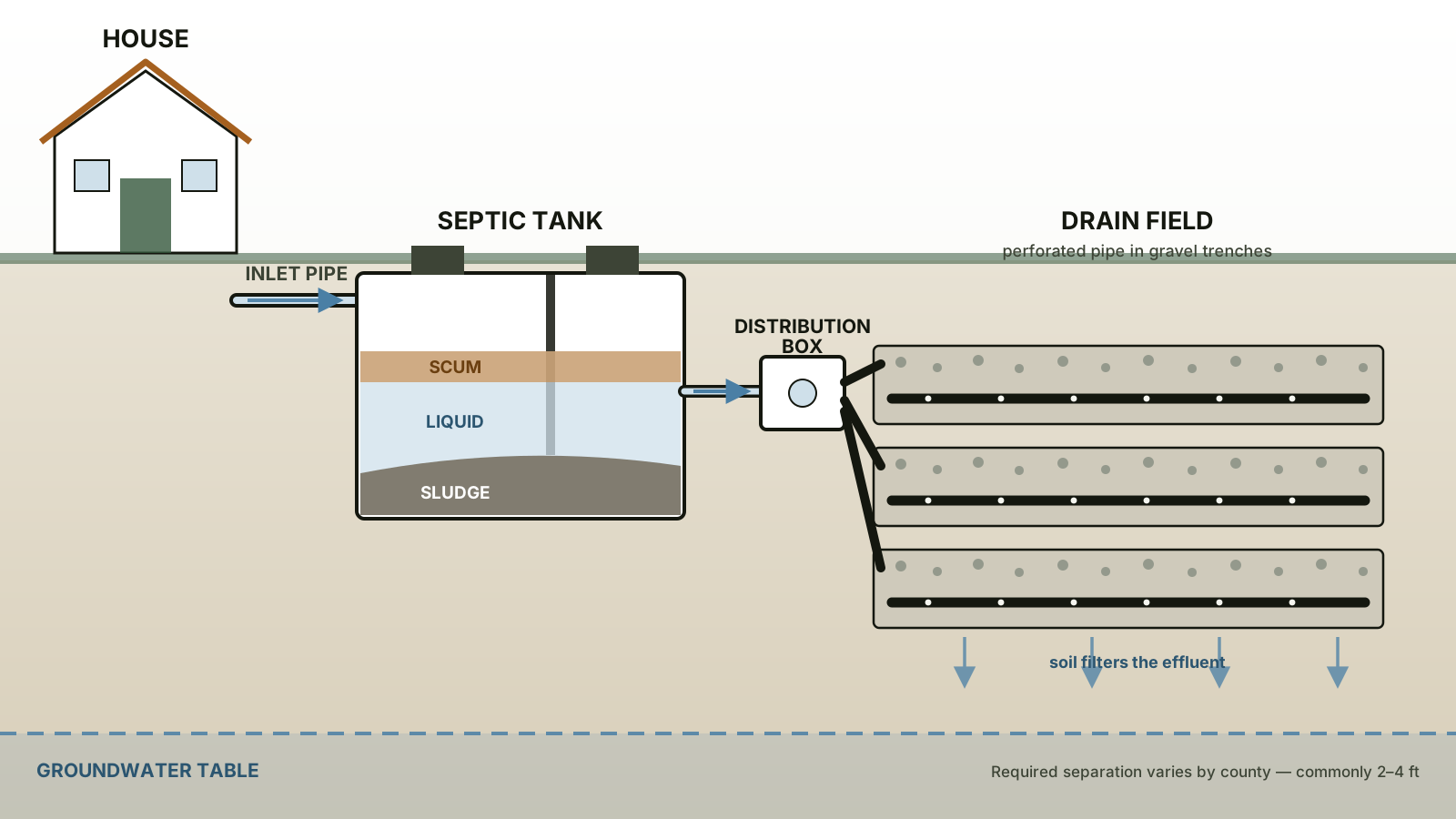
A septic quote is really four jobs bundled together. Dillon Septic, who install across Central and South Texas, publish their component breakdown — and it is the clearest answer to "what am I paying for" that we have found anywhere.
| Component | Cost |
|---|---|
| Site evaluation and soil test | $300 – $1,200 |
| Permits and inspections | $250 – $800 |
| Septic tank | $1,200 – $3,500 |
| Drain field / treatment area | $3,000 – $9,000 |
| Labor and equipment | $2,000 – $6,000 |
| Final installation and setup | $500 – $1,500 |
Source: Dillon Septic published pricing, retrieved August 2026.
The tank is the cheap part
Look at that table again. The tank is $1,200 to $3,500 — roughly 15 to 25 percent of the job. The drain field is nearly three times as much.
This matters because a lot of pages advertise "septic tank cost" and quote the tank alone. If a number you are given sits under about $5,000, it is not a working system. Ask what it excludes before you compare it to anything.
Quality Septic in Florida put labor and machinery at 30 to 40 percent of a total replacement. Materials take roughly 40 to 50 percent, and design, permits and inspections the remaining 10 to 15.
Why does your soil decide the price?
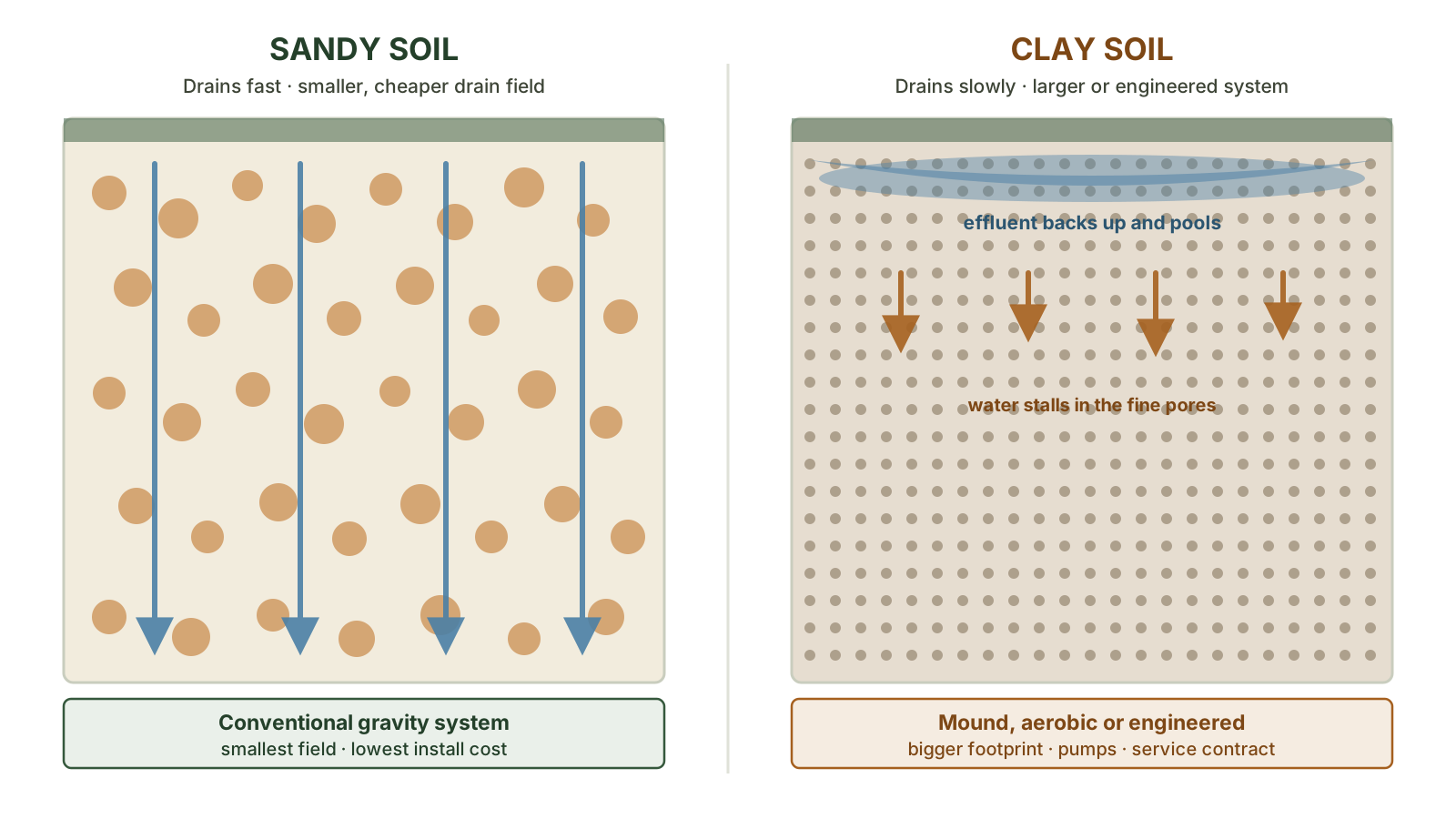
Wastewater leaves the tank and has to soak away through the ground at a predictable rate. Sandy soil drains fast and takes a small, cheap field. Clay drains slowly and needs a much bigger one — or a system that stops relying on the ground altogether.
Dillon Septic name the two Texas problems directly: black gumbo clay, too dense to absorb, and limestone, which gives no filtration at all. They put the penalty for clay-heavy soil at 30 to 50 percent above a normal install.
Florida's problem is the opposite — water, not rock. Seasonal water tables within 24 inches of the surface force a mound or elevated field, adding $5,000 to $15,000. Inside a springs protection zone, an advanced treatment unit runs $20,000 to $35,000.
Two real jobs, same state, nearly double the price
Dillon Septic publish two completed installs that show exactly what soil does to a bill. Same company, same region, same year:
- Johnson City, TX — gravity system on sandy soil. $7,200, finished in three days.
- Canyon Lake, TX — aerobic spray system on rocky soil. $13,400, including permits and inspections.
Nothing about the houses drove that $6,200 gap. The dirt did.
What does a septic system cost in Texas and Florida?
These are the two states we cover most closely, and they behave very differently. Texas is an aerobic-heavy market because so much of it is clay and rock. Florida runs cheaper on sand, then jumps sharply near water.
| System type | Texas | Florida |
|---|---|---|
| Conventional gravity | $6,300 – $10,000 | $5,000 – $9,000 |
| Aerobic (spray) | $10,000 – $15,000 | $13,000 – $25,000 |
| Aerobic (drip) | $12,000 – $18,000 | — |
| Low-pressure dosing | $8,000 – $12,000 | — |
| Mound | $10,000 – $20,000 | $12,000 – $28,000 |
| Advanced treatment (springs zones) | — | $20,000 – $35,000 |
Sources: Texas Septic Guide, updated March 2026. Septic & Well Pro, updated April 2026. Texas figures exclude evaluation, permits and engineering — add $1,500 to $5,000.
A note on city-level prices
You will find city averages online — Angi puts Houston at $7,889 and Tampa at $3,838. Treat those carefully. Installers in both states quote materially higher: Quality Septic says Tampa runs $5,000 to $9,000, and Dillon puts Central Texas at $8,000 to $15,000.
Angi's city figures are reported by its own members and mix full installs with partial replacements and repairs. Tampa's low end of $1,550 is less than a Florida permit plus a tank. Useful for direction, not for budgeting.
How big a tank do you need?
Counties size systems by bedroom count, not by how many people live there. A couple in a five-bedroom house pays for five bedrooms. The logic is that the house outlives the occupants.
Texas sets it in state rule, and it does it in two steps — which is why you will see conflicting bedroom-to-gallons charts on other sites. There is no single table. 30 TAC §285.91, Table III turns bedrooms and floor area into a daily flow, then Table II turns that flow into a minimum tank volume.
| Bedrooms | Floor area | Flow / tank — standard fixtures | Flow / tank — water-saving fixtures |
|---|---|---|---|
| 1 – 2 | under 1,500 sq ft | 225 gpd → 750 gal | 180 gpd → 750 gal |
| 3 | under 2,500 sq ft | 300 gpd → 1,000 gal | 240 gpd → 750 gal |
| 4 | under 3,500 sq ft | 375 gpd → 1,250 gal | 300 gpd → 1,000 gal |
| 5 | under 4,500 sq ft | 450 gpd → 1,250 gal | 360 gpd → 1,250 gal |
| 6 | under 5,500 sq ft | 525 gpd → 1,313 gal | 420 gpd → 1,250 gal |
Look at the last column before you sign anything. Water-saving fixtures drop a three-bedroom house from a 1,000-gallon tank to a 750, and a four-bedroom from 1,250 to 1,000. Texas writes that discount into the rule, and almost nobody quotes it.
Source: Texas Administrative Code, 30 TAC §285.91 — Table III (wastewater usage rate) and Table II (septic tank sizing), as compiled in TCEQ publication RG-472. Tank volume is set by formula, not by a lookup: 750 gallons up to 250 gpd, 1,000 up to 350, 1,250 up to 500, then 2.5 × flow above that. §285.32 adds a floor of 30 inches of liquid depth. Where bedroom count and floor area disagree, the larger figure governs, and actual metered water use beats the table if it is higher.
Florida works differently. Rather than going straight from bedrooms to a tank size, it sizes from estimated daily sewage flow under Chapter 62-6, F.A.C. — and the flow figure comes from bedrooms and floor area together:
| Dwelling | Design flow |
|---|---|
| 1 bedroom, 750 sq ft or less | 100 gallons/day |
| 2 bedrooms, 751 – 1,200 sq ft | 200 gallons/day |
| 3 bedrooms, 1,201 – 2,250 sq ft | 300 gallons/day |
| 4 bedrooms, 2,251 – 3,300 sq ft | 400 gallons/day |
| Each additional bedroom or 750 sq ft | add 60 gallons/day |
Source: Florida Administrative Code, Chapter 62-6, Rule 62-6.008, Table I. Note the rule the table does not show: where bedroom count and floor area land in different rows, the one producing the greater flow wins (Table I, footnote 4). A three-bedroom house of 2,400 sq ft is sized as a four-bedroom house. Tanks handling blackwater have a hard floor of 900 gallons.
That flow figure then sets the drain field. Florida does not publish a square-foot figure per bedroom — it divides the flow by a loading rate set by your soil, exactly the arithmetic every other state uses. Rule 62-6.008 Table III caps the rate at 0.80 gallons per square foot per day in clean sand, 0.65 in loam and silt loam, and 0.35 in clay loam and silty clay. Clay, hardpan and bedrock are unsatisfactory for a standard system at any size.
So the same three-bedroom house at 300 gallons a day needs roughly 375 sq ft of trench on sand and about 860 sq ft on clay loam — the soil, not the bedroom count, is what moves the number. Our drain field sizing guide works the same equation through step by step.
Careful with the "100 square feet plus 50 per bedroom" figure you will find on several septic sites quoting Florida. That number is real, but it is Rule 62-6.008(4)(a) — the minimum for an optional separate laundry-waste drain field, a second small system that takes washing-machine water only. It is not the sizing rule for your actual drain field, and it is roughly a quarter of the right answer if you use it as one.
What does the permit cost, and who issues it?
Your county, in almost every case. This trips people up because state agencies publish a fee and readers assume it applies everywhere.
TCEQ says it outright: it "is not often the OSSF permitting authority" in Texas. Its own $200 single-family fee plus a $10 state fee applies only where no county program exists. Real county fees vary widely:
| County | Fee |
|---|---|
| Bexar, TX | $230 |
| Montgomery, TX (SJRA / Lake Conroe) | $300 |
| Blanco, TX | $375 |
| Travis, TX | $285 – $700 by system type |
| Williamson, TX | $510 conventional · $710 aerobic |
| Hays, TX | $610 |
| Florida, statewide construction permit | $475 – $525 |
| Charlotte, FL (repair / replacement) | $475 |
| Alachua, FL | $200 – $500 new install |
Sources: county fee schedules and TCEQ, retrieved August 2026. Texas fees range roughly $30 to $710 statewide.
Florida is changing who runs this
Under the 2020 Clean Waterways Act, Florida's septic program is transferring from the Department of Health to the Department of Environmental Protection. Since 2 January 2025, DEP administers permitting in 16 Panhandle counties plus Marion.
Everywhere else it is still your county health department, and DEP has not published a schedule for the rest. If a page tells you Florida septic permits go through DOH, check the date on it.
How long does the whole process take?
The digging is fast. The paperwork is the schedule risk, and almost nobody says so.
Dillon Septic put physical installation at two to five days, with evaluation and permitting taking one to three weeks before that. County review times stretch well beyond their figure in busy areas:
- Rural Texas counties — around 2 weeks
- Busy Texas metros — 4 to 6 weeks
- Hays or Travis County — 8 weeks or more
- Hill Country and Edwards Aquifer areas — 8 to 12 weeks all in
- Florida — 4 to 12 weeks, longest in Hillsborough, Orange, Duval and Palm Beach
Florida's dry season, roughly October to May, is peak demand. Wet-season high water tables cause the worst delays of all, because the site cannot be properly assessed.
How long does a septic system last?
The drain field fails first, and it is not close.
| Component | Lifespan | Notes |
|---|---|---|
| Concrete tank | 40+ years | Degrades when hydrogen sulfide converts to sulfuric acid |
| Fiberglass / plastic tank | 30 – 40 years | |
| Steel tank | 15 – 25 years | Pre-1980 baffles rust out at 15 – 20 |
| Drain field | 20 – 30 years | The limiting component in almost every system |
Source: Eagle Septic, retrieved August 2026.
A well-maintained concrete tank routinely outlives two drain fields. So when someone says their septic system failed, they nearly always mean the field — and skipping pumping is what kills it early, because solids carry over and permanently seal the soil.
Is replacing an old system dearer than installing a new one?
Yes, by roughly 15 to 30 percent. Dillon Septic put replacements at $9,000 to $18,000 and give three reasons: the old tank and lines have to come out, the soil may be compacted or contaminated and need corrective work, and access is harder because the house and landscaping already exist.
Their practical advice is worth repeating — if you are building anyway, install during construction. Equipment can reach everything while the lot is still open.
How do you get an accurate septic quote?
Get the site evaluation done first. Without it, every number you are given is a guess, and installers price guesses defensively — in their own favor.
- Ask whether the drain field is in the price. This is the single most common gap between two quotes that look comparable.
- Ask whether the permit fee and county inspection are included, or billed on top.
- Ask what happens to the spoil. Hauling excavated soil away is frequently separate.
- Ask if the county requires a maintenance contract. Aerobic units usually do, at $200 to $400 a year plus $10 to $20 a month in electricity.
- Ask for the license number, then look it up yourself. Septic is a licensed trade in both Texas and Florida.
One more, and it is the cheapest insurance on this page: if you are buying land, make the purchase contingent on a passing perc test. A failed test after closing is how people end up owning ground they cannot build on.
Where this fits
This page covers one part of a larger job. The service hub explains how the whole thing works, what it costs, and how to hire for it.
Sources
Every figure on this page traces back to one of these. Open them and check us — that is what they are here for.
- 30 TAC 285.91 — Tables (design criteria) Tables II and III — soil classification and drain field sizing.
- 30 TAC Chapter 285 — On-Site Sewage Facilities The Texas rule chapter governing septic design, siting and permitting.
- TCEQ — On-Site Sewage Facilities Texas program pages: permitting, licensing and designated agents.
- F.A.C. Rule 62-6.008 — System Size Determinations How Florida sizes a system, including the laundry-waste provisions.
- Florida Statutes 381.0066 — Onsite Sewage Program Fees Statutory permit fees — a fee schedule, not an estimate.
- US EPA — Septic Systems Federal guidance on onsite wastewater treatment.
- USDA NRCS — Web Soil Survey Free soil series and percolation data for any US parcel.
Links verified August 2026. Tell us at info@landclearingandexcavation.com if one has moved.
Frequently asked questions
How much does it cost to put in a septic tank?
The tank on its own runs $1,200 to $3,500 depending on size and material. That is only 15 to 25 percent of a working system. Installed with a drain field, excavation and permits, budget $3,591 to $12,463, averaging $8,023.
If a quote comes in under about $5,000, ask what it excludes. It almost certainly does not include the drain field.
How long does a septic system last?
The drain field fails first, and it is not close. A concrete tank lasts 40 years or more, fiberglass and plastic 30 to 40, and steel only 15 to 25 — pre-1980 steel tanks are notorious for rusted baffles.
The drain field lasts 20 to 30 years under normal use. When someone says "my septic failed," they almost always mean the field. A well-maintained concrete tank routinely outlives two of them.
Do I need a perc test before installing a septic system?
Yes, in nearly every US county, and it comes before the permit application, not after. The EPA's guidance puts the workable range for a conventional system at 1 to 60 minutes per inch. Under 30 usually passes outright, 30 to 60 may push you to an alternative system, and over 60 typically fails.
Budget $300 to $1,900 for the test. In Texas the site evaluation runs $600 to $2,500.
What happens if my soil fails the perc test?
You buy an engineered system instead. A mound adds roughly $4,000 to $10,000 over a conventional system and an aerobic unit adds $3,000 to $8,000, according to Eagle Septic. In Florida, unsuitable soil is often excavated and replaced with septic-grade sand.
This is exactly why experienced buyers perc a lot before they close on it, not after.
Who issues the septic permit?
Your county, almost always. TCEQ states plainly that it "is not often the OSSF permitting authority" in Texas — county fees range from about $30 to $710. Florida construction permits run $475 to $525.
Florida is mid-transition: septic permitting is moving from the Department of Health to DEP, which already handles 16 Panhandle counties plus Marion.
Is it cheaper to repair or replace a septic system?
Repair, almost always — until the drain field is what failed. A pump or baffle repair is a few hundred dollars. A drain field replacement costs nearly as much as a whole new system.
Are there grants or loans to help pay for a septic system?
Yes, if you qualify. The USDA's Section 504 program offers very-low-income homeowners in eligible rural areas 20-year loans at a fixed 1% up to $40,000, and grants up to $10,000 for homeowners aged 62 and over — $15,000 in presidentially declared disaster areas.
The part most people miss: you can combine a loan and a grant up to $50,000, or $55,000 in a declared disaster area. That covers an all-in septic project outright for most rural households.
USDA Rural Development confirms the funds can cover septic design, permits and installation. Start at rd.usda.gov.
Get quotes from local contractors
Tell us about the job and we will pass it to licensed contractors who work in your area. No cost, no obligation.