
At a glance
- Baffle replacement
- $300 – $900 the most common septic repair there is
- Distribution box
- $500 – $1,500 deep excavation can add $1,000–$2,000
- Effluent pump
- $500 – $1,300 repair is $300–$600 if it is salvageable
- Effluent filter
- $30 – $80 DIY $200–$300 if a pro does it
- Cracked tank
- $500 – $5,000 by severity — past 25 years, replace instead
- Stop repairing at
- 50% of the component's replacement cost
Septic repairs run $150 to $5,000, depending entirely on which part failed. A lid is $150. A baffle is $300 to $900. A distribution box is $500 to $1,500. A cracked tank can reach $5,000.
Before you price any of it, work out whether the trouble is in the tank or in the drain field. One is a few hundred dollars. The other can be ten thousand. The tell is simply where the water shows up.
Tank problem or drain field problem?
This is the most valuable thing on the page, so it goes before the prices. Everything to the left of the tank outlet is a hundreds-of-dollars problem. Everything to the right of it can be a five-figure one.
| What you see | Where the problem is | Likely cost |
|---|---|---|
| Backups and slow drains throughout the house, yard dry | Tank. Full tank, clogged effluent filter, or outlet baffle. If those check out, the inlet baffle. | $300 – $900 |
| One fixture slow, everything else fine | House plumbing — not the septic system at all | plumber's call-out |
| Soggy soil, standing water or lush green stripes over the field in dry weather | Drain field. The soil has stopped absorbing. | $5,000 – $20,000 |
| Standing water over one spot within the field | A broken or cracked pipe at that point — not whole-field failure | $200 – $800 |
| One section of the field soaked, the rest dry | Failing distribution box overloading one run | $500 – $1,500 |
| Pump alarm sounding, or frequent switch clicking | Pump or float switch — tank side | $300 – $1,300 |
Two of those rows are good news that looks like bad news. Water over one spot in the field is a broken pipe, not a dead field. One soaked section with the rest dry is a distribution box.
Both get quoted as "your drain field is failing" often enough to be worth knowing. Ask the contractor to show you why they have ruled those out.
| Component | Typical range | Average | Basis |
|---|---|---|---|
| Effluent filter (DIY replace) | $30 – $80 | — | the part alone; $200–$300 for a pro visit |
| Tank lid | $150 – $500 | — | a riser to bring it to grade is $200–$400 |
| Inlet or outlet baffle | $300 – $900 | — | part is a $15–$50 PVC tee; the cost is access and labor |
| House-to-tank line | $200 – $800 | — | excavate and replace a damaged section |
| Effluent / lift pump | $500 – $1,300 | — | repair $300–$600 where salvageable |
| Distribution box | $500 – $1,500 | — | part $200–$600; deep excavation adds $1,000–$2,000 |
| Cracked tank repair | $500 – $5,000 | — | by severity; replacement is $3,500–$8,500 |
Last updated: · Reviewed by Nisar Dalvi
The cheap parts protect the expensive ones
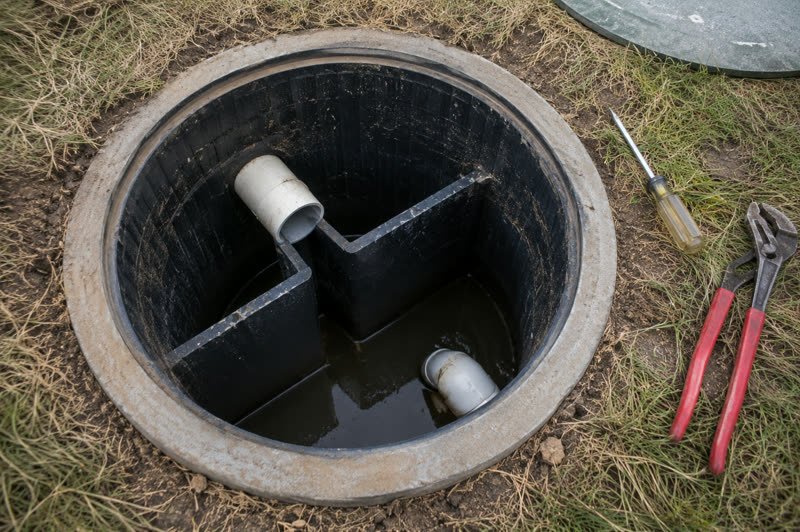
Look again at the baffle line in that table. The part itself is a PVC tee costing $15 to $50. The $300 to $900 is access, pumping and labor.
That cheap piece of plastic is the only thing keeping solids inside the tank. When an outlet baffle fails, solids flow straight into the drain field and seal the soil permanently — the $5,000 to $20,000 failure. It is the highest-return repair in the entire system, and almost nobody thinks about it.
It is also the most delayed one, for the worst possible reason: nothing visible happens when a baffle breaks. No backup, no smell, no alarm. It quietly sends solids downstream for months or years while everything appears fine, and by the time symptoms show up the damage is in the field, not the tank.
The habit that prevents it costs nothing: ask your pumper to look at the baffles every time the tank is open. Thirty seconds, no charge, and it is the single cheapest insurance available on a septic system.
Every component, priced
Effluent filter — $30 to $80 DIY, $200 to $300 with a pro
A separate device at the outlet baffle that adds a stage of filtration. Most tanks built since the 1990s have one. It needs cleaning every pump-out, and a pumper will usually do it for $50 to $100 if it is not already in their price.
Baffles, inlet and outlet — $300 to $900
The most common septic repair there is. Concrete baffles corrode under hydrogen sulfide attack; the replacement is usually a PVC tee. See above for why this one matters more than its price suggests.
Distribution box — $500 to $1,500
The box that splits flow evenly between drain field runs. The part is $200 to $600; deep excavation can add $1,000 to $2,000. Worth fixing early — an unbalanced D-box overloads one section of field and will take the whole thing down with it.
Lid and riser — $150 to $500
A lid replacement is $150 to $500. While you are there, a riser at $200 to $400 brings the access permanently to grade and pays for itself in two or three pump-outs in avoided digging fees.
Effluent or lift pump — $500 to $1,300
Repair runs $300 to $600 where the unit is salvageable, replacement $500 to $1,300. An alarm or repeated switch clicking is the usual first sign.
Cracked tank — $500 to $5,000
Wide range because it covers everything from sealing a hairline crack to a structural repair. Past a certain point this stops being economic — replacement is $3,500 to $8,500.
The line between house and tank — $200 to $800
Excavate and replace the damaged section. If tree roots caused it, clearing them is temporary — the roots come back unless the tree goes ($400 to $1,200) or a barrier goes in.
When does repair stop making sense?
Two rules, and they are worth applying before you spend rather than after.
1. The 50 percent rule. If a single repair costs more than about half of what replacing that component would cost, replacement is usually the better buy — you get a new service life instead of an extension.
2. Age plus recent failure. A concrete tank past 25 to 30 years, or steel past 15, that has failed in any way in the last five years is at the end of its useful life. Repairs at that point buy time, not reliability.
For scale, the bands run roughly: minor repairs $50 to $900 · mid-range $300 to $1,500 · major $500 to $5,000 · full drain field replacement $5,000 to $20,000, with most people paying about $10,000.
One caution on the sales side. Pressure without explanation — "your tank is about to collapse" with no diagnosis offered — is a documented pattern in this trade, and it appears in the industry's own trade press as a known practice. Always diagnose before deciding. A contractor who is right will be happy to show you why.
What can you legally do yourself?
More than you might expect, and less than some people attempt.
Homeowner territory in both Texas and Florida: riser lids, above-ground pipe fixes, effluent filter cleaning and swaps, alarm resets.
Licensed contractor required: anything involving excavation, tank entry, or drain field work. In Texas, TCEQ requires installation by a licensed Installer I or II depending on system type, and any non-emergency repair needs a permit — emergency repairs may proceed but must be reported to the permitting authority within 72 hours of the work starting — in most counties that means the county health department or authorized agent, not TCEQ directly. In Florida, only a DEP-licensed contractor may do the work, and registered septic tank contractors perform site evaluations for repairs.
One rule with no exceptions: never enter or lean into a septic tank.
The gases are lethal and they act fast. People die in septic tanks every year, and a grim share of those deaths are second and third people who went in to help the first. Clean the filter from outside the riser, wearing gloves. There is nothing in that tank worth your life.
Questions to ask before you authorize work
- How did you rule out the drain field? Or the tank, if they are quoting a field job.
- Is the diagnostic fee credited against the repair?
- Can you show me the failed part? A baffle or filter comes out; ask to see it.
- What does this repair protect, and what happens if I wait six months?
- Is pumping included in this price? Most tank-side repairs need the tank emptied first.
- Does this need a permit, and are you pulling it?
- What is your license number? Then look it up — TCEQ in Texas, DEP in Florida.
And while someone is already there with the lid off: ask them to check the baffles. It is free, it takes half a minute, and it is the repair most worth catching early.
Where this fits
This page covers one part of a larger job. The service hub explains how the whole thing works, what it costs, and how to hire for it.
Frequently asked questions
How much does septic tank repair cost?
Anywhere from $150 to $5,000, because "septic repair" covers a lid replacement and a cracked tank equally. The most common repair is a baffle at $300 to $900, and a distribution box is $500 to $1,500.
The one that matters most is the cheapest to get wrong: a failed outlet baffle is what lets solids escape into your drain field. That $300 part protects a $5,000 to $20,000 one.
How do I know if the problem is my tank or my drain field?
Look at where the water shows up. Backups in the house with a dry yard point at the tank — a full tank, a clogged baffle, or the effluent filter. Soggy ground, standing water or bright green grass over the field in dry weather points at the field.
One slow fixture on its own is usually house plumbing and not septic at all. There is a full symptom table on this page.
What is the most common septic tank repair?
Baffle replacement. Baffles corrode over time — concrete ones get attacked by hydrogen sulfide — and once broken they let solids escape toward the drain field.
It is also the most delayed repair, for the worst reason: nothing visible happens when a baffle fails. It quietly sends solids downstream for months until a cheap part has turned into a five-figure field repair.
When should I stop repairing and replace the system?
Two triggers. First, if a single repair exceeds roughly 50 percent of what replacing that component would cost, replacement is usually the better buy.
Second, age plus recent failure: a concrete tank past 25 to 30 years (or steel past 15) that has had any failure in the last five years is telling you something. At that point repairs buy time, not reliability.
Can I repair my own septic system?
Some of it, in both Texas and Florida. Riser lids, above-ground pipe fixes, effluent filter swaps and alarm resets are homeowner territory.
Anything involving excavation, tank entry or drain field work needs a licensed contractor — Installer I or II in Texas, DEP-licensed in Florida. And one non-negotiable: never enter or lean into a septic tank. The gases are lethal, and they have killed people who were only trying to help someone else out.
How much is a septic service call?
A basic look-and-report visual visit runs $100 to $300, and is sometimes bundled free with other work. Same-day or after-hours response adds $100 to $300.
Practice mirrors plumbing: expect a trip or diagnostic fee in the $75 to $200 range, commonly credited back if you approve the repair. Ask whether it is credited before you book — that question is worth more than the exact number.
How often should the effluent filter be cleaned?
Every pump-out, so every 3 to 5 years for most households. Most tanks built since the 1990s have one — a Polylok or Zabel unit sitting at the outlet.
A pumper will do it for $50 to $100 if it is not already included, and a replacement filter is $30 to $80. Clean it at the riser with gloves on. Never lean in.
Get quotes from local contractors
Tell us about the job and we will pass it to licensed contractors who work in your area. No cost, no obligation.