
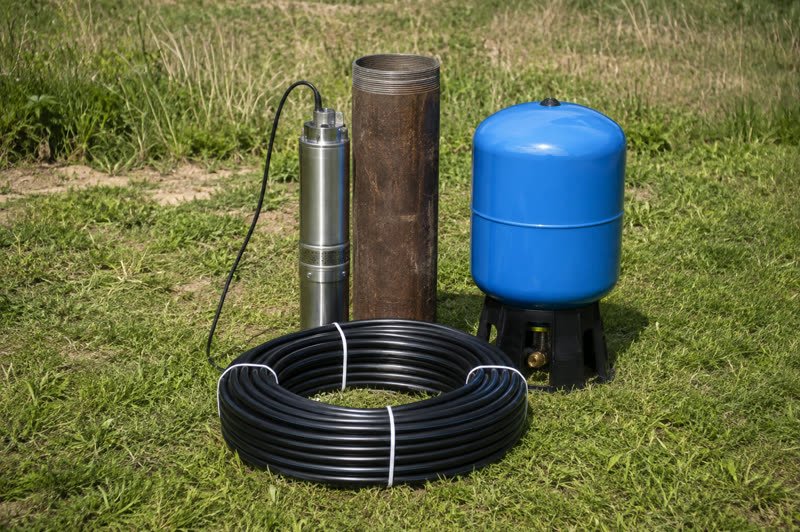
The short version
- Jet pump
- pulls from above and physics caps how far it can reach
- Suction limit
- about 25 ft ~28 ft with a shallow-well ejector kit
- Submersible
- pushes from below 400+ ft with enough impeller stages
- Usable tank water
- 25 – 30% of volume a 20-gallon tank gives 5 – 6 gallons
- Healthy cycling
- 6 – 8 per hour 30+ per hour can kill a pump in 1 – 2 years
- Tank pre-charge
- 2 PSI below cut-in 28 PSI on a 30/50 switch
A well pump has two jobs, and most homeowners only know about the first one. It lifts water out of the ground — and it maintains usable pressure in the house without running every time somebody washes their hands.
The second job belongs mostly to the pressure tank, and that matters more than it sounds: a large share of what gets diagnosed as a failed pump is a failed tank taking the pump down with it. This page explains both, plus how a replacement is sized and what the early warnings look like.
How does a jet pump move water?
By cheating. A jet pump does not have the strength to lift a column of water on its own — it tricks the atmosphere into doing the lifting.
The venturi, which is the whole trick
A jet pump is a centrifugal pump — impellers and diffusers — with one extra part bolted on: a jet ejector, which is a matched nozzle and venturi.
High-pressure water is forced through the nozzle. Squeezing it that way makes it accelerate sharply, and as velocity goes up, pressure goes down. That creates a low-pressure zone right at the mouth of the ejector, and well water is pushed in behind it by the ordinary weight of the atmosphere.
Nothing "sucks" water up a well. A pump lowers the pressure above the water; the air pressing down on the water table does the actual lifting. That single fact explains every limitation of every above-ground pump ever made.
Which is why 25 feet is a wall
Atmospheric pressure can only support so tall a column of water, so there is a hard ceiling that no amount of horsepower moves.
- A plain centrifugal pump with no ejector manages roughly 10 to 15 feet of suction lift.
- A shallow-well jet pump puts the ejector in the pump housing, ahead of the impeller, and reaches about 25 feet.
- A shallow-well ejector kit recirculates part of the discharge back through the ejector and can push that to about 28 feet — but delivered volume falls as the distance to water grows. You buy reach with flow.
The deep-well jet: move the ejector down the hole
For water sitting roughly 25 to 100 feet down there is a clever workaround. Instead of trying to create suction at the surface, you send the ejector down the well on two pipes:
- A pressure pipe carrying high-pressure water down to the ejector.
- A suction or return pipe bringing the combined flow back up.
Because the low-pressure zone is now created at depth rather than at the pump, the suction limit stops applying. The jet lifts water to a level the surface pump can finish by ordinary suction. It is a genuinely elegant piece of plumbing and it is why two-pipe well heads exist.
How does a submersible pump move water?
By not bothering with any of that. A submersible sits in the water at the bottom of the well and pushes upward, which sidesteps the atmospheric ceiling completely.
Stages, stacked
Inside the housing is a series of impellers and stationary diffusers. The motor spins the impellers; centrifugal force flings water outward and accelerates it; the diffuser catches that fast-moving water, converts its speed into pressure, and hands it to the next stage.
Each stage adds pressure. Stack enough of them and you can lift from practically any residential depth — multi-stage submersibles routinely serve wells beyond 400 feet. This is the key structural difference between the two families, and it explains the whole market:
A jet pump is limited by physics. A submersible is limited by how many stages you bolt together.
One has a wall it can never get past. The other has a price that goes up.
Why pushing beats pulling
| Jet pump | Submersible | |
|---|---|---|
| Where it sits | Above ground, in a well house, basement or pit | In the water, at the bottom of the well |
| How it moves water | Venturi creates low pressure; atmosphere pushes | Multi-stage centrifugal; motor pushes directly |
| Depth ceiling | ~25 ft shallow, ~100 ft as a two-pipe deep-well jet | Effectively unlimited for residential wells |
| Priming | Must be primed; loses prime if it leaks air | Never needs priming — it is already underwater |
| Motor cooling | Air, in whatever space it lives in | The well water around it — which is why it must stay submerged |
| Electricity | Commonly 800 – 2,000 watts | Often less, for the same work at depth |
| Noise | Audible, mechanical | Near silent — you hear the switch and tank, not the pump |
That last row has a diagnostic consequence worth remembering: on a submersible system, every noise you can hear is coming from the pressure switch and tank. If something sounds different, it is almost never the pump you are hearing.
What is the pressure tank actually doing?
This is the least understood component in a private water system and the one most likely to be quietly destroying your pump right now.
The air spring
A modern pressure tank contains a sealed rubber bladder with compressed air behind it. Water pumped into the tank squeezes that air, and the compressed air is what pushes water to your taps when the pump is off.
The cycle runs on two numbers set at the pressure switch:
- Cut-in — the pressure at which the switch starts the pump. Commonly 30 PSI.
- Cut-out — the pressure at which it stops. Commonly 50 PSI.
- Drawdown — the usable water delivered between those two points, and it is much smaller than people assume. Only about 25 to 30 percent of a tank's total volume is usable. A healthy 20-gallon captive-air tank delivers roughly 5 to 6 gallons.
The 2 PSI gap, which nobody explains
The tank's air pre-charge is set 2 PSI below cut-in — 28 PSI on a 30/50 switch, 38 PSI on a 40/60. That gap looks arbitrary. It is not.
Sitting just under cut-in means that at the instant the pump starts, there is still a thin layer of water in the tank. The bladder is not slammed flat against the bottom of the shell on every single start.
Multiply that by six to eight cycles an hour for fifteen years and you can see why the gap exists. It is a fatigue-life setting, not a performance one.
Checking it takes a tire gauge on the Schrader valve at the top of the tank, with the system depressurized. Pre-charge drops over time even on a healthy tank, because air slowly permeates through the rubber and the valve itself can seep.
| Switch | Pre-charge | Checked |
|---|---|---|
| 30 / 50 PSI | 28 PSI | With the system drained and no water pressure on the tank |
| 40 / 60 PSI | 38 PSI | Same — a pressurized tank reads wrong |
What "waterlogged" actually means
When the bladder fails, water fills the entire tank and the air cushion is gone. There is nothing left to store energy, so drawdown drops to almost nothing.
The consequence is mechanical and brutal. The pump satisfies cut-out in seconds because there is no volume to fill, then pressure collapses back to cut-in seconds later, and it starts again. Short-cycling.
The numbers make the stakes clear. A healthy system cycles 6 to 8 times an hour under moderate use. A waterlogged tank can push that past 30 — and a pump cycling 30+ times an hour can fail in one to two years instead of the usual ten to fifteen.
The field test: press the pin in the Schrader valve on top of the tank. Air means the bladder is intact. Water means it has failed and the tank needs replacing — and the pump has been paying for it ever since.
Two causes that are not the bladder
Worth knowing so you do not replace a good tank:
- Lost pre-charge with an intact bladder. Air permeates slowly through rubber and leaks at the valve. The fix is adding air, not a new tank.
- A tank too small for the pump's flow rate. Perfect bladder, correct pre-charge, still short-cycles — because the drawdown volume is too small for how fast the pump fills it. This is a sizing error, and it usually dates back to the original install.
A leaking check valve down in the well can also mimic waterlogging closely, which is one reason the cheapest-cause-first diagnostic ladder is worth walking in order rather than guessing.
How is a replacement pump sized?
Two numbers define every pump on the market, and neither of them is "how deep is the well."
Total dynamic head — the number that is not well depth
TDH is the total resistance the pump has to overcome, expressed in feet. It adds up four things:
- The pumping water level — how far down the water sits while the pump is running.
- The vertical rise from there to the pressure tank.
- Friction losses in the pipe and fittings.
- The tank operating pressure, converted to feet. One PSI is about 2.31 feet of head.
Worked example: 100 ft of lift + 20 ft of friction + (50 PSI × 2.31 = 115 ft) = 235 feet of total dynamic head.
Notice that the pressure setting contributed more head than the lift did. That is normal, and it is why a pump cannot be chosen from depth alone.
And the distinction that catches almost everyone: what matters is the pumping level, not the drilled depth. A 300-foot well with water standing at 50 feet is an easier job than a 200-foot well with water at 180.
Gallons per minute, from peak demand
Flow is sized from simultaneous peak use, not from average daily consumption. The common rule of thumb is 1 GPM per fixture. A typical three-bedroom, two-bath house has 10 to 12 fixtures and wants roughly 8 to 12 GPM; most homes land in a 6 to 12 GPM band.
Well yield, which overrides both
Here is the constraint that beats every other number on this page.
A pump must never be rated to draw more than the well can sustainably produce. A licensed contractor establishes that with a yield test, measuring the GPM the aquifer actually supports over time.
If your demand exceeds your yield, the answer is a storage tank, not a bigger pump. A larger pump on a weak well just draws it down faster.
Oversizing is a genuine failure mode, not a harmless margin. An oversized pump on a low-yield well pulls the water level down past its own intake, runs dry, and short-cycles against the pressure tank — dry running and rapid cycling being the two most destructive things that can happen to a pump, arriving together.
If yield is the binding constraint rather than the pump, the eventual answers are storage, hydrofracturing, deepening or a new well — in roughly that order of cost, and none of them fixed by a larger motor.
| Well depth | Rough HP |
|---|---|
| Under 100 ft | 1/2 HP |
| 100 – 200 ft | 3/4 HP |
| 200 – 300 ft | 1 HP |
| 300 – 500+ ft | 1.5 – 2 HP |
Treat this table as a sanity check on a quote, never as the basis for one. Real selection comes from plotting your GPM and TDH against a specific pump's performance curve — depth alone is not sufficient, and a contractor who sizes from depth alone is guessing.
What are the parts of a well, top to bottom?
Useful vocabulary, because it is hard to evaluate a quote for components you cannot name. Here they are in the order a technician meets them.
| Component | What it does |
|---|---|
| Well cap | The sanitary seal at grade. A damaged one is a direct contamination path into your drinking water. |
| Casing | Steel or PVC pipe lining the bore. Holds the hole open and seals out surface water and shallow contaminated groundwater. |
| Pitless adapter | Below-frost-line fitting that routes the water line sideways to the house while keeping the casing sealed. |
| Screen | Slotted section at the producing zone. Lets water in, keeps sand and gravel out; slot size is matched to the aquifer's grain size. |
| Static water level | Depth to water at rest, with the pump off. |
| Pumping water level | Depth to water while pumping. The gap between the two is the drawdown, and the pump lifts from here — not from static. |
| Drop pipe | The riser carrying water up. It also carries the pump's weight, which is why deep pulls are a rig job. |
| Torque arrestor | Rubber collar gripping the casing wall, absorbing the twisting jolt each time the motor starts. Without it the pump spins and chafes wire and pipe against the casing. |
| Check valve | Holds the water column in the drop pipe when the pump shuts off. A failed one lets the column slam back down and mimics a waterlogged tank. |
| Pump and motor | Sealed as one unit, set below static level, cooled by the water around it — which is why continuous submersion is not optional. |
| Wiring | 2-wire puts the starting components inside the motor: simpler install, but a failure means pulling the pump. 3-wire puts them in a control box above ground: easier and cheaper to service. |
The torque arrestor is the one worth asking about specifically. It is a cheap rubber part that prevents the most avoidable form of premature failure — a pump that has spent years scraping its own wire against a steel casing.
What are the early warning signs?
These arrive weeks or months before anything dramatic. All of them justify a scheduled service call rather than an emergency one, which is also materially cheaper.
- Cycle frequency changing. The earliest measurable signal, and you need no tools — just a watch. Baseline is 6 to 8 starts an hour under moderate use. Anything faster, especially when drawing small amounts of water, points at pre-charge loss before it becomes full waterlogging.
- Sputtering or spitting air at the taps. Air is entering the system. Usual suspects: a falling water level pulling the pump toward its intake, a suction leak on a jet pump, or a failing check valve.
- The sound changing. A jet pump running rougher or louder. On a submersible, new noise at the tank or switch — because that is where you hear a submersible system.
- Cloudy, sandy or gritty water. Suggests a failing screen or a pump set too low and drawing sediment. Sediment abrades impellers and seals, so this one is actively shortening the pump's life while you watch it.
- Pressure sagging when a second fixture opens. Low pressure upstairs, not being able to run two things at once, or a pump that runs and runs without reaching cut-out — all say the pump is losing ground against demand.
- A rising electric bill with no change in habits. A pump running longer or more often to deliver the same water.
If you note only one thing from this page, count cycles once a season. Run a tap for a couple of minutes, listen for the pump starting and stopping, and see whether the rhythm has changed since last time.
It costs nothing, it needs no tools, and it catches the tank failure that would otherwise take the pump with it.
When something does need diagnosing, work up from the cheapest possible cause — the cost guide's diagnostic ladder starts at a free breaker check and a $25 part, and a fair number of "dead pumps" never get past rung two.
Can you replace a well pump yourself?
In Texas and Florida, generally no — pump installation on a private well is licensed work in both states, and the license covers pump work specifically rather than only drilling. The registries are public and looking a contractor up takes two minutes; the cost guide has the statutes and the lookup detail.
Setting the law aside, the physical reality is worth stating plainly. A drop pipe full of water at 300 feet is several hundred pounds suspended over an open hole in the ground. If it gets away from you, the pump goes to the bottom of the well and recovering it — a "fishing" job — can cost more than the pump did.
There is a real difference between swapping an accessible shallow jet pump in a well house and pulling a submersible, and it is not unreasonable for a competent homeowner to think about the first. Check your state and county rules before you touch either, because doing unlicensed well work is its own problem regardless of how it turns out.
How often should you test the water?
Annually, at minimum — total coliform bacteria, nitrates, total dissolved solids and pH, per EPA and CDC guidance, plus anything known to be a local issue such as arsenic or radon. Your county health department can tell you what those are. Every three to five years, run a broader panel including metals and minerals.
Test off-schedule when any of these happen:
- Someone in the household becomes pregnant, or a young child moves in.
- Taste, smell or appearance changes at all.
- Any repair or replacement opened the well system — a pump pull included.
- After flooding, or any significant environmental change nearby.
- Known water problems appear in the area.
- You have just bought the property. Test immediately, to establish a baseline you can compare against later.
The part that surprises new well owners: nobody is testing this for you. The Safe Drinking Water Act applies to public water systems. Private wells serving fewer than 25 people fall entirely outside it — monitoring is the owner's job.
And many contaminants are undetectable by taste, smell or appearance. Clear, pleasant water is not evidence of anything.
One result deserves a specific reaction rather than a general one. A coliform or nitrate hit on a rural property with its own septic system is a septic question before it is a well question — a failing drain field near a well shows up in the water long before it shows up in the yard. Test the water, then look at the field.
The one thing to take away
The pump gets the blame and the tank does the damage.
A pump is a fairly simple machine that lasts a decade and a half if you let it work the way it was designed to — starting a handful of times an hour and running for a while each time. The most common way to shorten that life by ten years is a failed or wrongly pre-charged pressure tank that has it starting and stopping every few seconds, all day, for two years, while the household notices nothing at all.
So: check the pre-charge against the switch setting, press the Schrader valve once a year, count cycles once a season. Then when something does go wrong, walk the diagnostic ladder from the cheap end instead of the expensive one.
What comes next?
Land preparation runs in a sequence. Getting the order wrong is the most expensive mistake on a raw lot — grading before the septic is sited means paying to move the same dirt twice.
Sources
Every figure on this page traces back to one of these. Open them and check us — that is what they are here for.
- US EPA — Private Drinking Water Wells Federal guidance for private well owners.
- Texas TDLR — Water Well Drillers and Pump Installers Texas licensing program for well drillers.
- Florida DEP — Water Well Contractor Licensing Florida well permitting and contractor licensing.
Links verified August 2026. Tell us at info@landclearingandexcavation.com if one has moved.
Frequently asked questions
How does a well pump work?
Two families, two entirely different tricks. A jet pump sits above ground and pulls, using a venturi to create low pressure that atmospheric pressure pushes water into. A submersible sits at the bottom of the well and pushes, using a stack of impellers.
Neither one runs continuously. Both fill a pressure tank, which stores water under compressed air so the pump does not have to start every time you open a tap.
Why can a jet pump only pull water from about 25 feet?
Because it is not really pulling — atmospheric pressure is pushing. A pump can only lower the pressure above a water column; the atmosphere does the lifting, and at sea level it can only support so tall a column.
A plain centrifugal pump manages about 10 to 15 feet. Adding a jet ejector gets you to roughly 25, and a shallow-well ejector kit that recirculates some of the water can reach about 28. Past that you have to put the work down the well, which is what a deep-well jet or a submersible does.
How can you tell when a well pump is going bad?
Before the dramatic symptoms, watch the boring one: how often it cycles. A healthy system runs 6 to 8 times an hour under moderate use. Cycling every few seconds when you draw a small amount of water is the earliest measurable warning, and it usually points at the tank, not the pump.
Then: sputtering or spitting air at the taps, pressure that sags when a second fixture opens, cloudy or gritty water, a change in the sound the system makes, and an electric bill that climbed with no change in habits.
Can I replace my well pump myself?
Usually not legally, and often not physically. In Texas and Florida installing a pump on a private well is licensed work — the license covers pump installation, not just drilling.
The physical side: 300 feet of drop pipe full of water is several hundred pounds hanging over an open hole, and a dropped pump is a fishing job that can cost more than the pump. A shallow jet pump swap in a pit house is a different proposition from a submersible pull, but check your state rules before either.
What does a pressure tank actually do?
It is a compressed-air spring. Water is pumped in against a sealed air cushion behind a rubber bladder; that compressed air is what pushes water to your taps between pump cycles.
Only 25 to 30 percent of a tank's volume is usable water — a 20-gallon tank delivers 5 to 6 gallons. When the bladder fails, the tank fills completely, the cushion disappears, and the pump starts short-cycling. That is what kills pumps early.
How much does it cost to have someone replace a well pump?
Depth drives it far more than the pump does, and the range is wide enough that a single figure would mislead you. Our well pump replacement cost guide breaks it down by depth and pump type, and covers the line item nobody quotes up front — what pulling the old one costs.
Read the cheap-causes-first section there before you authorize anything. A pressure switch is a $25 part and it is behind a lot of pumps that get declared dead.
How often should private well water be tested?
At least once a year for total coliform bacteria, nitrates, total dissolved solids and pH — that is the EPA and CDC baseline — plus whatever is a known problem locally, such as arsenic or radon. A broader panel including metals every 3 to 5 years.
Test outside the schedule when someone becomes pregnant or a child moves in, after any repair that opened the system, after flooding, and whenever taste, smell or appearance changes. Private wells serving fewer than 25 people are not covered by the Safe Drinking Water Act — nobody is testing it for you.
Get quotes from local contractors
Tell us about the job and we will pass it to licensed contractors who work in your area. No cost, no obligation.