
At a glance
- Material, per ton
- $10 – $50 crusher run low, #57 mid, pea gravel high
- Delivery, per ton
- $10 – $25 often free within ~5 miles on a 5-ton minimum
- Beyond the radius
- ~$10 / extra mile haul can equal the stone past 10–15 miles
- DIY, installed
- $1 – $3 / sq ft material plus your own labor
- Contractor installed
- $2 – $5 / sq ft with grading and compaction
- Tandem truck
- 12 – 15 tons $400 – $900 a load
- Geotextile fabric
- $0.15 – $0.30 / sq ft worth it on soft ground, marginal on firm
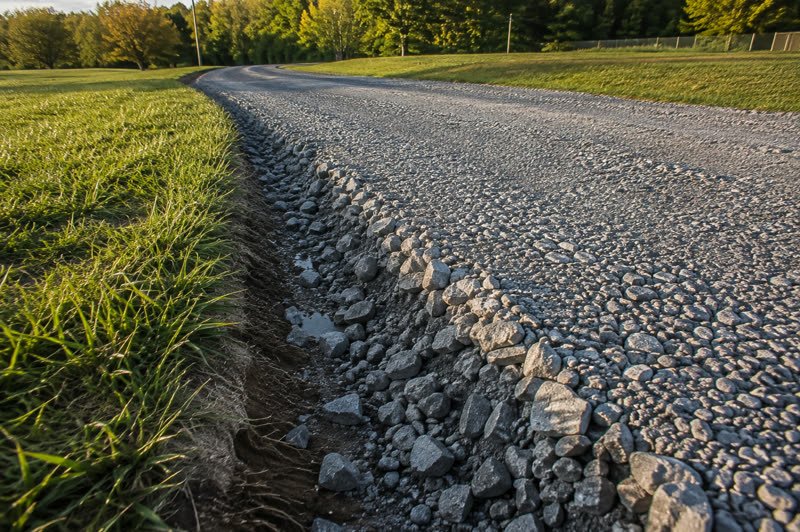
A gravel driveway costs $1 to $3 per square foot if you spread it yourself, and $2 to $5 per square foot installed. Stone is $10 to $50 a ton, plus $10 to $25 a ton for delivery.
The variable nobody quotes you up front is distance. Past roughly 10 to 15 miles from the quarry, delivery can cost as much as the stone.
| Line item | Typical range | Average | Basis |
|---|---|---|---|
| Stone, material only | $10 – $50 / ton | — | By material; crushed limestone and #57 $15–$75 |
| Pea gravel | $30 – $50 / yd | — | Sold by the yard as often as the ton |
| Delivery | $10 – $25 / ton | — | Or free inside ~5 miles, 5-ton minimum |
| Delivery, beyond radius | +$1 – $2 / mile | — | Some yards charge ~$10 per extra mile |
| Minimum delivery fee | $50 – $150 | — | Applies whether you order 3 tons or 8 |
| DIY installed | $1 – $3 / sq ft | — | Material plus spreading it yourself |
| Contractor installed | $2 – $5 / sq ft | — | Grading and compaction included |
| Grading and drainage | $200 – $800 | — | Site prep before any stone lands |
| Geotextile fabric | $0.15 – $0.30 / sq ft | — | About $75–$150 on a standard driveway |
Last updated: · Reviewed by Nisar Dalvi
What actually drives the price?
Four things, and only the first is the one people shop on.
- Material. $10 to $50 a ton. Crusher run sits at the low end, #57 and crushed limestone in the middle at $15 to $75, pea gravel at the top.
- Haul distance. $10 to $25 a ton, or free inside about five miles on a five-ton minimum, then roughly $10 per additional mile. Some yards price it as $1 to $2 a mile beyond a standard radius instead.
- The minimum delivery fee. $50 to $150 regardless of load size. Order in full loads — the last few tons of a full load are the cheapest you will buy.
- Whether someone else spreads it. Labor and equipment add roughly $0.50 to $1.50 a square foot on top of material.
How much stone do I need?
Three steps, and the middle one is what most calculators skip.
- Volume. Length × width × depth in feet, divided by 27 for cubic yards.
- Compaction allowance. Stone settles under traffic. Order the in-place volume and you finish short — add 8% for rounded pea gravel, up to 22% for crusher run, which has fines that pack down hard.
- Weight. Quarries sell by the ton. Convert at 1.3 to 1.5 tons per cubic yard, which varies with material and moisture.
A 100 by 12 foot driveway at 4 inches deep needs roughly 22 to 24 tons. That is about 15 cubic yards in place, near 17 once you allow for settling.
Our gravel driveway calculator does all three steps and gives you the answer in tons, which is what the quarry needs.
How deep should the gravel be?
Four inches for a light-duty surface on ground that already drains. Eight to twelve inches where anything heavy will drive on it.
Below four inches, stone works down into the subgrade instead of staying where you put it. Above about six inches you should be building in two layers — larger base stone underneath, smaller surface stone on top — rather than running one size the whole way up.
Is geotextile fabric worth the money?
It costs $0.15 to $0.30 a square foot, roughly $75 to $150 on a standard driveway. Whether it pays for itself depends entirely on what is underneath.
- Soft or clay subgrade — yes. Fabric separates stone from soil so your gravel stops disappearing downward, and it meaningfully extends the interval between top-ups.
- Firm, well-drained, naturally gravelly ground — marginal. The problem it solves is not really present.
Contractors tend to either ignore fabric entirely or sell it as mandatory. Neither is right. Look at what your subgrade does after rain and decide from that.
What does it cost to keep?
A gravel driveway is cheap to build and never quite finished. Plan on $100 to $500 a year as an owner-maintained figure.
| Job | Cost | How often |
|---|---|---|
| Regrade and top up | $300 – $800 per load | Every 2 – 3 years |
| Annual upkeep | $100 – $300 | Yearly — material and grading out ruts |
| Contracted regrading | $0.50 – $2 / sq ft | As needed |
| Top-up gravel | $50 – $75 / ton | With each regrade |
Which stone should I actually buy?
The commonest expensive mistake is not ordering too little. It is ordering the wrong material.
Rounded stone never locks together, so it migrates under tires and ends up in the grass. Angular stone with fines binds into a surface that holds. A common answer is crusher run as a base with a thin #57 top coat, accepting that the top coat needs raking now and then.
Which size does which job, and why one stone size the whole way up performs worse than two, are covered in our guide to choosing driveway gravel.
If the ground under the driveway holds water, fix that first — drainage and grading is the cheaper problem to solve before you put stone on top of it.
What comes next?
Land preparation runs in a sequence. Getting the order wrong is the most expensive mistake on a raw lot — grading before the septic is sited means paying to move the same dirt twice.
Sources
Every figure on this page traces back to one of these. Open them and check us — that is what they are here for.
- US EPA — Stormwater Discharges from Construction Activities The one-acre federal permit threshold for clearing and grading.
Links verified August 2026. Tell us at info@landclearingandexcavation.com if one has moved.
Frequently asked questions
How much does a gravel driveway cost?
$1 to $3 per square foot if you spread it yourself, and $2 to $5 per square foot installed by a contractor with grading and compaction.
On a typical 100 by 12 foot driveway at 4 inches deep — roughly 22 to 24 tons of stone — material alone runs a few hundred to around $1,200 depending on the material and how far the quarry is.
How much does a ton of gravel cost?
$10 to $50 a ton for the material, with crushed limestone and #57 spanning $15 to $75. Pea gravel is commonly sold by the yard at $30 to $50.
Then add delivery of $10 to $25 a ton. Many yards deliver free inside about five miles on a five-ton minimum and charge roughly $10 per extra mile beyond that.
Why is delivered gravel so much more expensive at some places?
Haul distance, and it is not a small effect. Beyond roughly 10 to 15 miles from the pit, the delivery line can equal the cost of the stone itself.
That is why no national average per delivered ton is worth much. Call the nearest quarry, ask for a delivered price per ton on your material, and use that.
Watch the minimum delivery fee too — $50 to $150 applies whether you order three tons or eight, so part loads are the most expensive stone you will buy.
How many tons of gravel do I need?
Multiply length by width by depth in feet, divide by 27 for cubic yards, add a compaction allowance, then multiply by 1.3 to 1.5 tons per cubic yard.
A 100 by 12 foot driveway at 4 inches deep is about 15 cubic yards in place, near 17 with settling, and roughly 22 to 24 tons of crushed stone.
Order to the top of the range. Being half a ton over leaves a small pile; being half a ton short means paying a second delivery charge.
Is geotextile fabric under a gravel driveway worth it?
On soft or clay subgrade, yes. On firm, well-drained gravelly ground, it is marginal.
The material runs $0.15 to $0.30 a square foot — about $75 to $150 on a standard driveway. What it buys is separation: it stops your stone migrating down into soft soil, which is the main reason driveways need topping up.
That is the honest middle position. It is cheap insurance where the ground is soft, and it is not a universal requirement.
What does a gravel driveway cost to maintain?
Budget $100 to $500 a year doing it yourself, more if you hire it out.
The usual pattern is a regrade and top-up every two to three years at $300 to $800 per maintenance load. Annual upkeep — fresh material and grading out ruts — runs $100 to $300. Contracted regrading is $0.50 to $2 a square foot and top-up gravel $50 to $75 a ton.
How much area does a truckload of gravel cover?
A tandem-axle truck carries 12 to 15 tons, which is roughly 8 to 10 cubic yards and costs $400 to $900 a load. A tri-axle carries 18 to 22 tons.
Spread 4 inches deep, a tandem load covers about 650 to 800 square feet — call it 55 to 65 feet of a 12-foot-wide driveway.
Get quotes from local contractors
Tell us about the job and we will pass it to licensed contractors who work in your area. No cost, no obligation.