
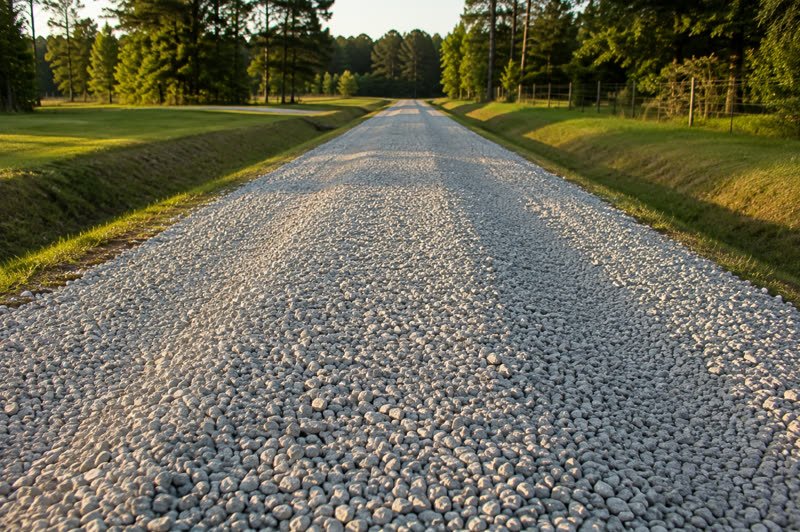
The short version
- The numbers
- are sieve sizes bigger number generally means smaller stone
- #57 stone
- open-graded no fines — drains hard, never compacts
- Crusher run
- dense-graded fines included — compacts hard, sheds water
- Layers
- base / mid / top no single material does all three jobs
- Total depth
- 4 – 12 in keyed to traffic and subgrade; sources disagree
- Crown
- 2 – 4% ¼ to ½ inch of fall per foot, center to edge
There is no single best gravel for a driveway, and asking the question that way is the reason most gravel driveways fail. A driveway has to do three different jobs — carry load, drain, and present a surface you can drive on — and no one material does all three.
Get one distinction straight and everything else follows: stone with the fines screened out drains but never compacts. Stone with the fines left in compacts hard but sheds water off the top. Both are correct somewhere. Using one where the other belonged is nearly every failure you will ever see.
What do the gravel numbers actually mean?
They are sieve designations, not measurements — which is why they run backwards from what people expect.
Aggregate is graded by passing it through a stack of screens. The number does not name a size — it names a gradation, the percentage that must pass each screen, published as ASTM D448 and AASHTO M43. So #57 stone means 95 to 100 percent passes a 1-inch screen, 25 to 60 percent passes a half-inch, and almost nothing passes a No. 4 — which is why the yard calls it "one-inch stone" and why the pile still holds a spread of sizes rather than one.
That spread is the point, not sloppiness at the quarry. A single-size stone will not interlock. Every supplier quoting a #57 is working to the same two standards, which is what makes the number worth asking for by name.
The counterintuitive bit: a bigger number generally means a smaller stone. #3 is 1 to 2.5 inches. #57 is around an inch. #8 is around three-eighths.
Nobody tells you this at the quarry, and it is the single most common reason a first-timer orders the wrong thing.
Open-graded or dense-graded?
This is the distinction that actually matters, and almost no supplier states it plainly because they are describing inventory rather than behavior.
| Open-graded (e.g. #57) | Dense-graded (e.g. crusher run) | |
|---|---|---|
| What is in it | A narrow band of similar-sized stone. Fines screened out. | Every fraction, from the top size down through stone dust. |
| Under compaction | Will not lock up. Stays open. | Fines fill the voids and bind. Rolls out tight and hard. |
| Water | Pours straight through the layer. | Runs off the surface — so it needs a crown. |
| Holds together by | Angular interlock alone. | Interlock plus fines acting as a binder. |
| Use it for | Drainage layers, middle courses, topping up an existing drive. | Base and surface courses on driveways carrying regular traffic. |
#57 stone — the open-graded workhorse
Around one inch, angular, clean, no fines. Defined under the standard aggregate gradation specifications, so a request for #57 gets you a consistent product almost anywhere in the country — which is more than can be said for most of the names on this page.
Because the voids stay open, water moves through it aggressively. It holds together purely through the angularity of the stone, and it does not compact into a solid mass no matter what you run over it.
Crusher run — the one that "hardens like concrete"
Quarried rock (or crushed concrete) run straight through a primary crusher with no clean screening step. Everything stays in the load, from the largest particle down to the dust.
Compact it — ideally while slightly damp — and the fines migrate into the voids, the layer tightens, and you get a firm, smooth-rolling surface that resists lateral movement. That binding action is what people are describing when they ask which gravel hardens like concrete.
The honest version: it does not become concrete. It is a compacted aggregate, it still needs regrading, and because it sheds water off the top rather than through, a crusher run surface without a crown will pothole faster than an open-graded one.
#3 and #4 — the sub-base
Roughly 1 to 2.5 inches. Large enough to bridge soft ground and carry load, open enough to drain freely. This is what goes at the bottom on a new driveway over native soil, and it is the layer most often skipped.
Pea gravel and stone dust — useful, but not here
- Pea gravel — small, smooth, rounded. Attractive, comfortable underfoot, and structurally weak as a driving surface for reasons covered below.
- Stone dust / screenings — the fines on their own. A good leveling course under pavers. Not a driveway material by itself.
Why is a driveway built in layers?
Because the three jobs conflict. A stone big enough to carry a truck is too coarse to drive on comfortably; a stone fine enough to drive on comfortably will not carry a truck. So you stack them.
| Layer | Typical material | Its job |
|---|---|---|
| Base | #3 or #4, 3 – 6 in | Carries the load and bridges soft subgrade. Large voids drain freely and stop the drive sinking. |
| Middle | #57 or crusher run, 2 – 4 in | Bridges the gap between big base stone and small surface stone, so the top layer cannot wash down into the base. |
| Surface | Crusher run, #8, or pea gravel, 1 – 2 in | What you drive on, and what you regrade. Sacrificial by design. |
On total depth, published sources genuinely disagree — you will find 4 to 6 inches, 8 to 12 inches and 12 to 18 inches all stated confidently. The disagreement is real and it is about traffic and subgrade, not about who is right. Light passenger use on firm ground sits at the shallow end; regular truck traffic or soft clay needs the deep end. Treat any single number you are quoted as a question to ask, not an answer.
Why one layer on bare soil always fails
This is the number one gravel driveway mistake, and it fails by a specific mechanism worth understanding.
Dump stone straight onto native soil and there is no graded transition between the two. Under a wheel load, two things happen at once and they compound: the stone punches down into the soft subgrade, and the subgrade fines pump up into the stone.
Within a season or two you no longer have a stone layer at all. You have gravelly mud, and no amount of new stone on top fixes it, because the new stone does the same thing.
Which is why separation fabric belongs underneath
A non-woven geotextile between the subgrade and the base layer stops that exchange. Stone cannot migrate down, soil fines cannot migrate up, and the base layer stays a base layer.
It is exactly the same principle, and the same product, as the fabric in a french drain — keeping two materials from mixing so that the coarse one keeps doing its job. If you have already read that guide, you know what the wrong fabric does. The same warning applies here: weed barrier is not separation fabric.
Worth stating plainly for anyone topping up rather than building: a brand new driveway on native soil wants all three layers and the fabric. An existing driveway that has simply worn thin usually needs one load of #57 or #89 spread and graded — not a rebuild.
Why does pea gravel make a bad driving surface?
Because of shape, and it is a genuinely mechanical failure rather than a matter of taste.
Crushed stone works because the faces lock. Angular edges wedge against each other under load, so the layer resists movement and spreads the wheel load sideways across itself.
Round stone has no faces to lock. Each pebble is effectively a small ball bearing, so under a tire it rolls rather than resisting. Three things follow:
- Ruts form down the wheel tracks and berms build along the edges, as stone is pushed sideways with every pass.
- Stone migrates into the lawn and off the edges permanently.
- There is no load spreading. Because it cannot be compacted into a coherent layer, the wheel load goes more or less straight into the subgrade instead of being distributed.
None of that self-heals. It gets worse each pass, and it is far worse on any grade — which is why sloped drives specifically call for angular material.
The fair version of the argument: pea gravel is not a bad material, it is a bad surface course for vehicles. It is comfortable underfoot, it looks good, and it is perfectly sensible for walkways, patios and low-traffic parking pads.
If you want the look on a driveway: use it only as a thin top course over a properly compacted crusher run base, expect to regrade more often, and do not use it on a slope or anywhere tires scrub — a turnaround will scatter it in a month.
Same material, six names
This section exists because ordering by the wrong regional name is how the wrong truck turns up — and the two families behave in opposite ways, so getting it wrong is not a small error.
All of the following describe the same dense-graded, compactable base material:
| Name | Where you will hear it |
|---|---|
| Crusher run · crush and run | Southeast and Mid-Atlantic — the most widely used names |
| ABC (Aggregate Base Course) | Southeast |
| DGA (Dense Graded Aggregate) · DGABC | Northeast; DGABC is the New Jersey DOT designation |
| GAB (Graded Aggregate Base) | DOT specifications across several regions |
| Item 4 | New York — corresponds to a state DOT subbase type |
| 411 · 21AA · 21A | Pennsylvania, Michigan and neighboring states |
| Quarry process (QP) · 21A / 21B | Virginia and West Virginia |
| Road base · road bond | Southwest and parts of the Midwest |
| MOT Type 1 | United Kingdom, if you are reading British sources |
The consequence is concrete, not academic: order by the wrong regional name and you can end up with #57 — open-graded, will not compact — delivered when you needed crusher run, or the reverse. You will not know until it is spread.
Describe what you need by behavior rather than by name: "a compactable, dense-graded aggregate with the fines left in" or "a clean, open-graded angular stone with no fines." Then confirm the gradation with the supplier. Any yard worth buying from will know exactly what you mean.
One nuance so this is not oversimplified. ABC and GAB are graded specifications with tighter quality control, generally written for road building; crusher run is a more general term for the same kind of material. In many cases they are effectively identical. In others, two products with near-identical names behave quite differently once installed. The name is not the thing — the gradation specification is the thing.
How much gravel do you actually need?
The arithmetic is simple and it is most of your bill, so it is worth doing before you call anyone.
- Square feet = length × width. A 10-foot-wide drive running 100 feet is 1,000 square feet.
- Tons — roughly 70 square feet per ton at 4 inches compacted, or about 45 square feet per ton at 6 inches.
- So: 1,000 sq ft at 4 inches is about 14 tons; at 6 inches, about 22 tons.
Order slightly over. Loose gravel loses real depth once it is rolled, and coverage shifts with stone size and how firm the ground underneath is. On a new build, run the calculation separately for each layer — the base is usually the biggest number and the one people forget to budget.
Delivered stone prices vary enough with region and haul distance that any national average would mislead you. Take your tonnage to two local suppliers and you will have a real number in an afternoon; when our gravel driveway cost guide publishes it will cover what the rest of the job adds.
Why do flat driveways pothole?
Because a gravel driveway has to shed water sideways within seconds of it landing, and a flat one cannot.
The pothole cycle is self-accelerating and it always starts the same way. A flat spot holds a puddle. The puddle soaks down and softens the base. A tire displaces the saturated material. The depression deepens, so it holds more water next time, so it softens more. Every pothole you have ever seen began as a low spot with nowhere to drain.
The fix is geometry, not material. Build a crown — the center 2 to 4 percent higher than the edges, which is roughly a quarter to a half inch of fall per foot. On a hillside drive, a single continuous cross-slope pitched toward the uphill ditch does the same job.
Crown and dense-graded stone are a matched pair, and they only work together. An open-graded surface lets water in regardless of shape, and a dense-graded surface with no crown just holds it on top. You need the material that sheds and the shape that sheds it somewhere.
And give the water a destination. Shallow ditches or a swale at the edges matter, because shedding water into a berm of accumulated gravel simply relocates the puddle.
What maintenance does a gravel driveway need?
Three recurring tasks on three different clocks, and one of them is not really maintenance at all.
Regrading — twice a year
A gravel surface migrates. A box blade or drag pulls stone from the berms back into the wheel ruts and restores the crown. Spring after the thaw and autumn before winter is the usual rhythm; more often on a slope or a long drive.
Do it when the surface is slightly damp. Dry gravel will not knit back together and saturated gravel smears rather than leveling.
It is worth knowing what regrading is really for: traffic flattens the crown within a season or two, so "regrade the driveway" mostly means "put the crown back."
Topping up — every few years
You lose material to plowing, to tire carry-out, and to washout. Use the same product as the existing surface, and on a worn drive one layer of #57 or #89 spread and graded is usually enough — you are not rebuilding, you are replacing what left.
Washout on a slope — a design problem wearing a maintenance costume
If a section of drive washes every spring, adding gravel every spring is paying rent on a problem rather than solving it. The fixes are drainage:
- Cross-drains or water bars that break a long run into short segments, so water leaves the surface before it picks up speed.
- Culverts at low points and a ditch along the uphill side so surface water never gets onto the drive in the first place.
- Angular stone — crusher run or #57 rather than river rock, because the edges grip on an incline.
And an honest limit worth stating: above roughly a 10 percent grade, a gravel surface will shed stone repeatedly regardless of what you do. At that point the choices are paving that section or accepting an annual re-stone as a running cost. Anyone who tells you a particular product solves it is selling the product.
The winter note nobody mentions
Plowing is the single largest source of material loss on a gravel drive. Skid shoes or a rubber cutting edge on the plow, and a blade set an inch high rather than scraping, will save you several tons over a decade — and several loads of stone is real money against the cost of a set of shoes.
The one thing to take away
Almost every gravel driveway problem traces back to one of two decisions, and both are made before a single stone is delivered.
The first is using open-graded stone where dense-graded belonged, or the reverse — clean #57 dumped on bare soil as a whole driveway, or crusher run laid flat with no crown so the water it refuses to absorb has nowhere to go.
The second is skipping the base. One layer on native soil looks fine through the first summer and is gravelly mud by the second, because stone and subgrade have simply swapped places.
So: work out which behavior each layer needs, describe that behavior to the supplier rather than trusting a regional name, put fabric between the soil and the stone, and build a crown. Do those four things and the rest of it is a drag blade twice a year.
What comes next?
Land preparation runs in a sequence. Getting the order wrong is the most expensive mistake on a raw lot — grading before the septic is sited means paying to move the same dirt twice.
Frequently asked questions
What kind of gravel hardens like concrete?
Nothing genuinely does — but crusher run (also sold as quarry process, ABC, DGA, item 4 or road base) is what people mean. It contains every fraction from the largest stone down through stone dust, and those fines lock the stone together under compaction into a tight, hard-rolling surface.
Two honest caveats. It needs to be compacted while slightly damp to bind properly — dumping it loose will not do it. And it never becomes concrete: it still needs regrading, and because it sheds water off the top rather than through, it must have a crown or it will pothole.
Is #57 stone good for driveways?
Excellent for some layers, poor as the only layer. #57 is open-graded — roughly one-inch stone with the fines screened out — so water pours straight through it and it will never compact into a solid mass.
That makes it a very good middle course, a very good top-up on an existing drive, and a very good choice where drainage matters. It makes it a poor single-layer driveway on bare soil, because with nothing binding it, the stone migrates and punches down into the subgrade.
How much driveway will 1 ton of gravel cover?
Roughly 70 square feet at 4 inches compacted depth, or about 45 square feet at 6 inches. So a 10-foot-wide, 100-foot driveway — 1,000 square feet — needs somewhere near 14 tons at 4 inches, or 22 tons at 6.
Order a little over. Loose gravel loses noticeable depth once it is compacted, and coverage varies with the stone size and how firm the subgrade is.
How much does a gravel driveway cost?
Delivered stone prices vary enough by region and haul distance that a national average would mislead you more than it helps — a quarry twenty miles closer changes the number materially.
What you can work out yourself is the quantity, which is most of the bill: length × width gives square feet, then roughly 70 square feet per ton at 4 inches. Take that tonnage to two local suppliers and you will get a real number. Add machine time for grading and, on a new build, the base layers underneath.
What gravel will not move or wash out?
Angular, crushed stone — and the reason is mechanical. Crushed stone has flat faces and sharp edges that wedge against each other under load. Round stone has none, so each pebble behaves like a small ball bearing and rolls out from under the tire.
On any slope this is decisive: use angular crusher run or #57 rather than river rock or pea gravel. But past roughly a 10 percent grade no stone stays put reliably, and the real fix becomes drainage — water bars and cross-drains to stop water gaining speed down the surface.
Why does my gravel driveway keep getting potholes?
Almost always because it is flat. Water that cannot run off the surface soaks into the base, softens it, and every passing tire then pumps fines up and stone down until a low spot becomes a hole.
The fix is geometry, not more gravel: build a crown of 2 to 4 percent — a quarter to a half inch of fall per foot from center to edge — so water leaves within seconds. Traffic flattens a crown within a season or two, which is what regrading is really restoring.
Get quotes from local contractors
Tell us about the job and we will pass it to licensed contractors who work in your area. No cost, no obligation.