
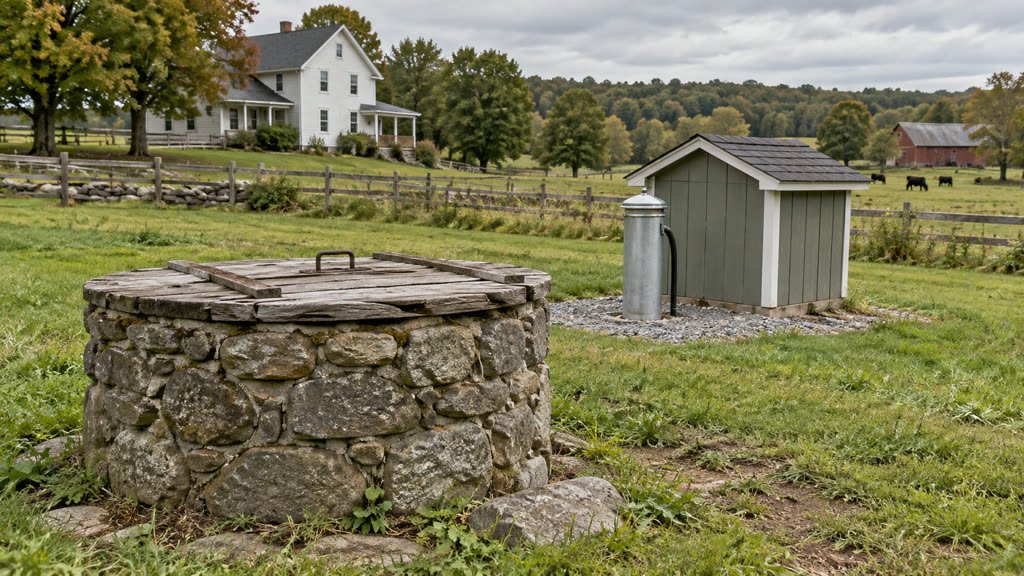
Shallow vs deep, at a glance
- Typical depth
- ~10 – 50 ft (dug or driven) 100 – 1,000 ft (drilled)
- Pump
- jet pump, works to ~25 ft submersible
- Contamination risk
- higher — draws from water nearest the surface lower — longer underground travel filters water
- Drought risk
- higher lower
- Upfront cost
- lower higher — $25–$100/ft, $8,000–$15,000 minimums
What's the difference between a shallow well and a deep well?
A shallow well taps the water closest to the surface, usually within about 50 feet. A deep well is drilled 100 feet or more into a protected aquifer. The depth changes the cost, the pump, the water quality and how well the well survives a drought.
The EPA groups private wells by how they're built:
- Dug wells: about 10 to 30 feet deep, wide, and not continuously cased.
- Driven wells: about 30 to 50 feet deep, made by driving a pipe into sand or gravel. Cased, but drawing from water near the surface.
- Drilled wells: often hundreds of feet deep, continuously cased and grouted.
When people say "shallow well," they mean dug or driven. "Deep well" almost always means drilled.
Is a shallow well safe to drink from?
It can be, but it carries more risk. Shallow wells draw the groundwater nearest the surface, which can pick up contaminants from septic systems, fertilizer, livestock and runoff.
The EPA notes that driven wells, though cased, "can be contaminated easily" because they draw from aquifers near the surface. Drilled wells, by contrast, have a lower risk of contamination because of their depth and continuous casing.
Deep wells are generally safer. Their water has often traveled a long distance underground, and the soil and rock filter out many contaminants along the way.
Either way, you're responsible for testing. The EPA recommends testing private wells at least once a year for bacteria, nitrates, dissolved solids and pH.
Which costs less — a shallow or deep well?
A shallow well costs much less to build, but a deep well often costs less over its life. The gap is mostly in drilling and pumps.
| Cost item | Shallow well | Deep well |
|---|---|---|
| Construction | low — short hole, often driven or dug | $25 – $100 per ft; $8,000 – $15,000 minimum charge |
| Pump | jet pump, $800 – $1,800 installed | submersible, $1,000 – $5,500+ installed |
| Long-term | treatment, re-drilling in drought | longer service life, steadier yield |
Deep-well pricing comes from our well drilling cost guide; pump prices from well pump installation cost.
Many counties won't permit a new shallow dug or driven well for drinking water at all. That can make the cost comparison moot — check your rules first.
Which pump does each type use?
Shallow wells use jet pumps; deep wells use submersible pumps. It comes down to physics: a pump at the surface can only lift water by suction from about 25 feet.
- Jet pumps sit above ground and pull water up. Standard shallow-well jet pumps work to around 25 feet. Easy to reach for repairs.
- Submersible pumps sit down in the well and push water up. They handle hundreds of feet efficiently but must be pulled out for repairs.
See how both work in our well pump guide.
What happens to each well in a drought?
Shallow wells go dry first. The water table drops in dry spells, and a shallow well may sit right at its top.
Deep wells reach aquifers that respond more slowly to a dry season. That's a big reason lenders and counties often prefer drilled wells for a full-time home.
What do state rules say about shallow wells?
Most states set a minimum casing depth, and many effectively rule out shallow drinking-water wells. Casing is the pipe that keeps surface water out.
Indiana, for example, requires new wells to have at least 25 feet of casing so surface water is filtered through soil before it reaches the well, according to Purdue Extension. Your state's number may differ.
Rules also set distances between your well and your septic system. Plan both together — see the septic installation hub.
Which should I choose for raw land?
For a full-time home, choose a drilled deep well wherever your geology allows. It's the safer, more reliable, more financeable option. To see how deep recorded wells go around your land, try our free well depth lookup.
A shallow well can still make sense for:
- Irrigation, livestock or garden water (not drinking)
- A seasonal cabin where local rules allow it
- Sites where the aquifer is shallow and deep water is poor quality
Ask a licensed driller to check local well logs before deciding. They show what depth your neighbors needed and how much water they got.
What comes next?
Land preparation runs in a sequence. Getting the order wrong is the most expensive mistake on a raw lot — grading before the septic is sited means paying to move the same dirt twice.
Sources
Every figure on this page traces back to one of these. Open them and check us — that is what they are here for.
- US EPA — Learn About Private Water Wells Dug, driven and drilled wells, depths and contamination risk.
- Purdue Extension WQ-22 — Private Water Wells Casing, setbacks and wellhead protection (Indiana rules).
Links verified October 2026. Tell us at info@landclearingandexcavation.com if one has moved.
Frequently asked questions
How deep is a shallow well?
Usually under 50 feet. Dug wells run about 10 to 30 feet; driven wells about 30 to 50 feet.
How deep is a deep well?
Generally 100 feet or more, and often several hundred feet in bedrock areas.
Are deep wells better than shallow wells?
For drinking water, usually yes. They're less exposed to surface contamination and less likely to go dry.
Can you use a jet pump on a deep well?
Only with a deep-well jet setup, and it's less efficient. Most wells deeper than about 25 feet use a submersible pump.
How long does a shallow well last?
It varies widely and depends on the water table. Shallow wells are more likely to need deepening or replacing after droughts.
Do I need a permit for a shallow well?
Usually, yes. Most states regulate all water wells, and some don't allow shallow wells for drinking water.
Get quotes from local contractors
Tell us about the job and we will pass it to licensed contractors who work in your area. No cost, no obligation.